"We are wishing that they call us and tell us that our brother is in the hospital"
The relatives of the missing seek answers while the town of Urda becomes aware of the magnitude of the tragedy

-
CAT -
CAST
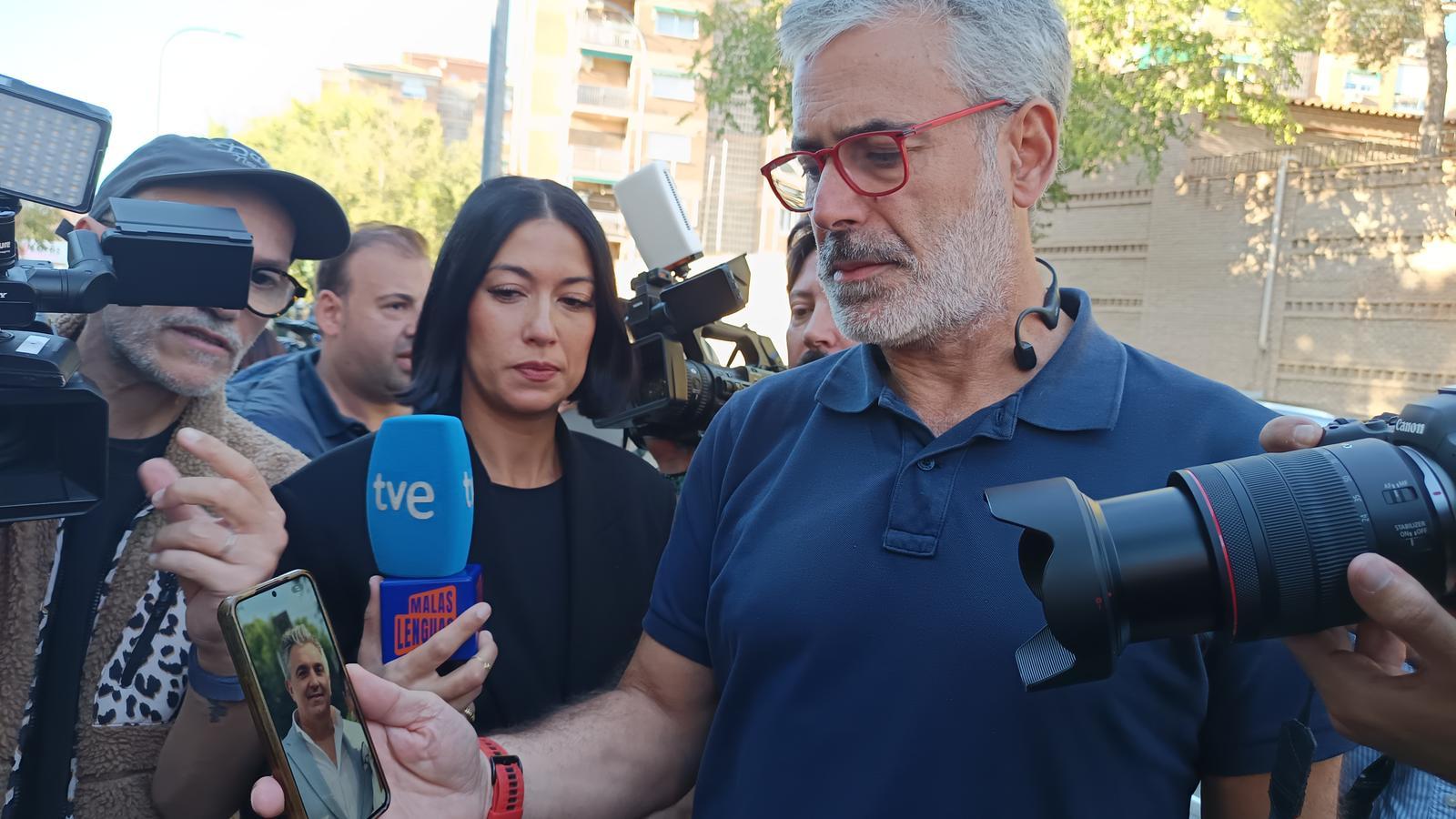
Urda / Toledo“Uncertainty, of course, is what is hardest to bear. But I believe there is one thing that counteracts it, which is hope, which must never be lost”. This is the reflection verbalized this afternoon by Manuel, the brother of one of the missing persons in the train accident in Urda, Toledo, who continues to long for good news. “There are peaks of absolute hope and peaks where you collapse”, admits his sister, Esther. Both have spent the day at the Casa Sacerdotal in Toledo, the space that has been set up for people who have not yet located their relatives. They are looking for Pepe, who is 54 years old and was traveling to Seville for work.
They sensed that something was wrong thanks to technology. At 9:05 in the morning, ten minutes after the collision, Manuel received an emergency alarm on his smartwatch. “I looked at the location and it was in the middle of the countryside”, he recalls. Immediately, he called his sister: “Do you know where Pepe is? Is he in Seville? Is he in Madrid?”, he asked her. And she got in touch with his wife, who confirmed to them that he was traveling to Andalusia. A few minutes later, Manuel saw on the television that there had been an accident near Toledo. He realized immediately: “My brother is there”.
On Wednesday afternoon, they went to the Civil Guard headquarters in Toledo to file a report. They had to explain what their brother looked like and provide specific details that would allow him to be identified –if he had piercings or tattoos, for example–, and they provided DNA samples so they could be compared with those of the victims recovered from the accident site. Throughout the day, they have been accompanied by other families –about fifty– and a team of psychologists. “We are hoping that they call us and tell us that he is in the hospital, that they are operating on him and that he hasn't called us because he is unconscious. It is the only hope we have left”, admits Esther.
The family of David Martínez, a 25-year-old boy, is experiencing the same. In a statement on X, they speak of “moments of enormous uncertainty and anguish” after going around to different hospitals looking for information, but they also assure that they maintain “the hope of locating him among the patients who are still unidentified”. They are not the only ones. The circle of David Reina, another young victim who is still missing, has shared images of him –with his tattoos– to try to find clues to be able to locate him.
Anguish and fear mix with anxiety and a lack of information, both among those who were on board the trains and cannot find their relatives or friends and among those who, already on Wednesday, the day of the accident, were traveling to seek answers. “Suitcases flew. I huddled in the seats, I have bruises on my knees. A rail entered my carriage, it was two meters away from me,” recalled Antonio, one of the injured. “Afterwards I got off, I went to the seventh carriage, where my colleague was, to look for him. But I didn't find him. We don't know where he is, we are moving heaven and earth to see if he appears, but there isn't much information,” he lamented. He himself participated in the rescue efforts with a stretcher made from the fiberglass of the carriages to carry the injured people to a safer area.
The consternation of a supportive people
This Thursday, the town of Urda woke up still in a state of shock. It is a shattered and emotionally devastated town. These are not the words of this passing visitor, but the generalized feeling of the residents of this small town in Castile-La Mancha, which will no longer be known for its Christ and will instead be remembered for a railway tragedy that is still hard to digest. And for the overwhelming solidarity it has offered.
Because if there is one thing everyone highlights, it is how the people of Urda reacted. The town "has poured its heart out." All the neighbors say so. "We were known for the Christ and now we will be known for this," laments a young man, who was chatting with his group of friends after Wednesday's minute of silence. It is not the only conversation in which the Christ of Urda appears. Its big day is September 29, just a month ago, when the town doubles or triples its population due to all the people who go to see the procession.
Early Thursday, Antonio—the town pharmacist, who was one of the first to arrive at the scene of the disaster—received a call from Mario, the man he helped right after the accident. He was "dying" while saying goodbye to his family. But he survived. "I see that, at least, God exists," he summarizes.
Yolanda spent hours at the pavilion helping out. "We will be talking about this for a long time," she assures. But at the same time, she celebrates that the town has been "exemplary." There are neighbors—more than one or two—who, after learning about the accident, drove to the scene of the disaster to help bring the injured to town. It was a "desolate atmosphere," they describe. There was no lack of willingness to help.
Gabriel was working in the field very close to the collision site. "I heard a crash like that of a bomb," he recalls. Sebas helped the relatives and the injured as best as he could. "You would see them and they would ask for a hug to have a little comfort," he explains. The good side always comes out. "I don't know where they got so much food from," exclaimed a lady in the Town Hall square. She was right. So much so that the bars had to close to prepare food for the victims and their families. In fact, there were establishments that even ran out of bread. Urda will never forget it. But the warmth it has provided in the most delicate moments will not be forgotten either.
