Videos come to light that show alleged aggressions by military personnel against migrants in Ceuta
The Moncloa had already announced an investigation and now expresses its "total dismay and condemnation" for the images
-
CAT -
CAST
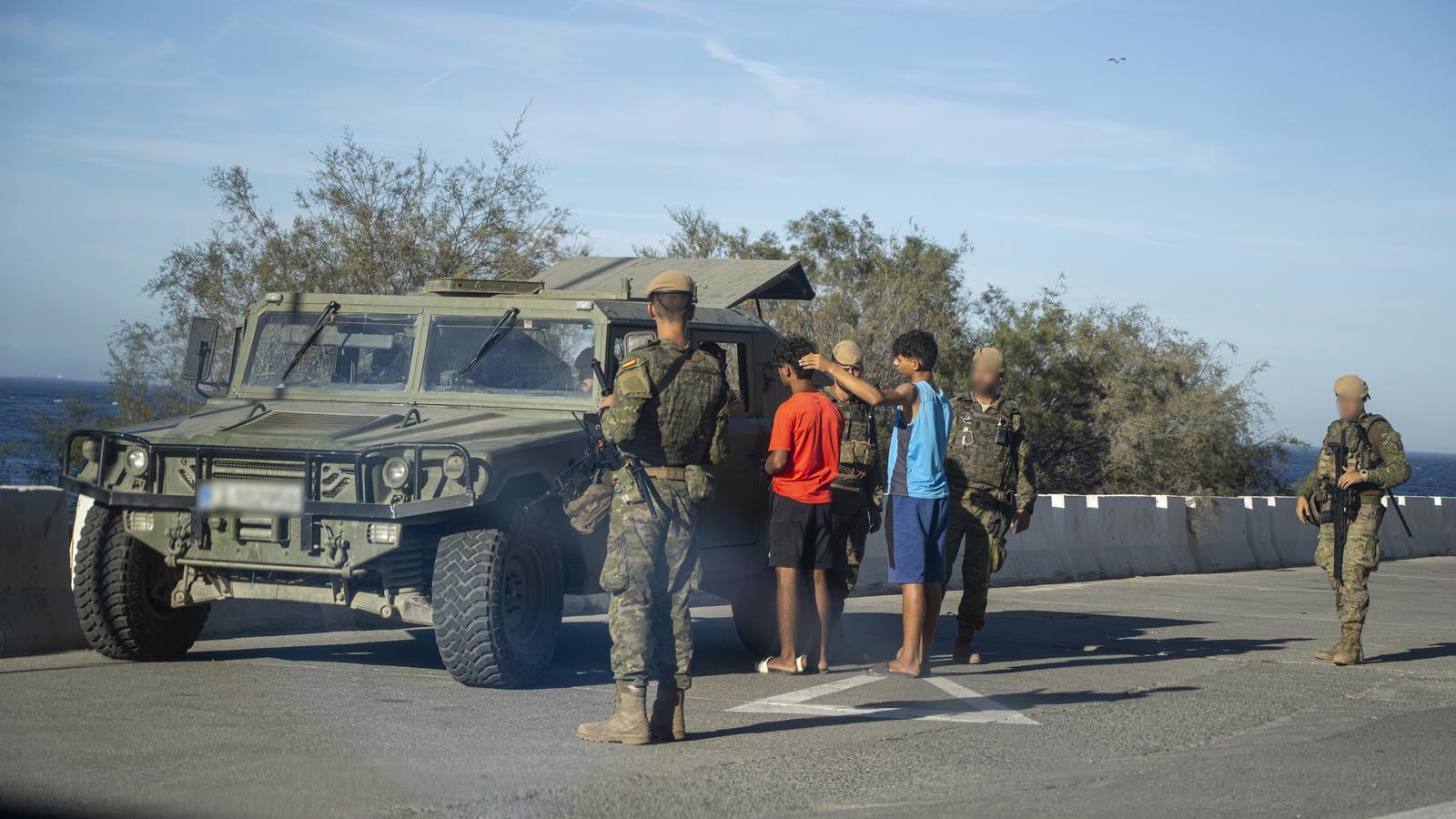
BarcelonaA week ago, a score of migrants reported having suffered beatings and humiliation by military personnel deployed on the streets of Ceuta and the Spanish government announced that it would open an internal investigation into the events. Days later, several videos have come to light showing some of the reported actions and providing graphic proof of them. The images, which Eldiario.es has had access to, show several uniformed soldiers chasing, subduing, and beating migrants at various points in the Spanish enclave.
In one of the recordings, several soldiers hit a young man who is already subdued on the ground with their batons. In another, two migrants are detained and pushed towards a ditch, where the soldiers also assault them.
The videos correspond to actions recorded between the end of August and mid-September in different parts of Ceuta. In Loma Colmenar, five recordings show various moments of an operation in which several military patrols intervene. The images allow the intervention to be observed from different angles and moments. In another case, in the area of the old guano factory, five witnesses have corroborated the events that appear in a video published by an activist from Ceuta, in which an alleged assault is seen.
The publication of the images has provoked a new reaction from the Spanish government. Sources from Moncloa have expressed their "total dismay and condemnation" and have reiterated that the executive will open an internal investigation into the allegations, just as it had already announced last week. When Eldiario.es asked about the actions, the Ministry of Defense did not want to make any statements.
Two months surviving on the street
Nearly two months have passed since thousands of people from Morocco carried out the most significant mass entry in the recent history of the Spanish state, and even now there is a large group—mostly men—living on the streets or on the beaches furthest from the urban center, as well as at the doors of some enclosures, such as some sixty women who, until this Friday, were surviving in a settlement at La Hípica, a reception facility.
The surroundings of the Trampolín beach are the most crowded: about 3,000 migrants still survive there who have not had access to one of the places enabled by the Spanish government in temporary reception centers. They have erected some shacks made of reeds, wood, and cardboard, improvised fires and sanitation problems, as well as some tents, and they extend along a kilometer of the Ceuta coastline. The conditions are very precarious and despite the installation of some showers, there are serious sanitation problems.
This Friday, a young migrant of Moroccan nationality died early in the afternoon in an illegal settlement at the old Guano Factory in Ceuta, near the Trampolín beach, for reasons that have not been determined. Emergency services were alerted by several migrants who had indicated that a companion was in a situation of extreme gravity. Although resuscitation maneuvers were performed on him, nothing could be done to save his life. Now the National Police have opened an investigation to clarify the causes of death, although initial signs point to the death being accidental or due to natural causes. The autopsy will determine it.
Vivas: "We want to return to normality"
The President of Ceuta, Juan Jesús Vivas (PP), defended this Friday the actions of the authorities during the mass entry of people on July 30 and 31 and questioned what would have happened if the 80,000 people who, according to him, entered the city had not returned voluntarily. "We also care about the 140 dead. It is easy to give an opinion from there. But one must be here because the damage to Ceuta is of such magnitude that it is necessary to make clear how we acted," he said in an interview with SER. Vivas assured that the people of Ceuta remain "worried, restless and sad" and that they want to "return to normality," which, according to him, involves the departure from Ceuta of "all the people who arrived in a massive and irregular manner."
The Ceuta president also justified his rejection of the camp set up by the Spanish government at the port for reasons of security and operability. According to Vivas, "all reports say that it is not viable because the port is a strategic and supply point." Finally, Vivas defended the actions of the army and the police at the border and stated that, in the event of a new mass entry, the people who arrived should be returned immediately.
