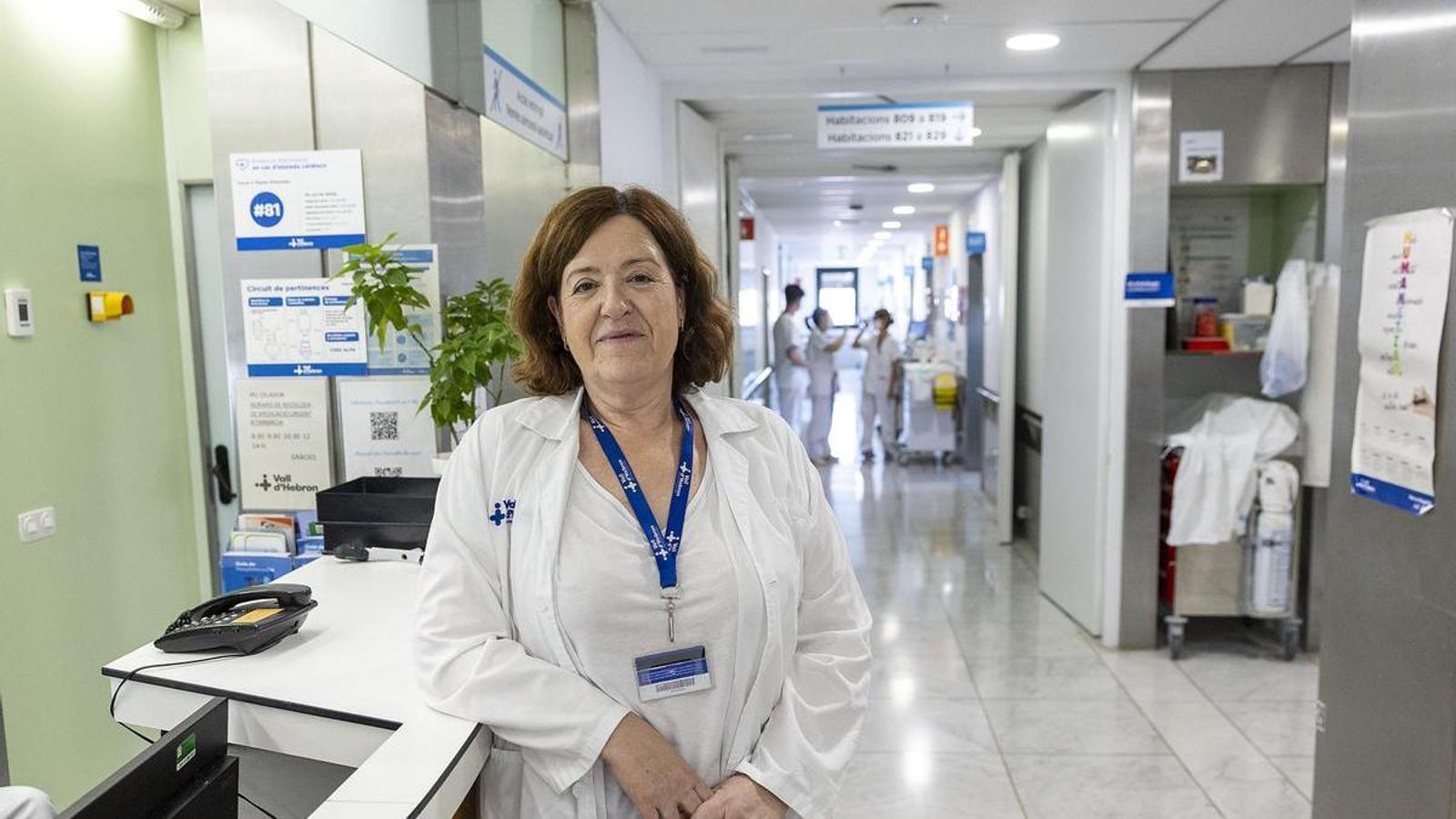
Olga Gavaldà: "There are those who think that, for donating organs, they return the corpse disfigured"
Surgical nurse supervisor of transplants at Vall d'Hebron

-
CAT -
CAST
The WhatsApp profile picture is misleading: Olga Gavaldà never hangs up her coat, meaning she never turns off her work phone. When she was 11 years old, she suffered a car accident and spent a lot of time hospitalized. There, she became absolutely clear that nursing would be her vocation. What she didn't know is that she would spend her entire career at the hospital where she was born by cesarean section. For 35 years, she has been part of the transplant team at Vall d'Hebron, the leading center in Catalonia with 387 interventions in 2025 and a benchmark in the country. She is in charge of coordinating a fast-paced mechanism.
You are an orchestra conductor. Who are the musicians?
— The nurses and surgeons who participate in transplants, and all complementary services: ICU, hospitalization, maintenance, medical technology, hospital pharmacy... And hospitality, because we will need to drink and eat during so many hours...!
Well, let's start the intervention: "We have a donor". Who do you call?
— I call the anesthesiologist, surgical nursing staff, anesthesia nursing staff, the nursing assistant, and the orderly who will participate in the extraction. They must stop what they are doing and have less than two hours: one to arrive and another to prepare the operating room and bring the donor up. Depending on the evaluation of the patient's organs, adjacent operating rooms are also prepared to implant whatever we can: a liver, a lung, kidneys... In parallel, the surgeon calls the recipient or recipients and they are also asked to come as quickly as possible. They undergo blood tests and chest X-rays and prepare for the operation.
I'm already nervous. How much time do you have to perform?
— The ischemia time depends on the organ. The lungs up to 6 or 8 hours. For the liver, more than 10 hours is not recommended. The kidneys up to 12. The heart must be transplanted immediately; we have at most 4 hours. The organs are kept at four degrees and are preserved in portable coolers, bagged with a preservation liquid, whether we keep them or they are sent to another hospital by ambulance or plane.
How many people are working at the same time?
— There can be up to four coordinated operating rooms: more than fifty people involved.
In my head, the donor's and the recipients' families are poetically close, at the hospital.
— No. In Spain it is prohibited for them to meet. When the procedure takes place, the donor's family is already at home.
How do you go about obtaining organs? How is it managed so that, in a moment of extreme pain, a family agrees for their loved one to be a donor?
— Transplant coordination doctors visit the ICU every day to see if there are potential donors, and the critical care units also communicate when someone has suffered brain death or is in an irreversible state. The doctors are the ones who conduct the interview with the family. It is explained that it is a catastrophic and definitive situation, and they are given the opportunity to donate. Most of the time, they say yes.
The legislation states that all citizens of the State are donors unless we say otherwise, but the reality is that the family is always consulted. What can I do to ensure it?
— Either you specify it in your living will or you go into La Meva Salut and select the option to become a donor. If you have it marked, that takes precedence. We have never encountered a situation where a family opposes it if the patient wanted to donate. It is very easy, it is just a click away. With organ donation, you can save the lives of seven people.
Why do some people say no?
— Mainly due to religious and cultural reasons. The preservation of integrity is a barrier, although there are more and more cremations. There are people who think that, by donating organs, they return the body disfigured and that is not true. Or that the funeral will be delayed, and that is not the case either: we need between four and six hours at most from the moment of death. Afterwards, the funeral home collects it, takes it to the mortuary and the family decides what to do with the body.
If there are communities that, out of conscience, are not donors, can they be recipients?
— Yes, they are.
If you don't manage to make the family see it clearly, do you experience it as a failure?
— We try anyway, but when the family says no, it is respected with a sense of regret. I know how many patients I have on the waiting list. Last year, at Vall d'Hebron alone we transplanted 195 kidneys, and even so we have a waiting list, because we have an increasingly older population with kidney failure, and we cannot keep up with the kidneys we have.
Does being an intermediate figure between life and death make you feel a certain power or, on the contrary, a lot of fragility?
— It makes you live life in a different way. We all worry about nonsense, but it makes you more aware that you have to live in the moment. Especially when you have pediatric donors, it affects everyone a lot, and you think: you have to enjoy your children, you have to enjoy what you have because at any moment you stop having it. How lucky, to have a healthy family.
When you see every day that life depends on these organs, it must be harder to believe in God than in public healthcare.
— I am a believer, in my own way, but above all I believe in public healthcare. I'll also tell you one thing: families that are very religious handle it in a different way. Yes, I do believe that something spiritual exists.
Does your heart still race when you have transplants? What is the most delicate moment?
— Yes. When they confirm the viability of the organ from a hospital and time is running out for us to prepare the recipient. It is the key moment: we must have the patient open and ready to implant the organ. We are racing against the clock.
And when you say "We have it"?
— When the clamps are removed and the blood begins to circulate through the organ. A heart that starts beating again, a lung that inflates, a liver that goes from brown to pink... it's fantastic, like a miracle. It means that everything is going well and the tension eases.
How does this job affect your life?
— When you are on call, you have to calculate that you can only go from Castelldefels to Mataró, and you cannot go to the cinema or the theater. My family has adapted to me. In the 90s we went around with a pager and my daughter knew that, when that thing went beep, mom would leave for ten or twelve hours.
