The Spanish government demands from Ceuta that it authorize the transfer of the 700 minors
The Minister of Youth says that half of the protected minors are girls and that "it is essential" to take them to the Peninsula
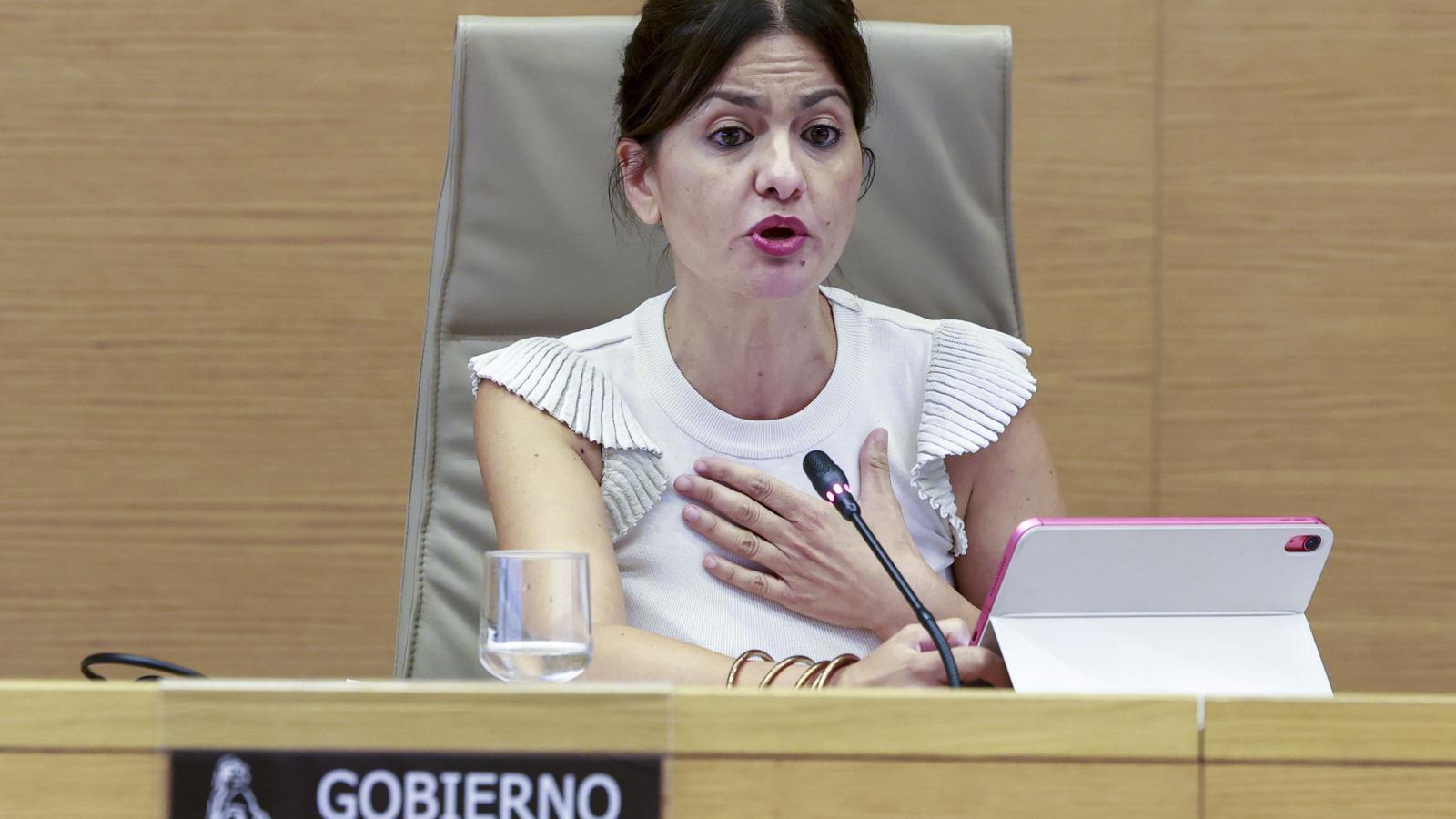

BarcelonaThe head of Youth and Childhood, Sira Rego, stated this Monday that the child protection system has registered 1,478 unaccompanied migrant children in Ceuta, and indicated that their transfer to the Peninsula is "essential" because the city, which has exceeded its reception capacity, "cannot be left alone." In a appearance before Congress to report on the Spanish government's management to resolve the migratory crisis, the minister was clear in defending the "best interests" of minors as a "democratic conquest" that distinguishes "the rule of law from an autocracy."a "democratic conquest" that distinguishes "the rule of law from an autocracy".
Rego indicated that the "change in profile" of the minors who arrived in Ceuta during the massive influx a month ago has forced her ministry to change its approach. Thus, of the 1,478 children registered, 700 are girls "of special vulnerability." That is, half. Traditionally, girls who migrate alone were a minority. For example, in Catalonia, they represent less than 5% of unaccompanied minors under the guardianship of the Generalitat. Furthermore, according to the minister, "many minors under 13 years of age" have entered Ceuta, a group that until now was also practically testimonial in the reception system.
In this first appearance, the minister insisted that family reunification of minors in Morocco remains the "priority" of the Spanish government, but indicated that returns cannot be made without following the legal procedures, such as assessing the families' capacity and the children's opinions. However, it is not always possible: until July 30, the Spanish executive has sent 600 files to Morocco to verify if the biological families are capable of receiving the migrant child, but so far they have only received "silence," the minister clarified. "If reunification is safe, reunification will happen," she insisted.
The minister indicated that the ministry is working on three alternatives for these minors. On the one hand, the transfer of 500 girls to the Peninsula, a step for which she has not provided a date or which entities will be responsible for their reception. She only indicated that it is a possibility that can be done "immediately" and that they will be housed in "small centers" in different cities, but for now, they are awaiting authorization for the transfer from the president of Ceuta, the Popular Party's Juan Jesús Vivas.
Ceuta will maintain the guardianship of these children, while custody will pass to foster care entities and not, as is normally done, to autonomous communities. The other avenue the government is working with are "bilateral agreements" between communities, a formula that has already been successfully used on other occasions, the minister reported, who also thanked the predisposition of many families to welcome and care for these children.
In parallel, the State Attorney General's Office has recorded 22 sexual assaults on migrant women and children in Ceuta since the mass entry. Nine of the victims are girls and adolescents between 14 and 17 years old. There is also a man who is part of the LGTBI collective who has been assaulted. For the moment, there are eight men being investigated as alleged perpetrators.
Defense of the best interests of minors
At the beginning of her speech, Sira Rego warned the deputies: "I will not discuss whether a boy or girl deserves to have rights. If a girl suffering violence on the other side of the border deserves a right or not." And she was firm in making it clear that children "are not invaders but subjects of rights." Along these lines, she insisted that she will not allow "childhood to be criminalized" and reproached those who "irresponsibly" have been encouraging for weeks to "hunt migrants" in Ceuta. "Hate does not solve the emergency," she concluded.

