The Pope urges employers to treat workers "with dignity"
Leo XIV charges against hypocrisy and asks not to kneel before the Lord and to "despise the brother"
-
CAT -
CAST
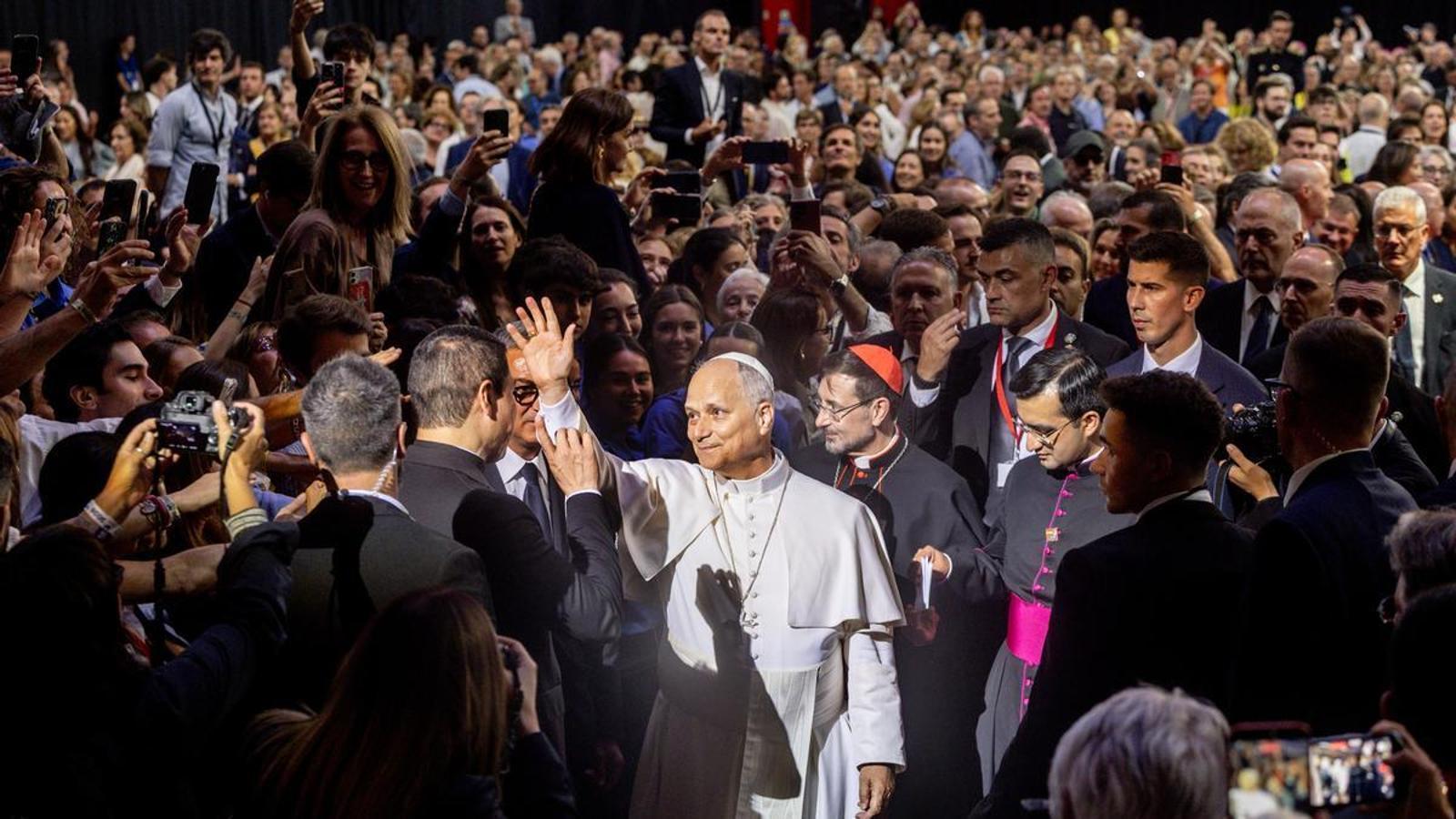
MadridAfter assigning homework to politicians in a forceful intervention at the Royal Palace of Madrid, this Sunday the Pope continued in the same vein and addressed businessmen. At this afternoon's event at the Movistar Arena, which featured a combination of artists, athletes, and union and business representatives, Leo XIV once again raised his voice to ask businessmen to treat workers "with dignity".
Aware that the Catholic Church is "going against the current" in many aspects, he listened to the plea of the Spanish employers' associations and unions, but sent a clear message: he asked that "companies recognize the dignity of the person and that work continues to be a source of hope" so that "business activity does not view the worker as just another factor in the equation of their interests".
In this regard, he commented that "economic and institutional structures are just only to the extent that they serve the integral development of the person and foster responsible participation for all". In fact, he made an effort to defend that one cannot "ignore that the condition of the poor represents a cry that constantly challenges our lives, our societies, our political and economic systems, and the Church". A narrative that aligns with the criticism against neoliberal capitalism that Pope Francis already intensified.
From the conception that "the Church does not detach itself from anything truly human", Leo XIV asked businessmen to have "the same consideration and treatment for each other", "without pretensions of greatness", but rather by putting themselves "on the level of humble people". With the guideline that they must "be at peace with everyone".
On the other hand, the pontiff not only praised culture, art, and sport, asking that they not be "only for the elites" and for "business", but he also hit the nail on the head by stating that "technological progress must take into account the elderly, the poor, and those who have no voice". He also highlighted the "Christian imprint" in Europe in the spiritual field and emphasized communication, which can be used to "sow division or awaken hope".
Message to the faithful against hypocrisy
In the morning, Leo XIV addressed the faithful, insisting against hypocrisy and asking for a clear commitment. In what was his first Mass in the country, he sent very specific messages to believers: that they practice a daily faith and commit themselves "personally" to building the common good. But above all, he appealed to put hypocrisy aside: "Religiosity is a school that teaches us to kneel before God and our neighbor, because no one can kneel before the Lord and despise his brother," said the Pope during the homily of the multitudinous Mass celebrated in Cibeles Square. Leo XIV also defended a religiosity that is not "a museum of the past to visit".
Hours before the celebration, many citizens were already approaching the vicinity of the area, wanting to secure a place from which to see, or at least hear, the Pope. A large security detail prohibited access to the square and its surroundings from 9 a.m. – the Mass began at 10:30 a.m. and lasted two hours.
The Spanish capital was overwhelmed by the Mass, a massive celebration. The 380,000 allocated tickets were clearly insufficient, leading to 720,000 people in the surrounding areas, caught between frustration at not being able to see the Mass from Cibeles – many with tickets, which shows the chaos – and the joy of experiencing it alongside other believers in the heart of Madrid. This did not prevent moments of indignation among attendees, including Venezuelans, Brazilians, and entire families from Madrid – some from Opus Dei – and from other parts of the country, who could not hear the celebration.
. The campaign includes entities such as the Ferrer i Guàrdia Foundation.
In front of the Cibeles fountain, the altar has been erected, while at street level there were also reserved areas for authorities, with the Royal Household at the forefront, and two thousand religious figures. A small area with chairs has also been reserved for the companies that have sponsored the pontiff's trip, from the construction company ACS, to El Corte Inglés or Mapfre. The Spanish government was represented by the Minister of Education, Milagros Tolón (PSOE). Also attending the ceremony were the leader of the PP, Alberto Núñez Feijóo, the president of the Community of Madrid, Isabel Díaz Ayuso, and the mayor, José Luis Martínez Almeida; and from Vox, their spokesperson in Congress, Pepa Millán.
Commitment to those in need
Under a blazing sun, Leo XIV has called for a faith committed to the most needy –he cited Saint John of the Cross, imprisoned in Toledo for wanting to reform the Carmelite order by returning it to austerity–, but also an open and shared faith: "May it not close us in private devotion, but send us to water our brothers, our families, our towns, those who suffer or have lost hope," he said during the homily.
The Church has long lived with concern about the rise of new spiritualities outside institutional ecclesiastical circles that focus solely on emotional experience. The Spanish Episcopal Conference, for example, has pointed to the case of Christian groups like Hakuna, which has been embraced by Ayuso's government (PP), for instance.

After the celebration, Leo XIV participated with the popemobile in the Corpus procession with a route of 3 kilometers through the center of the Spanish capital, which was filled with carpets of multicolored flowers. Specifically, 160 volunteers have placed 130,000 yellow and white carnations.
Call for secularism
But within the framework of the Pope's trip to the State, which includes his visit to Catalonia on Tuesday and Wednesday with a mass at the Sagrada Família, there are those who have also denounced the involvement of public institutions and, therefore, public resources, taking into account that Spain is a non-confessional country. "We are concerned that this religious visit is treated by institutions as a State visit, with the deployment of public resources that this entails. This confusion weakens institutional neutrality and perpetuates privileged treatment that contradicts the constitutionally recognized principle of non-confessionality," have denounced from the campaign Jo no t'espero. The campaign includes entities such as the Ferrer i Guàrdia Foundation.
