The future Sants station redraws the accesses to the AVE and Rodalies
The renovation of Sants Station is RCR's most complex project

-
CAT -
CAST
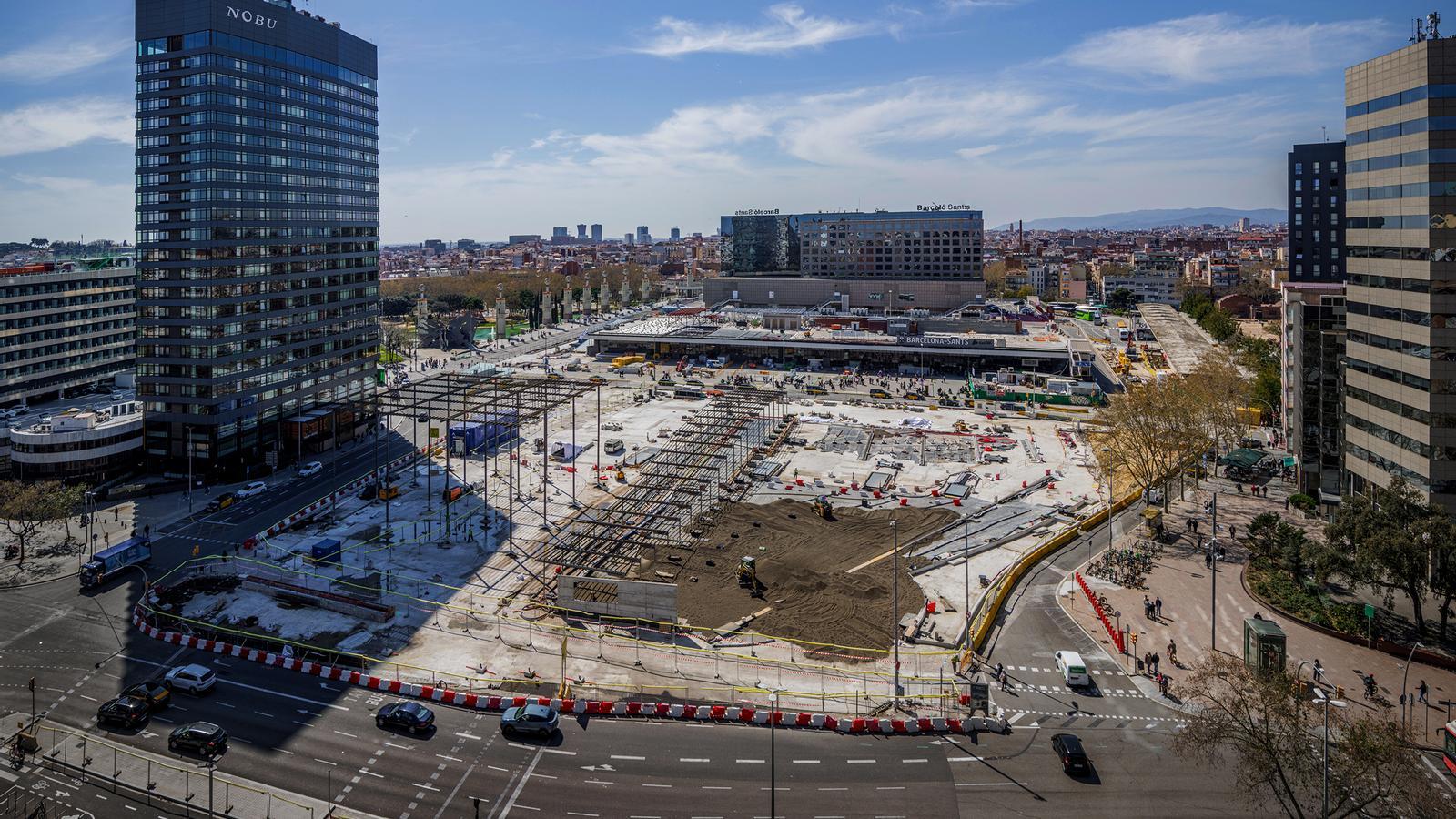
BarcelonaRafael Aranda, Carme Pigem and Ramon Vilalta have their most demanding project in hand, the expansion and renovation of Sants station, at the most intense moment of their careers, with projects in different phases in Dubai, China, Mexico, France, Albania, Portugal and Taiwan, among others. “Sants is a project of great complexity, we have never had one of this magnitude on the table,” states Vilalta. “We are working on a highly complex infrastructure, which does not stop during construction, and this makes the work very difficult,” he points out. Furthermore, in parallel to the initial phases of their project – which now focuses on the recovery of the environment, especially the emblematic Plaça dels Països Catalans, and the new high-speed and commuter train halls – Adif is carrying out about thirty small facility improvement projects. The first significant change that will be seen will occur around the station, which was previously like a roundabout around the Plaça dels Països Catalans. In the future, traffic will be limited to the sea side, next to the Parc de l'Espanya Industrial. Likewise, the RCR project for the Plaça dels Països Catalans, an award-winning work by Helio Piñón and Albert Viaplana, is based on the conclusions of a citizen participation process and on "restoring the original project" of the square and expanding it to double the current space, with a kind of passepartout that includes various points of vegetation. The works on the square are scheduled to be completed between the end of the year and the beginning of 2027, while the expansion of the lobbies will continue until February 2028. To make the station more open to the city, Sants will also have an access on the mountain side and an access on the sea side. Both will open during the last quarter of this year. "The station had become small, but, moreover, the expansion is necessary due to the liberalization of operators. Now trains pass through Sants much more frequently," points out the architect of the firm responsible for the project, Noèlia Baldayo.

The future high-speed concourse will occupy the two quadrants on the mountain side, with exits onto Plaça dels Països Catalans and arrivals onto Plaça de Joan Peiró. As for Rodalies (commuter rail), it will remain on the Besòs-Mar side of the station. The works have involved removing the false ceilings, so travelers go up and down under a cloud of cables and pipes. And some of the key elements of the project by the architects from Olot are already beginning to be visible: the opening of two large perpendicular axes that will cross the station on all four sides, and the expansion of the concourses with an upper floor, which will be sheltered by a large roof. “One of Sants' most significant shortcomings was that you ended up losing your bearings because it had very low ceilings and very little natural light. These axes will be one of the great improvements, because people will orient themselves much more easily,” says Vilalta.
The objective is to expand spaces, better organize passenger flows, and prepare the station for the expected growth in travelers, which could reach 74.7 million by 2030. The renovation will allow for a 15% increase in the general hall area, a 175% increase in High-Speed rail, an 85% increase in Commuter rail, and a 40% increase in customer service areas.The station currently serves about 140,000 daily users, which is why the works are being carried out in phases and with interior closures using provisional plasterboard partitions to isolate the work areas from passenger routes.Among the works that have already been carried out is the opening on the side facing the Parc de l'Espanya Industrial, and nearby is the structure of the ramp that will connect the Rodalies hall with the upper floor, where there is now a car park and one of the entrances to the Hotel Barceló Sants. In addition, some of the inclined pillars that will support the roof of the Rodalies hall can already be seen. "What was a car park will become a new level of the city," says the architect. "In fact, what we are now doing is recovering the buildability that the station has had since the 2000s," points out Baldayo.
