Sánchez announces a plan for migrant integration: "Without them, Spain would lose 19% of its GDP in 2050"
The Spanish government announces a 500 million euro plan to strengthen the integration of foreign people

-
CAT -
CAST
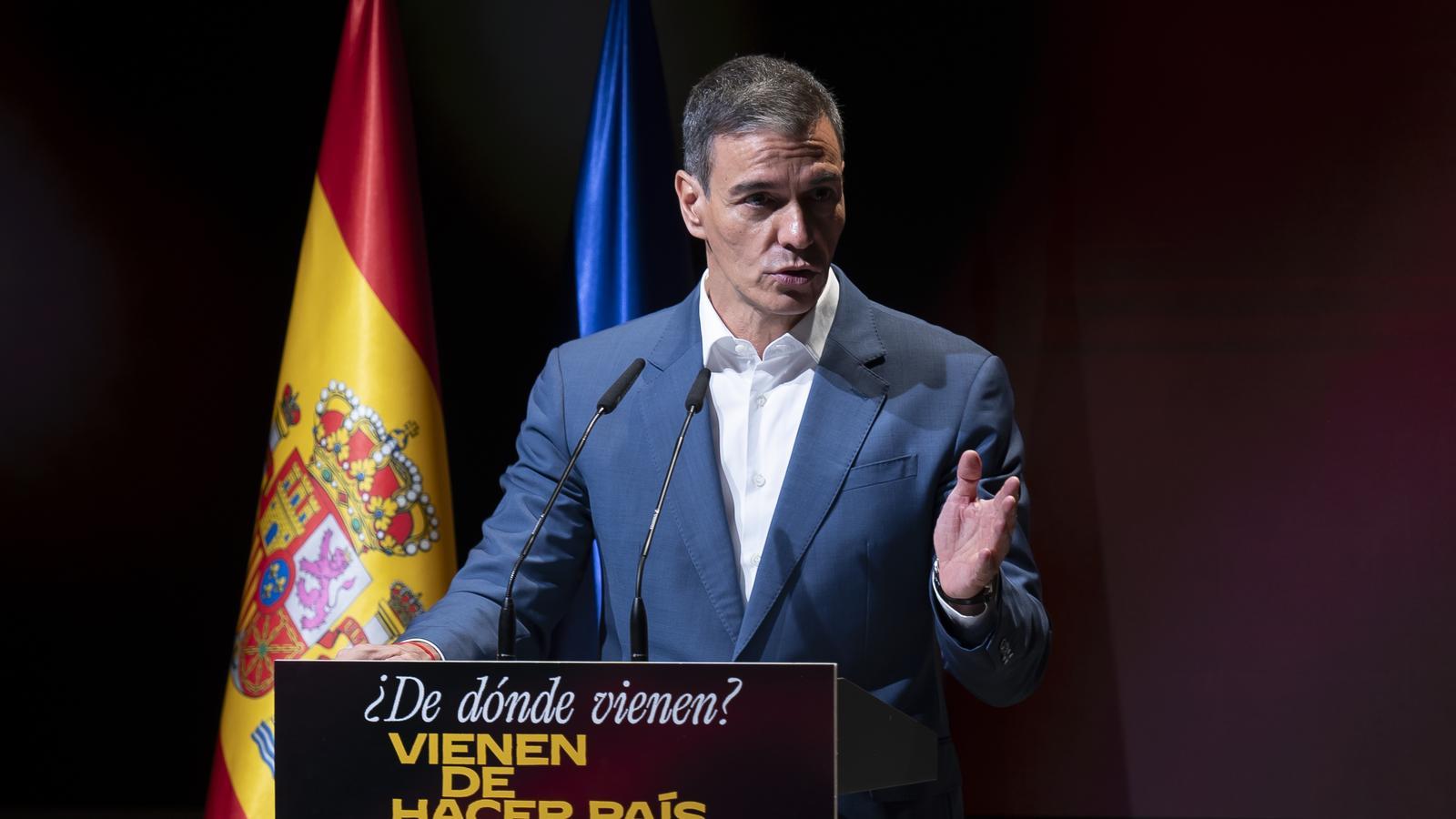
MadridOn the day the extraordinary regularization process for migrants in the country concludes, the Spanish government has presented its Integration and Citizenship Plan; a program financed with an initial allocation of 500 million euros annually, aiming to strengthen the inclusion of foreigners arriving in Spain. "Faced with fear, rigorous policy; faced with hatred, humanity," stated the President of the Spanish government, Pedro Sánchez, during the presentation, thus emphasizing the initiative's benefits.
At a time marked by the controversial "national priority" championed by the PP and Vox, a concept that at La Moncloa they have amended from the first minute, and before it was known that the Supreme Court is considering raising a preliminary ruling to the Court of Justice of the European Union (CJEU) on whether the extraordinary regularization conflicts with EU law, Sánchez did not hesitate to criticize those who, he says, "deny" the migratory reality and fuel "xenophobic discourses that do not solve the problem".
Against this, the President of the Spanish government insisted that the integration of migrants, by combining measures such as facilitating their regular administrative status and controlling borders, is not only an "intelligent" issue – he exemplified that irregular immigrant arrivals have been reduced by a third compared to the same period last year – but also "good for the [Spanish] economy". "Without migration, Spain would lose 19% of its GDP by 2050", he asserted. And, taking as a reference a projection that the executive commissioned from the National Office of Prospective and Strategy of the Ministry of the Presidency, he added: "[There would be] 90,000 bars with their shutters down. 50,000 Primary and Secondary school classrooms without students and 220,000 agricultural holdings disappeared, one in three".
The plan announced this Tuesday and promoted by the Ministry of Inclusion, Social Security and Migrations will mobilize more than 500 million euros in just one year. "It is a plan to take advantage of the opportunities that migration brings and to respond to the challenges that any social change entails," said Sánchez. Its deployment, as well as the budget, "will evolve according to the needs" of the moment.
What does the plan say?
Legal avenues and resource unification
The document is structured around four main axes and 16 specific measures. The first axis is the management of migratory flows and regularization as a basis for integration. Here, the extraordinary process that ends precisely this Tuesday comes into play, which has received more than 1.2 million requests from migrants, as revealed by Sánchez.
A labor mobility strategy will also be launched to open "legal, safe, and orderly channels, respond to the needs of the economy, and facilitate integration," and the State Agency for Human Mobility will be created, a one-stop shop to "bring together functions and resources currently dispersed" across different departments regarding international protection, migratory, and border control procedures. Specifically, it will maintain differentiated procedures for international protection and residence and will preserve security and border control competencies.
Vocational Training and high-demand sectors
The second axis is that of the recognition of a job as the main tool for inclusion, personal autonomy and cohesion. Thus, for example, more than 35 million euros will be allocated to "facilitate" the integration of migrants into sectors with high demand: construction, hospitality and care. An extraordinary vocational training offer endowed with 150 million euros and an extraordinary offer of 100,000 places "connected" to the demands of the labor market are also planned.
Learning languages, norms and values
A third pillar will be integration as a "reciprocal commitment". 30 million euros will be allocated to programs to strengthen the learning of the official languages in the State and of the norms —and democratic values, such as equality between women and men, the rights of LGTBI+ people, freedom of expression, the non-confessionality of the State and respect for the law—, and to community integration programs to improve coexistence. Regarding Catalan, sources from Sánchez's executive point out that knowledge of the language will not have special value. The fight against hate speech will also be strengthened.
Strengthening of public services
Finally, a fourth axis will be to make citizenship "effective" and for migrants to have "equal opportunities" guaranteed. With this objective, more than 200 million euros will be allocated to strengthening public services. This means, Sánchez stressed, promoting educational success and combating school segregation; acting against discrimination in access to housing and guaranteeing effective access to the health system.
