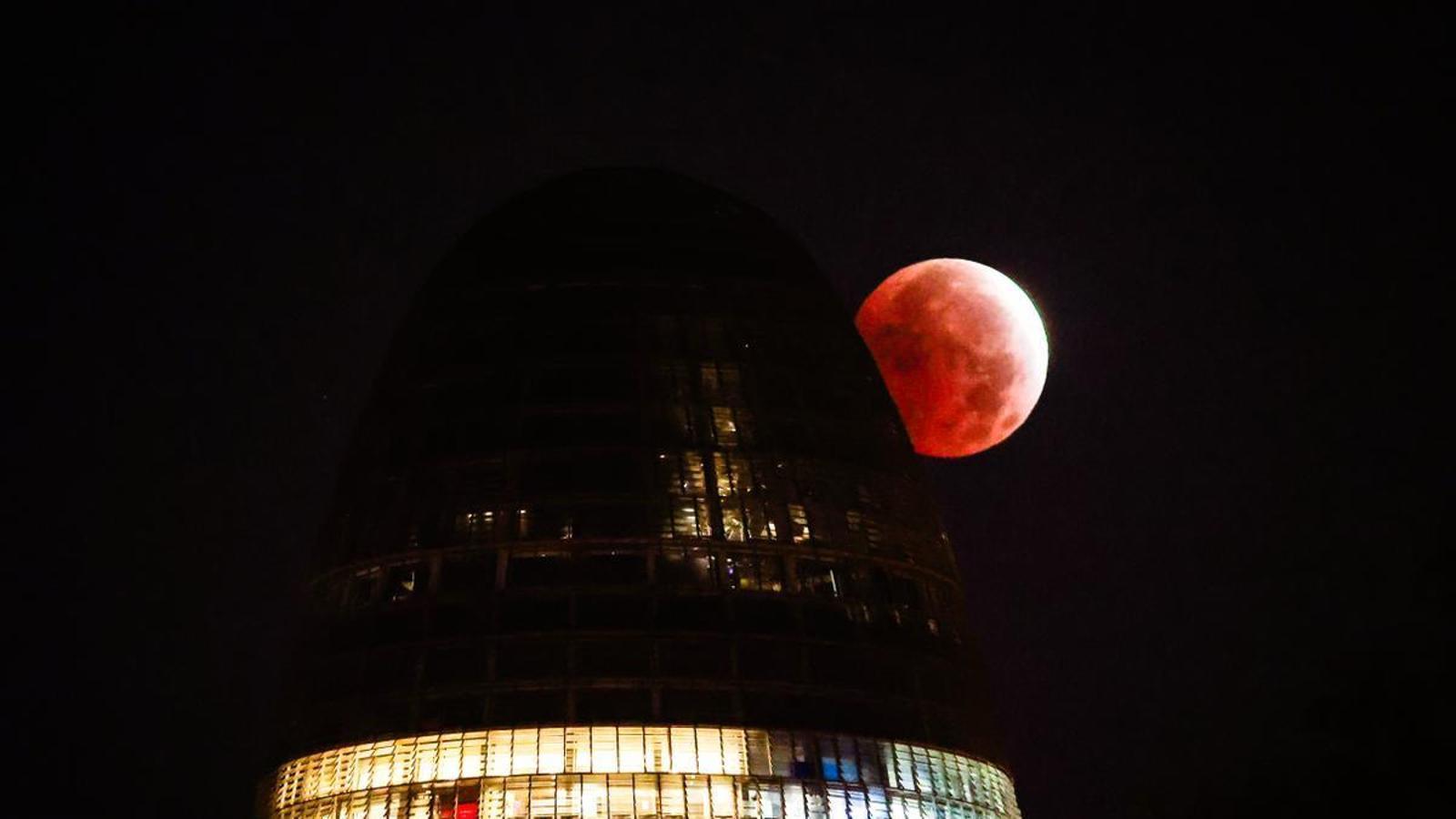
A red Moon: this is how the eclipse has been seen in Catalonia this morning
At 06.12 a.m., the Earth's shadow has covered 93% of the satellite's surface
-
CAT -
CAST
Barcelona2026 continues to be the big year of eclipses. After the solar eclipse on August 12, the Moon has now been the protagonist. At 04:25 AM this Friday, the Earth blocked the sunlight and began to cast a shadow on the Moon, covering 93% of the satellite's disk at its peak. In addition, the moon also turned a reddish color.
Where and when was the eclipse seen?
In Barcelona, the lunar eclipse began at 4:32 AM and ended shortly before 8 AM. However, its maximum splendor lasted less: it took place at 6:12 AM. At this point, 93% of the satellite's disk was obscured. Little by little, the size of the shadow cast on the moon gradually decreased, and the satellite regained its light until it set behind the horizon, around 7:20 AM.

In general, the best spots to see the phenomenon have been locations with a completely free, unobstructed western horizon. However, the full phenomenon could not be seen from Catalonia: the eclipse did not end until 7:52 AM, and by then the Moon had already been hidden behind the horizon in Catalan territory for half an hour. Only from the west of the Peninsula could all phases of the eclipse be appreciated. Specifically, in Asturias, Galicia, Extremadura, part of Andalusia, Castile and León, and the Canary Islands.
A moon tinged with red
From 05.30 a.m. onwards, it was possible to begin to appreciate how the satellite was tinged with a reddish or pinkish color, which progressively increased with the extension of the shadow. This color appears when part of the Sun's light passes through the atmosphere before reaching the Moon. The atmosphere, which acts as a natural filter, disperses blue light but allows red-toned rays to pass through, which end up projected onto the Moon.
Without approved glasses
As we already warned yesterday, this time the phenomenon could be seen with the naked eye. The lunar eclipse occurs when the Earth positions itself between the Sun and the Moon, casting its shadow on the satellite. Therefore, looking at it directly is not harmful to the eyes. Telescopes, binoculars, and conventional cameras can also be used without any risk of eye injury.
