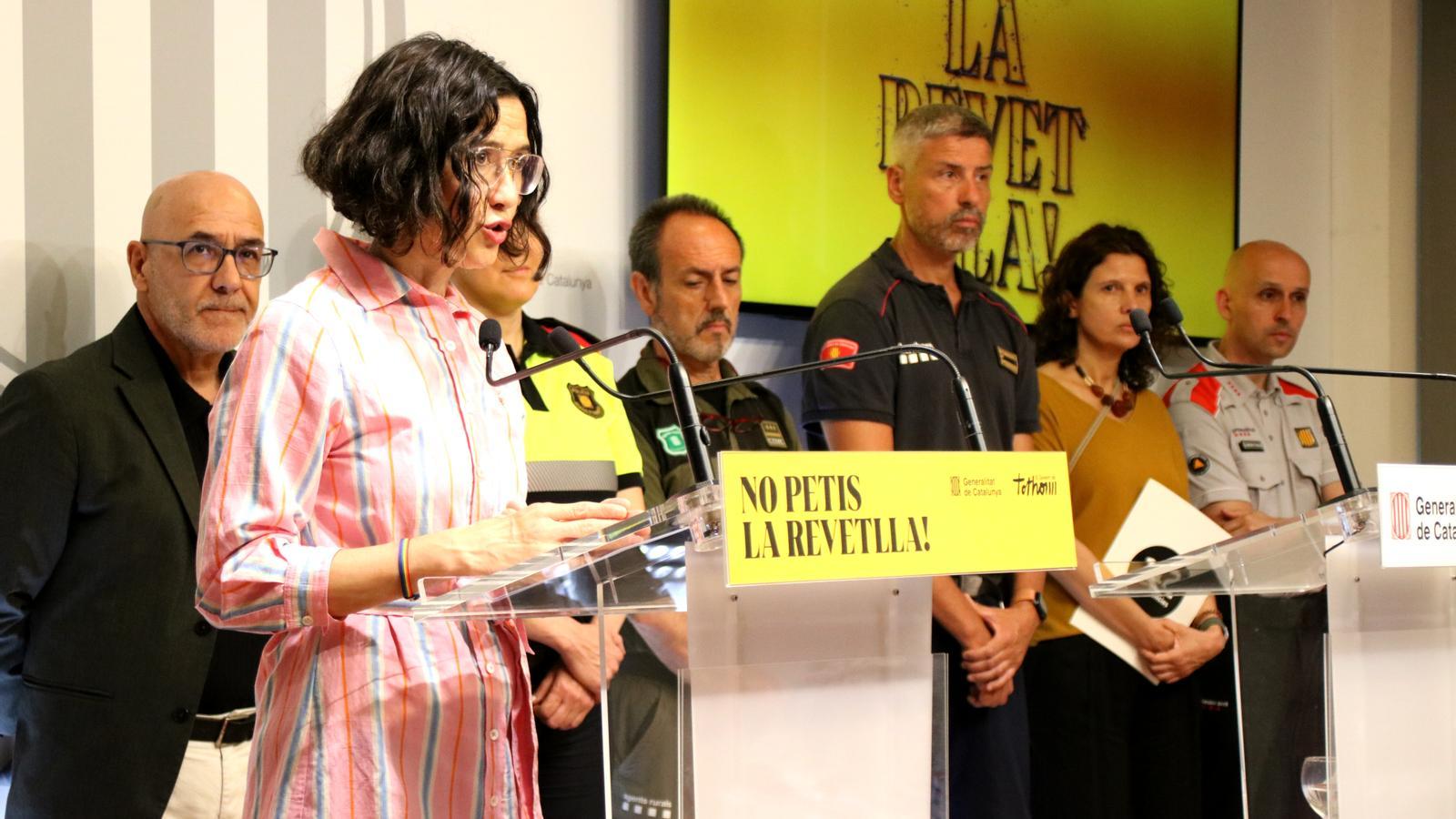
Just like last year, Civil Protection has launched a campaign to promote a safe celebration of Sant Joan's Eve. With the same slogan as 2025, "Don't set off fireworks", practical advice is given on the use of fireworks and how to prevent fires through leaflets, posters and social media materials. For example, collecting clothes left out to dry and closing doors and windows. It also states that bonfires must be authorized by the town councils and that, as far as possible, noise should be avoided for highly sensitive people and animals. Among the suggestions is not to ignite pyrotechnics inside bricks, bottles or other containers that can generate shrapnel when they explode.In a press conference, Parlon insisted on caution and recalled that last year firefighters received 1,356 calls between 8 p.m. on June 23 and 8 a.m. on June 24. In this regard, he reported that between June 22 and 28, more than 200 rural agents are expected to be deployed throughout the territory, 133 professionals from CAT112 and 50% more firefighters on duty. On the other hand, during these six days, 678 drug and alcohol checks will be set up on the roads.Sant Joan always represents a challenge for mobility, as many people travel, especially by car, to celebrate Sant Joan's Eve. Parlon highlighted that this year Sant Joan's Eve falls on a weekday and "this may affect mobility". In this regard, he pointed out that the departure of 610,000 vehicles is expected this weekend, of which 290,000 will return, and for Sant Joan's Eve, he calculated that 490,000 will leave and 240,000 will return.
Fragile forests and saw in motion: Catalonia enters the fire season
Parlon warns that the weekend fires in Ponent make us "stay alert" for Saint John's
-
CAT -
CAST
BarcelonaWith the arrival of summer, forests and agricultural lands across the country are threatened by high temperatures, low humidity, and dry vegetation, but also by human activity, which is the main cause of fires in Catalonia, whether by accident or negligence or by intentional acts. Experts and authorities warn that the country has fully entered the high fire risk season and, in fact, this weekend, several simultaneous fires in the natural environment in Lleida have strained emergency services. At present, the Government has activated level 3 out of 4 – very high fire danger – in about fifty municipalities in Ponent and Central Catalonia, and on the eve of Sant Joan's Eve, the Minister of the Interior, Núria Parlon, has asked the public for "maximum caution" when setting off fireworks – they must be at least 500 meters away from forests and natural surroundings – and when lighting bonfires.
In the last 40 years, fires in the natural environment have been changing their behavior because forests are increasingly vulnerable. The deputy inspector of the Generalitat Firefighters and the Forest Action Group (GRAF) unit, Asier Larrañaga, explains that the number of fires and hectares burned annually in Catalonia has decreased, from 12,000 to 2,000. However, now, when one breaks out, it is more common for it to get out of control for two main reasons: the lack of management of trees and undergrowth, which would allow reducing the energy an fire can have, and the meteorological and environmental conditions, aggravated by the climate crisis.
"We are a very sensible country because a lot of awareness work has been done on the use of tools or practices that can pose a risk to the natural environment. This has meant that while in the nineties 775 ignitions were recorded per year, now 515 are declared," he exemplified in a work session led by the beBartlet team and promoted by the Catalunya La Pedrera Foundation, owner and manager of thousands of forest hectares in Catalonia. However, Larrañaga emphasizes, the speed of fire propagation has skyrocketed, making extinction by firefighters increasingly complex. If the major fires of 1994 – which mainly affected Bages, Berguedà, and Solsonès – could burn 345 hectares per hour, it is now not uncommon for this figure to climb to 800 hectares per hour and generate situations like those experienced last year in La Segarra.
Low forest management
On the forest surface of Catalonia, a great deal of "fuel" accumulates. In just 40 years, the plant matter that can burn and feed a fire has skyrocketed from 35% to 71%, indicates GRAF's deputy inspector, who attributes this to periods of drought and lack of rain, which favor forest mortality and, therefore, the spread of fires. "Now the trees arrive in a better water state than in previous years thanks to the rainy period we have experienced. This means that, for the moment, we view the start of summer with optimism. However, if it doesn't rain in June and July, conditions will worsen in cultivated fields and forests, as herbaceous vegetation has grown a lot and is drying out," anticipates the director of CREAF, Joan Pino, in statements to ARA.
Approximately 60% of Catalan forests are private, while the remaining 40% are public. If all owners managed the land – clearing and removing trees and undergrowth, as well as creating protection strips – the amount and continuity of fuel would be reduced, and the fire would be easier to control. But this is not happening: although there has been improvement, there is still too much land vulnerable to fire. In fact, decades of neglect – despite there being a forest law, there are no responsibilities against those who neglect their properties – on Catalan lands pave the way for flames of 15 or 20 meters high to swallow entire trees. "If the land is managed, the crowns don't burn, and the forests don't have to start from scratch," points out Larrañaga.
On the other hand, and in addition to the fuel, Pino states that meteorology will play a key role in all of this in the coming months: "If temperatures reach 40°C and there is a westerly wind with intense dry and warm winds, the risk increases significantly, and there can be simultaneous fires." Now, moreover, climate change favors sixth-generation fires, which are characterized by the formation of large convective clouds generated by the heat of the fire that connect the lower and upper layers of the atmosphere (pyrocumulus). This dynamic can cause extreme fire behavior, with very high propagation speed, great intensity, and sudden changes in wind direction and strength, making them very difficult to extinguish. "Bringing firefighters inside is killing them," admits Larrañaga.
Rural Agents reported this Monday that the agricultural sector in Ponent is in full harvest activity, an essential task, but one that entails high risks in the current climatic context. For this reason, a special operation has been deployed with nearly a hundred people dedicated daily to surveillance and support of the sector, as well as air resources and immediate intervention units. "And another important problem: we increasingly have more people living next to the forest. Therefore, we increasingly have a bad combination of warmer and drier summers, more population near the forest, and more vegetation to burn," values Pino. In his opinion, Catalonia has invested heavily in the detection and rapid extinction of fires, but now what is missing is to place more emphasis on fire prevention.
