Outbreak of tension at the housing protest in Barcelona
The protesters have claimed the right to emancipate themselves and to strike generally before the early elections

-
CAT -
CAST
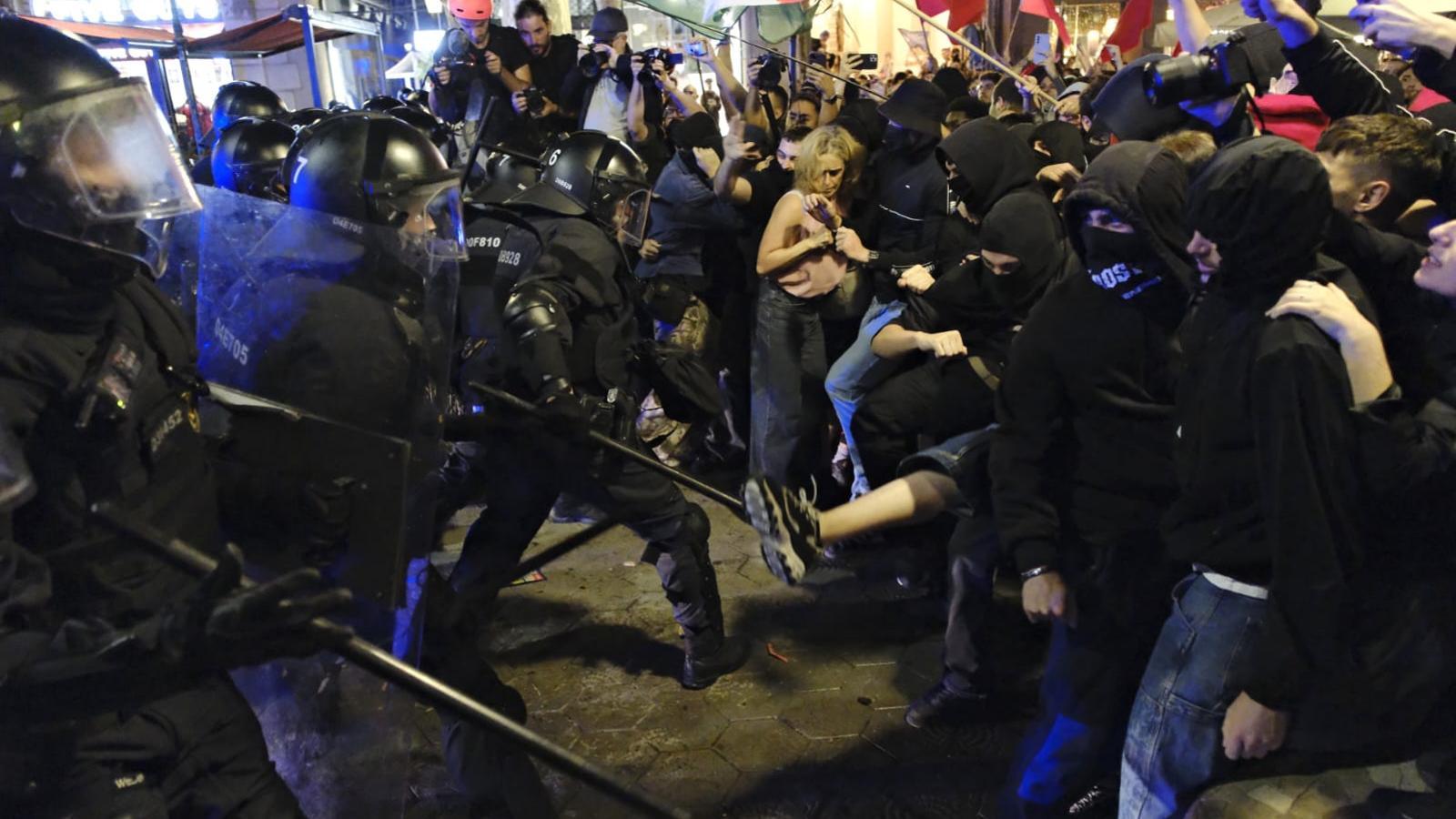
BarcelonaEscalation of tension at the massive demonstration in defense of housing in the center of Barcelona. After a couple of hours of peaceful protests, the Mossos d'Esquadra have charged against a group of protesters who lit bonfires at the intersection of Gran Via and Passeig de Gràcia and who were throwing stones, bottles, pyrotechnics, and urban furniture at the officers. Once the protest was formally called off, the officers deployed a police cordon to contain the protesters' advance. While one column moved in the direction of Plaça Catalunya and another towards Tetuan, the police, with a large deployment, responded with baton strikes. There have been some identifications and arrests, and the operation remains active past 10:30 PM.
The housing crisis has turned everything upside down in a few weeks and the tenants' unions are not letting up: they warn that the announced early call for elections does not solve any problems nor does it change the plans to go on a general strike. This Monday they confirmed it as thousands of protesters took to the streets of Barcelona again to frontally reject speculation and claim the right to housing. A protest that was supposed to take place on Saturday – like in the rest of the country's major cities – but which in Catalonia had to be postponed due to heavy downpours, and which brought together 20,000 people according to the Barcelona City Council, 120,000 according to the organizers.

The demonstration began at Plaça Urquinaona and advanced along Ronda Sant Pere to the Arc de Triomf. When the head of the march reached this point, there were still protesters at the start who had not yet begun to move due to the large influx of people. Shouting "No neighbor out of the neighborhoods," "Rentiers are guilty, governments are responsible," and "It makes no sense, people without homes and homes without people," they advanced along Passeig de Sant Joan to Plaça Tetuan. The demonstration continued along Gran Via and will end at Passeig de Gràcia, where a call will be made to participate in the sit-in at Plaça Catalunya.
The call has reached people of all kinds, and the profile of the protesters is quite diverse. Laia, Lucas, and Núria are students and still live at their parents' house, but they did not hesitate to take to the streets this Monday to demonstrate for the right to housing. "We will never be able to emancipate ourselves like this, it is our future," he explains. David, on the other hand, explains that he is a homeowner and that he came in solidarity with all the people who cannot buy an apartment. "Rents are impossible, and luckily I was able to buy an apartment. I am mortgaged for 30 years, mind you," he says. He wants to make it clear that he is one of the few in his group who has been able to buy.

Before the protesters began the march, ARA reported that there will be a general strike for housing before the Spanish elections on November 29. The majority unions, CCOO and UGT, have announced that they are supporting the stoppage proposed days ago by the tenants' unions, which on Sunday already had the support of the CGT union, according to sources familiar with the conversations. The spokesperson for the Tenants' Union, Carme Arcarazo, celebrated the accession and argued that broad consensus is needed to carry out this stoppage. "We want this strike to be a success: we are facing a very powerful enemy," she warned. And she added: "We have one month to organize the entire working class of the country."
The spokesperson for the Socialist Housing Union of Catalonia, Gisela Bermúdez, harshly criticized all political leaders and said that "there is no party that really wants to put an end to the housing crisis" because "no party wants to break with the housing business." She also demanded "the expropriation of all apartments" owned by large holders, banks, and vulture funds; lowering rent prices by half; and implementing indefinite contracts so that the working class "stops suffering anxiety."
The Housing Union Confederation of Catalonia also wanted to point out the role of the Generalitat government in the housing crisis. According to its spokesperson, Marta Espriu, President Illa also has "responsibility" in managing the situation. And, from the PAH, Juanjo Ramón celebrated that "the streets have woken up," and believes it is "a window of opportunity" and "a framework of hope" for everyone who has lost their home in recent years.
The decrees are approved again
The Minister of Culture, Ernest Urtasun, has confirmed that the Spanish government will once again approve on Tuesday the royal decree-laws on housing that were rejected last Friday in the plenary session of Congress –with the votes against from the PP, Vox, and Junts–, but with some variations, although he has assured that they will not lower "any of the protection measures." Specifically, it will re-approve measures such as the ban on evictions until 2030, the extension of rental contracts until December 31, 2028, the regulation of tourist and seasonal rentals, or the regulation of vulture funds. "If there is any improvement that can be made, always in the sense of improving protection, we will study it between now and tomorrow," he said.
The two decrees were published last Wednesday in the Official State Gazette (BOE) and were in force until Friday. In this period, they managed to stop at least a dozen evictions in Barcelona. With them, both the possibility of launching the so-called indefinite rental contracts expires –the automatic extensions of contracts are lost, which in some cases would be accompanied by compensation to tenants if the law is not complied with– as well as a battery of measures, many of which are social, also regarding housing. For example, the moratorium on some evictions for vulnerable families.
