"I'm afraid to take the bus": getting back on the vehicle that crashed in Lleida 24 hours later
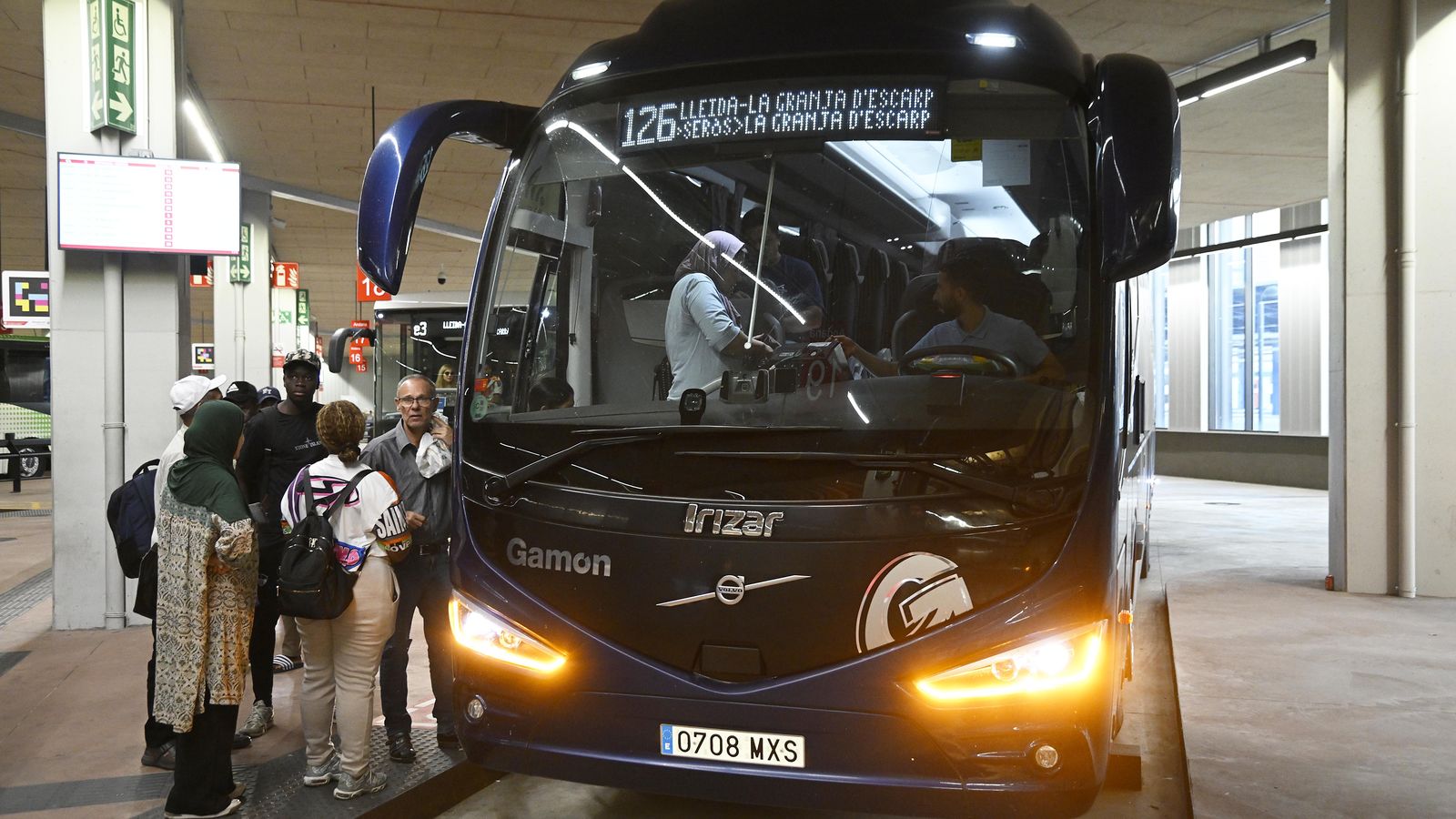
Thursday morning a score of passengers were taking the bus that covers the route to La Granja d'Escarp while the authorities investigate why the driver lost control of the vehicle

-
CAT -
CAST
LleidaLife goes on. At the same time. At the same place. But on a different bus. Work never stops. This Thursday, at seven in the morning, Angi, José, and Oukakalong boarded the Lleida - la Granja d'Escarp bus again, as they had done on Wednesday, the day when, suddenly, the vehicle they were traveling in crashed into the wall of the Diputació de Lleida: the "most serious" accident in the city's history, as described by the mayor of the capital of Segrià, Fèlix Larrosa. Of the 44 injured, nine people remain hospitalized, three of them in the ICU. Of these, two are in critical condition and one is stable within the severity.
Angi's face reflects the horror of what happened 24 hours earlier: a slight wound on her nose, a bump on her forehead, jumbled memories. "It was horrible, everyone was screaming. I thought I was going to die," explains this Colombian woman who was heading to Aitona. Beside her, José nods. He was in the back of the coach, which was less damaged by the impact. From inside the vehicle, he had the sensation that the driver, who had been working for three days and was accompanied by another driver, accidentally accelerated after losing control. The accident took place a few meters from the bus station, on rambla de Ferran, just as the journey began. If it had happened in another area, José is clear that all 44 passengers could have died.
This Thursday, Oukakalong had no choice but to get back on the bus where yesterday he saw some of his friends seriously injured. This Gambian works in a fruit warehouse in Soses and admits he has "anxiety" after what he experienced. "I'm afraid to take the bus," he admits, although words are unnecessary: his face speaks for itself. He is scared, waiting for the bus that the new driver, Adil, is taking out of the station at 7:12 AM. On board, 18 more people. "It was a very difficult day," confesses Adil, accustomed to making the route to La Granja d'Escarp.
Loses control
A few seconds later the bus passes in front of the Diputació de Lleida building. Their gazes go to the wall of the building, scratched by the impact of the vehicle. It is the only mark of the tragedy: two whitish areas on the stone. The workers have fixed it quickly. The cleaning services have just gone over the area. There are no marks on the road. The lamppost that the bus took was already replaced in the afternoon. Only the tree that was violently uprooted by the impact is missing. A few meters further on, Juan, Sergi, Òscar and Albert watch the bus pass while they finish their coffee at Cafeteria Rambla. They are forty meters from the accident site. They were all there on Wednesday, the day of the crash. They remember how the vehicle was going straight and, suddenly, it turned sharply "ninety degrees" until it hit the building's wall. They believe the bus was not going excessively fast (it is a 20 km/h zone), but that the novice driver lost control when she hit a metal part that protects the sidewalk, where there is a bus stop. At that moment, they point out, the woman accelerated or, at least, "didn't know how to brake." Precisely, police investigations must determine what caused the accident – whether it was the impact with something – and the driver's subsequent reaction.

Exiting the building, he braked the vehicle and caused the passengers and the second driver who were in the front right to be seriously injured. The 59-year-old man, a resident of Aitona, was thrown out. One of the Diputació workers, Gerard, saw it as he was crossing the boulevard towards the building. "It was very hard, it smelled of an accident, of burnt plastic," he recounts. He saw the impact from behind. He was not aware of the magnitude of what had happened until he circled the vehicle and saw the front part. A woman was applying a tourniquet to the driver's leg. There were people coming out bloody. Others were trying to break the windows to get out of the vehicle. On Wednesday, Gerard found it difficult to work and needed a colleague to go with him on his usual route through the territory. "There were three seconds of silence and, suddenly, screams," adds Juan. Sònia saw it from the other side, head-on. A few meters away, while setting up the terrace of the cafe where she works. "It was horrible, like a bomb. Bang, bang, bang," she nervously recounts. While calling 112, she was counting the injured.
The bus passed between two cement benches in front of the Diputació before crashing into the building. A few meters away, right where the driver lost control, there is a stop for urban buses. Francisca and Patricia were saved by a few seconds. Every day, at 7:15 a.m., they usually stop there. When they arrived at the stop this Wednesday, the vehicle had just crashed. "They were getting off the bus, some lying on the street," says Francisca, whom her daughter called a few minutes later to see if she was okay, knowing that the place where the accident had occurred is where she waits every day, at the same time.
The majority of the passengers who took the crashed bus are workers. Many from the countryside. Sub-Saharan and North African seasonal workers who go to fruit warehouses or to pick fruit, and who live in Lleida. "When it's school time, there are also some students," explains Crista, who also usually takes this bus every week. She is one of the users who wait inside the gigantic bus station of Lleida, opened a few months ago. People wait drowsily in the silence, oblivious to the maneuvers of the bus driven by Adil towards La Granja d'Escarp and on which Angi, José, and Oukakalong are also traveling today, while some of their colleagues remain hospitalized in critical condition.
