Eclipse for history: "This only happens once in a lifetime"
Thousands of people, fascinated by an astronomical phenomenon that will not be repeated in more than 150 years in Catalonia

-
CAT -
CAST
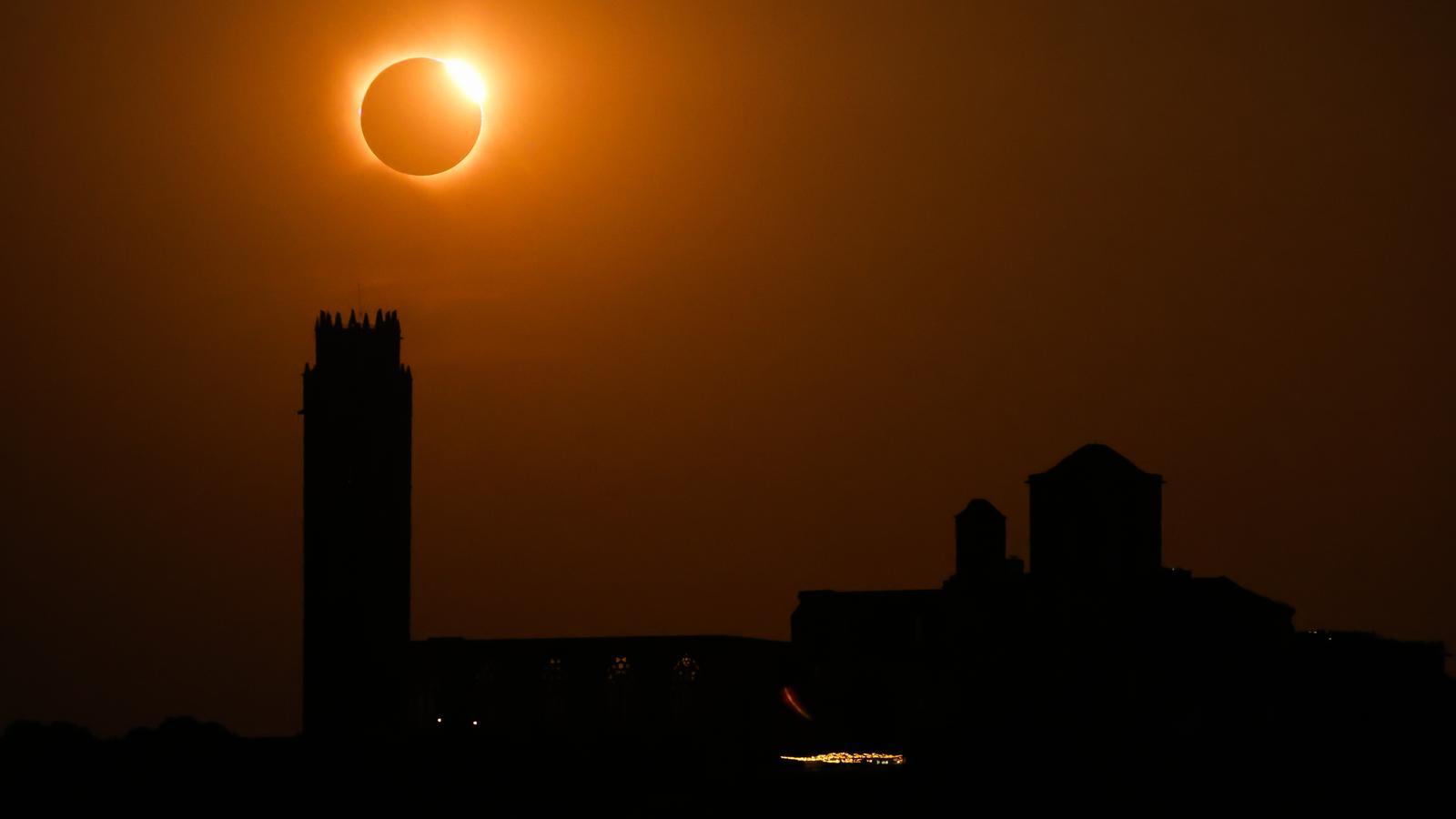
BarcelonaNot even the guitarist of Queen wanted to miss it. Brian May has been just one of the hundreds of thousands of people who this Wednesday have dropped everything to experience a minute and a half that is already history: the only total solar eclipse that will be seen in Catalonia —and in part of the Iberian Peninsula— in more than a century. From the Trabucador sandbar in the Ebro Delta, from a cove in Mallorca, from the Prades mountains, or even from an industrial estate in Valls or from a municipal football field in a Lleida neighborhood. Neither the heat nor the fear that the clouds would play tricks have hindered this astronomical phenomenon for which Catalonia had been preparing for more than a year.
"This only happens once in a lifetime," explained Sara and Mia, mother and daughter from Ripollet, from the Trabucador bar, who wanted to arrive early to be among the first to secure a prime spot to watch the minute and a half of darkness. At this point in the Delta at six in the morning, dozens of caravans were already filling the area's parking lots. Being the most prepared, however, also came at a price: the heat of the waiting hours under the sun, as in various parts of Catalonia the thermometer exceeded 40°C. Camping chairs, parasols, fans, and water bottles were the main tools to overcome the long wait until the evening. In fact, in some football fields where observation points had been organized, such as in L'Ametlla de Mar, sprinklers were also activated to cool down during the afternoon.
However, the moment the Moon covered the Sun, all discomforts were completely forgotten. Light gave way to darkness and many began a choreography of movements to put on and take off their glasses while commenting on the play. At La Seu Vella, in Lleida, many described the scene as "magical" and celebrated the culminating moment with collective applause. "Suddenly it became night, everyone fell silent, and with so many people, that silence really struck me," explained Josep Cangulells in statements to the ACN from Les Borges Blanques, where up to 5,000 tickets were distributed to watch the eclipse. "It gave me goosebumps," admitted Josep Maria from Marina Port Tarraco in Tarragona, where up to 15,000 fans gathered.
At the Ebre Observatory, in Roquetes, at the peak of the eclipse, some tears of emotion were also seen. There, 300 people were fascinated by the darkness, including the President of the Generalitat, Salvador Illa, and the Minister of Research and Universities, Núria Montserrat. Both agreed in highlighting that the phenomenon was "a gift from nature." "Looking at the sky from here is a gesture and a tribute to the work done, to the scientific work done from here," celebrated Illa.
In Barcelona, where the phenomenon was partially seen (99.8%), many have tried to climb to places like Montjuïc Castle or the stands of the magic mountain pool to enjoy the moment. Some hotels in the Catalan capital, such as Barceló Raval, have also organized events on the top floors to watch the eclipse. In their case, demand exceeded expectations, and they had to turn away several guests who tried to go up to the rooftop without a reservation. "We had booked because we've been to the terrace before to watch the sunset and we didn't want to miss this one. Plus, you pay for the drink and they give you the glasses," explained, in English —despite living in Catalonia—, Paty and Bryan, mojito in hand.
Other Catalans have decided to move to other parts of Spain. This is the case for some members of the Sabadell Astronomical Association who have chosen a town in Burgos —as NASA has also done to broadcast the eclipse worldwide— to experience this historic moment. On the other hand, several fans of the Barcelona Astronomical Association (ASTER) have traveled to the Gallocanta lagoon, in Teruel. In fact, several Catalans have opted for this area, such as Mireya and Ferran, who have watched the eclipse from a hill in Muniesa. They have also taken the opportunity to try their luck: "I bought a lottery ticket today, let's see if we're lucky," she explained.
The chaos to arrive... and to leave
The magic of just over 90 seconds of darkness for many has been preceded by long hours of queuing, which were also repeated when returning home. Although being in the middle of August many opted to leave hours or days before the eclipse —the Servei Català de Trànsit already registered an increase in vehicle traffic on the AP-7 on Sunday and Monday—, this Wednesday at midday and in the early afternoon, traffic jams to travel south have been repeated. In fact, on the AP-7 more than 30 kilometers of queues accumulated during the afternoon and there were also traffic jams on the A-2 in Martorell and on the C-31 on the Garraf coast. “The GPS increasingly says we will arrive later...”, Marta explained worriedly to ARA. Despite leaving at a quarter past three from Cerdanyola del Vallès to arrive on time to see the eclipse in one of the designated areas in Les Borges Blanques, she was worried because by mid-afternoon she had been stopped on the A2 near Cervera for some time.
The Government's main recommendation for getting around was to try to avoid the AP-7 to prevent the saturation of this route, but those who also encountered problems were those who chose the train to travel to the point where they would see the eclipse. On the platform of Sants and Sant Vicenç de Calders stations, there were significant crowds of people trying to catch a train to the point where Civil Protection had to activate the pre-alert of the Ferrocat plan. In addition, several users complained on social media that people were traveling crammed inside the trains and some had suffered dizziness due to the heat. To all this, a new incident at Castelldefels station had to be added, which caused 30-minute delays on the R2 Sud and Regionals Sud trains.
To return, at the moment, traffic on the AP-7 is not problematic, but there is significant saturation at the train stations. Especially in Tarragona and Tortosa, where there are scenes of crowded platforms with passengers trying to catch some of the trains (which are already arriving full) to go home.
