Cradles in classrooms: a walk through the poorest neighborhood in Spain
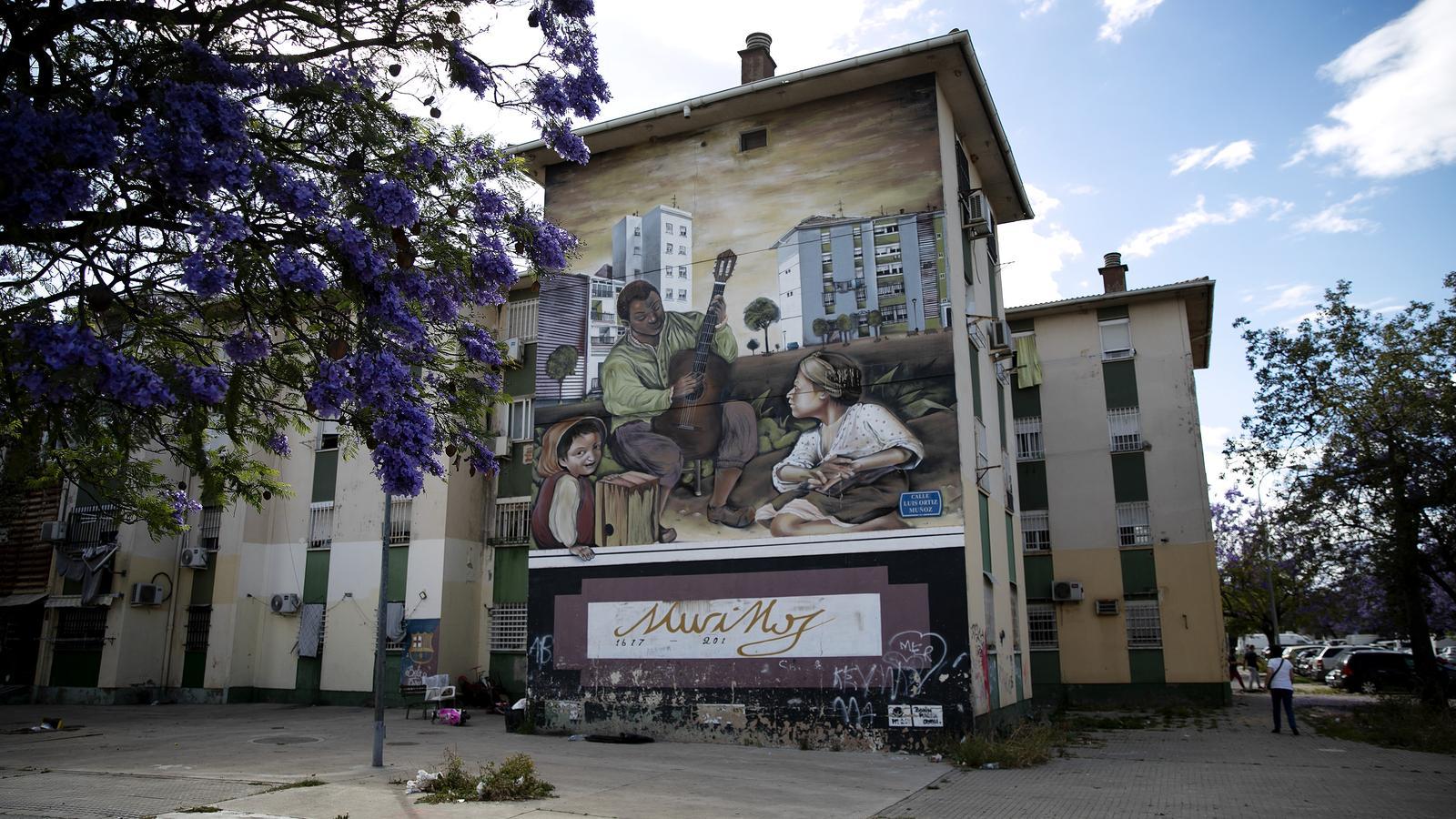
The ARA travels through the Polígono Sur of Seville, the area with the lowest per capita income in Spain and known by the nickname Las 3.000 Viviendas

-
CAT -
CAST
SevilleHe is riding a bicycle. She is looking at her phone. The child must be 3 or 4 years old. "She can't be the mother, can she?" I think. I ask Nati, who is walking beside me. She smiles. She wouldn't be surprised, even though that girl – she looks like a girl – could be 15 at most. In this area, the street names are litanies, that is, religious supplications: refuge of sinners, comforter of the afflicted, help of Christians. On these walls, divine proclamations take on another dimension. Nati explains to me that one of the concerns she had during the years she was a school principal was precisely that the girls would not stop studying, especially when they were asked for their hand in marriage. And this could happen very soon. At 11, at 12, at 13. "How did you do it?" I ask. "By trying to work with the families," she says. After a while, they call me: "Did you see what Nati said?" I approach. "Oh, yes, I forgot something," she says. And she blurts out, with a tone of normality: "They also put cribs in the classrooms." "What?" I say. "Yes, cribs, so they wouldn't leave.
Vulnerability and poverty are normally explained in numbers. It can also be done here: 60% is the unemployment rate; 4,000, the power outages in the last year; 7,400 euros, the average annual income. But in the coming hours, we will see that poverty and marginalization are also images: a bus, a fan, a modified engine. This is not an exhaustive X-ray. It is not an in-depth study. It is a walk through the Polígono Sur of Seville. 150 hectares squeezed between the train tracks and the highway, where it is not known for sure how many people live, and which holds the sad record of being the poorest neighborhood in Spain. This is a walk through what is known by the nickname of Las 3,000 Viviendas. Waiting for the bus
It is a grid-like space where, at a very short distance, there is the CAP, a drug addiction center, a gypsy association, and a Christian parish. In these few meters, the relatively new and clean facilities of the primary school mix with clearly intoxicated people, gypsies playing music –who knows if to celebrate something– and children participating in parish activities. “I thought it could be a good starting point,” says Alfonso. It is a scene that is surreal, decadent, and marginal. “Welcome to the backyard of the city.” He is a member of the Platform We Are Also Seville, which also includes Nati, who is already retired but has worked all her life in the neighborhood school; Luisa, 63, who cleans houses, and Neiva, 33, who breaks all the stereotypes and statistics and has completed a master's degree in public policy after studying two bachelor's degrees. She is the one who made the posters that paper the neighborhood demanding the bus, which no longer arrives because the drivers report that stones are thrown at them. “When they have problems in the center of Seville, they don't stop passing through,” says Neiva. It is difficult not to think of the 47. Of Torre Baró's fight to have a bus. It was the year 78. Today, in Las 3.000 Viviendas, there are people who have to walk half an hour to reach the first point where there is a stop. With all that it implies for doing everyday things like going to the supermarket or going to work.

Engines on bicycles
It is known as Las Vegas and is the most deteriorated area. The ground floors of the buildings, which are empty, are in a lamentable state. Many neighbors sit in a circle on chairs in the street, and small children ride bicycles around them. The speed is surprising. How is this possible? Ah, I look closer. They have customized the bicycles. They have some kind of engine that allows children aged four, five, and six to go at full speed without helmets. "And you should see it at night, it's a real party," says Nati. They explain to me that when it gets dark, they light bonfires in the street, play music, and hold illegal races at full speed. "And the children?" I ask. Nati laughs and explains, with a marked Sevillian accent and at full speed, how many mornings the children missed school or fell asleep at their desks. "The children themselves told me that their mother had fallen asleep. Or sometimes that they had been forced to go to the doctor to say they didn't feel well and thus get a justification." Absenteeism is around 35% and the school dropout rate exceeds the astonishing figure of 60%. "The school staff does everything possible, but we need parents to get involved in the centers. A child who fails here comes from a broken home," says Alfonso. Many parents try to get their children to study outside the neighborhood. This is the case of Neiva, who spent all of secondary school saying she was from the next neighborhood, without telling her friends that she was actually from Polígono Sur. "We also lie when looking for work," says Luisa. "There are houses that if they know we are from here, they won't want us to come in to clean."
The fan
Leaving Martínez Montañés, Luisa meets a friend. I lend an ear and hear her talking about batteries: “I’ve already put them on the balcony. Two batteries, I won’t be without a fan this summer.” The neighborhood lives daily with power outages. But they emphasize to us that they prefer to call them blackouts: "Because we pay the bills," they emphasize. Of the 365 days of 2025, only six had electricity for 24 hours. This is a city, and a neighborhood, that in summer often reaches 40 degrees. They are collecting all the data and working to take it to the European Parliament. An important problem with the apartments, apart from the electrical installation, is that it is not known who they belong to. Just as it sounds. “Here, the vast majority of the apartments were protected housing –explains Alfonso–, but there have been illegal transfers and the reality is that today there is no census of who exactly lives in each door.” This leads to apartments being dedicated to drug trafficking, mafias that have sold homes for 15,000 euros, and it is not known with certainty who the owner of each apartment is.
17-M
There are no electoral posters nor has any rally been held. In this neighborhood, abstention in many places reaches 70%. In Martínez Montañés it rises to 85%. “The neighborhood is like this because that is what the policies that have been made have determined. Rather, those that have not been made,” lament the four. Alfonso explains that the process often repeats itself: European money that should be used for programs in the neighborhoods. This is channeled through NGOs that are not located there and end up carrying out programs without knowledge of the neighborhood's reality, without them lasting over time, and without any control of the results. Alfonso speaks of two forces: those who fight to transform the neighborhood and those who work to destroy it. "And who are the latter?" I ask him. “You can imagine, the clans that profit from illegality.”
We head back to the car. "What do you like about here?" I ask before leaving. “Here I have my five children and ten grandchildren –says Luisa–. And we still all know each other. I can tell you all the neighbors' names.” "And haven't you thought about leaving?" I ask Neiva. She is young, smart, educated. I don't know how to interpret the look on her face. I suppose it has crossed her mind. “What I want –she says– is to change things.” Retracing our steps, we pass the dilapidated bus stop, the closed shops, the junkies walking, and the uncovered garbage. I think of the bus, the fan, and the cribs. The images of a neighborhood that are also the Alfonsos, the Neivas, and the Luisas who fight to change it. We're almost there. The street sign indicates we are at the Gate of Heaven. It is the distance between divine promises and earthly shortcomings.
