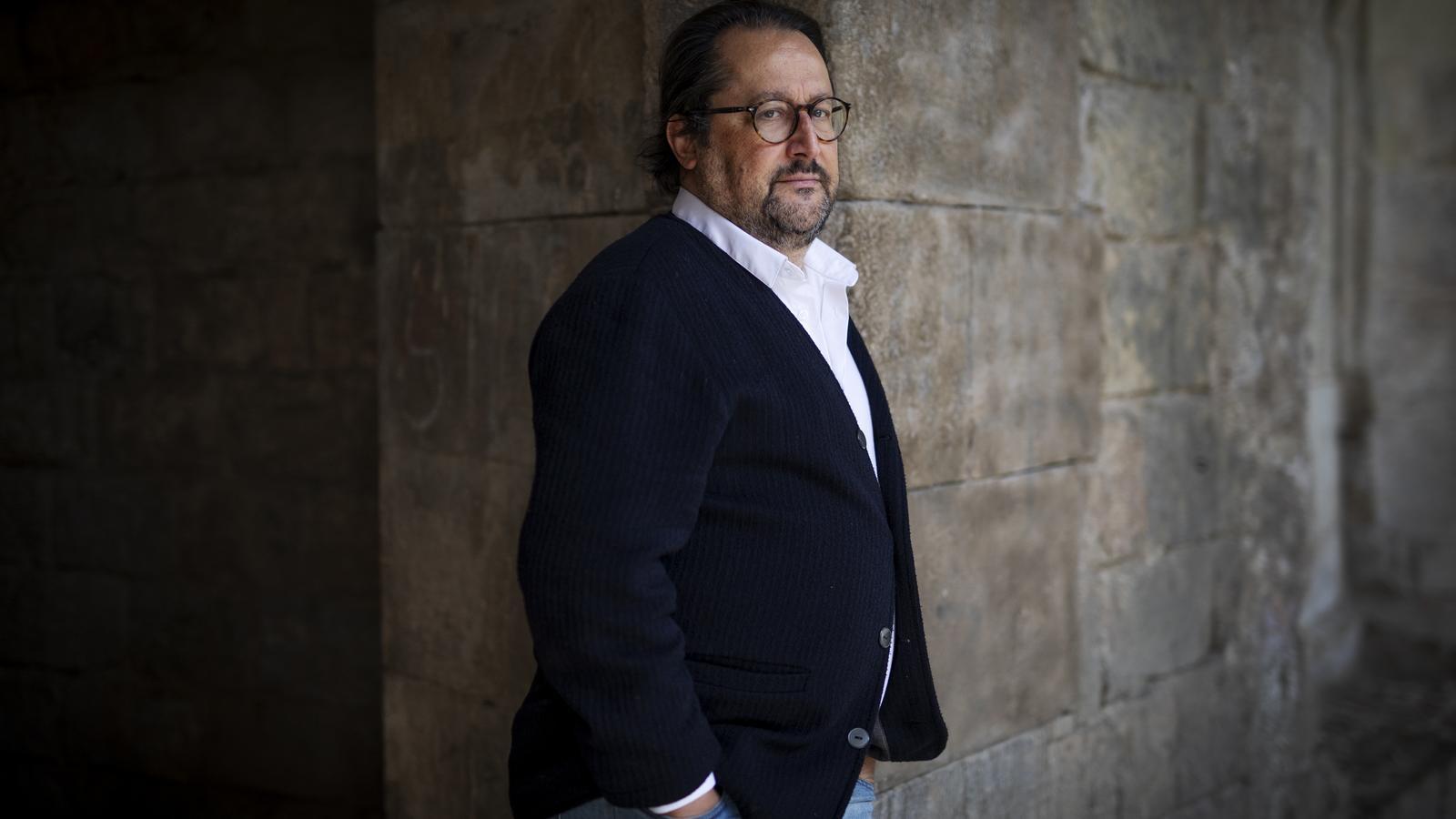
Francesc Magrinyà: "Cerdà would propose extending the green axes throughout the city"
Road engineer and author of the book 'Cerdà Theory'

-
CAT -
CAST
BarcelonaFrancesc Magrinyà (Barcelona, 1963) is a civil engineer and the country's leading expert on Ildefons Cerdà. A figure about whom, he says, an incomplete narrative has been imposed for years. To try to turn it around and coinciding with the commemoration of the 150th anniversary of his death, he has just published the book "Teoría Cerdà (Polytechnic University of Catalonia), a monumental work that brings closer the work, but also the thought, the environment, and the history of the creator of the Eixample. Magrinyà is also the curator of an exhibition about Cerdà that will be shown soon in Centelles, Barcelona, and Madrid.
Was he indebted to Cerdà?
— When the first National Congress of Urbanism was held in 1959, it became clear that there were only three or four planned cities in the world like Barcelona. From then on, the Eixample district was highly valued and analyzed extensively, but the problem is that it was done disconnected from the person behind it. There was a lack of this perspective to disseminate Cerdà's thinking.
One of the stigmas is that Cerdà's Ensanche is a project imposed by Madrid.
— What is not said is that those from Madrid were Catalans then. The moment when Catalans have more presence in Spain is the Revolutionary Sexennium. There is a generation where Cerdà, Pascual Madoz –Navarrese, but a deputy for Lérida for many years– and Laureà Figuerola are, who are people who move in Freemasonry and who have the ambition to transform society. It is a generation of Catalans linked to the project of modernizing Spain. These characters are cornered because according to the Lliga's narrative, this does not fit.
Milà i Fontanals or Puig i Cadafalch are furious detractors of Cerdà.
— Pau Milà i Fontanals used to discredit Cerdà. In Puig i Cadafalch's case, he experiences the frustration of not being able to build in the Ensanche of bourgeois Barcelona. The international project, for which he commissions Jaussely to create grand boulevards in the Ensanche in the style of Paris, is never implemented because what remains in force is Cerdà's grid. Puig i Cadafalch takes this very hard.
Is there a kind of crusade of architects against Cerdà?
— Before, it was military engineers and architects who decided the city. In 1851, however, the Ministry of Development was created, which was entirely controlled by engineers and which, from 1858 to 1868, defined the city's planning. For architects, it was as if the city's design was kidnapped from them for a decade.
They don't take it well.
— Cerdà is a mechanicist. He plays Tetris and the modernists want to make art. They are two oppositions of urbanism. Afterwards there is also the critique of the bourgeoisie.
Why?
— Because they haven't been able to build a house with a garden as they would like, but rather have placed it in this grid structure.
What makes the Eixample innovative?
— It is the first modern treatise on world urbanism. Cerdà designs the minimum housing unit: housing as the primary founding element of urbanization and services as the cause of this urbanization, because people gather because they have services. He establishes instruments such as the grid, which separates the space of independence from the space of mobility. And another thing is that he creates the land readjustment system.
It is surprising that he, who never got to know cars, is thinking of streets 20 meters wide.
— At that time the widest street in the old city was Carrer Ample, which was 12 meters. He states that a minimum street should have 20 meters. He believes that the locomotive will end up being urbanized, and he wants to prepare the city so that this transport coexists with the cart, the diligence, and the pedestrian.

Some people say that green axes are a betrayal of Cerdà's Ensanche.
— Those who say that Cerdà's is the city of the car are not followers of Cerdà. Because he doesn't commit to a shape, he commits to principles. And the principles are that each transport node has its space. He wanted to urbanize the rural and ruralize the urban, and this implied introducing green into the city. I believe that today Cerdà would propose extending the network of green axes throughout the city.
What else would Cerdà do today?
— Cerdà would once again raise his principles to today's agenda. Therefore, what he would say is that we legislate so that there is housing. Because the first necessity for urbanization is to have housing. In summary: reorganize the housing system and make it accessible; reorganize transportation and make it accessible, and have access to green spaces.
Would density increase in the Eixample?
— It is a mistake to continue growing. We have to reorganize the city, but not on a municipal scale but on a metropolitan or regional scale. And from here we make a policy for this territory. We have to remake what already exists. Before it was the replanning to extend, now we have to make contributions to reorder the spaces and provide the minimums necessary for good coexistence, to have housing and to have facilities distributed in a fractal manner – another of Cerdà's great contributions – with communication systems. If Barcelona is today one of the important cities in Europe, it is because it has the Ensanche, which ensures there is commerce, there are workshops, and there is residence.
Is this at risk?
— I believe that the Eixample is at the end of an era. Extractive and dispossession policies endanger the minimum conditions for quality of life, which are good insulation and a good capacity for relating to facilities, from continuing to be provided. Today housing has become a commodity for exchange. This is what destabilizes cities around the world.
