Can I take off my glasses during the eclipse?
Experts do not agree 100% on whether to observe the entire phenomenon with protections

-
CAT -
CAST
TarragonaOn August 12th, it is very important to protect your eyes to observe the solar eclipse. Not doing so could have serious consequences for your vision. Electromagnetic radiation and infrared and ultraviolet light can cause lesions to the retina which, in some cases, can be irreversible. This harmful effect is known as solar retinopathy and manifests with symptoms such as the appearance of spots in the visual field, blurred vision, or vision loss, according to the Official College of Opticians Optometrists of Catalonia (COOC).
One of the risks that can make us forget this rule is that the retina has no pain receptors, and therefore, our eyes do not hurt if we look directly at the Sun. But this does not mean that the radiation is not damaging them. The eyes could even easily adjust as the Moon covers the Sun, creating a false sense of security that could lead to serious problems.
The duration of the eclipse will depend on the place from which we are observing it, but, in Catalonia, it will begin at 7:35 PM and end at 9:00 PM, just before sunset. This entire process includes the moment when the Moon begins to cover the Sun – which will last almost an hour –, the moment of total occultation – which will last a maximum of one and a half minutes and will only be appreciable from a part of the country –, and the last part, when the Moon will once again reveal the Sun, which will shine again for a few minutes until it becomes definitively dark. In this interactive map, ARA collects all the locations from where this phenomenon can be seen.
Always with glasses?
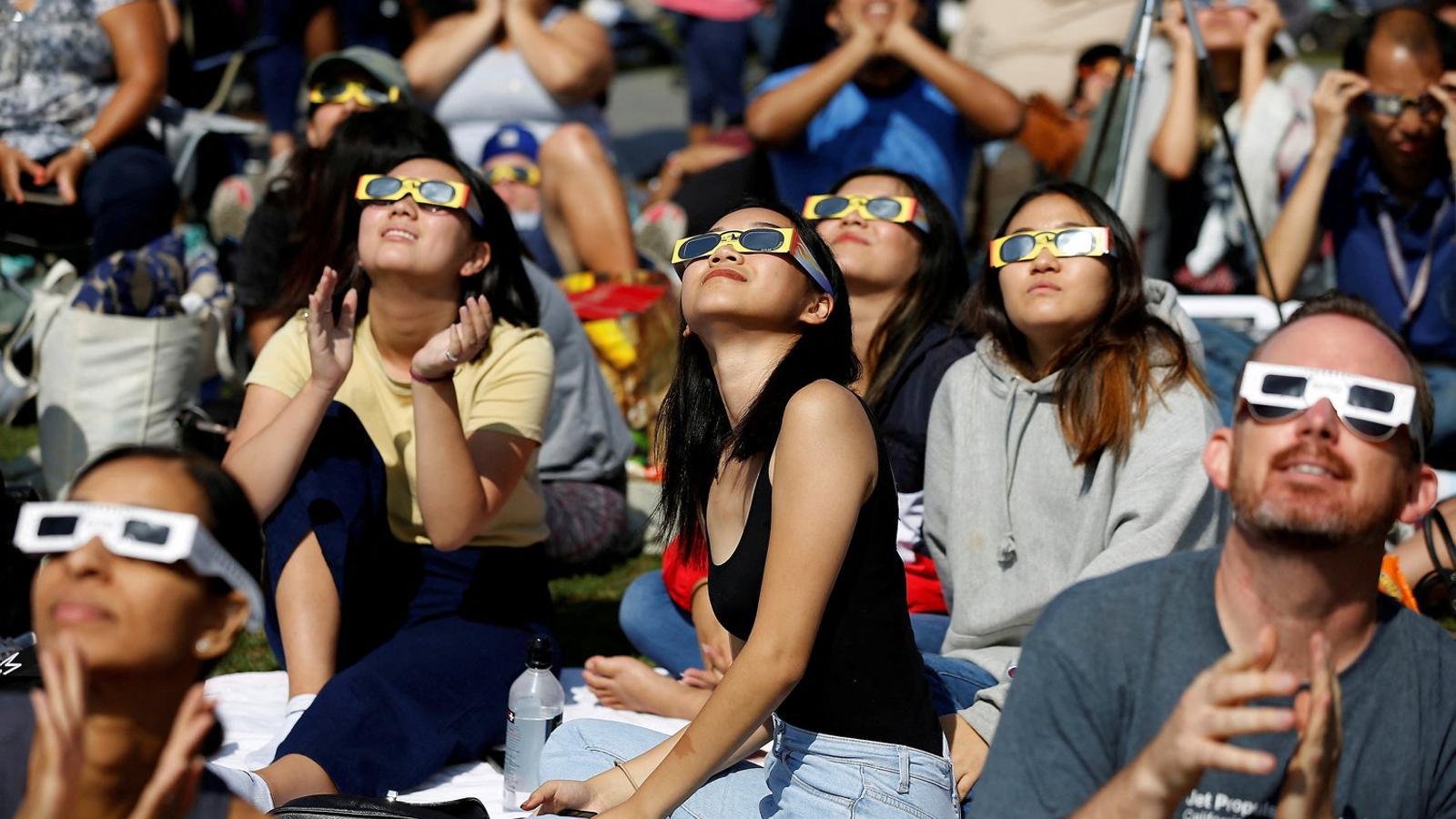
As long as the Moon is not completely covering the Sun, it is very dangerous to observe the phenomenon with the naked eye because the radiation will continue to reach us. This means that during the first and last phase we must wear approved glasses if we want to look directly at the Sun. From Barcelona and from Girona, the eclipse will not be total, meaning that from these two regions you must always wear glasses.
On the other hand, from the regions of Tarragona and from the south of Lleida, there will be a moment when the Sun will be completely hidden. It is during this time interval that we will be able to observe this spectacular phenomenon without glasses. "During the totality phase, and only in those moments, we must observe the eclipse with the naked eye, as the use of protective glasses would prevent us from seeing the solar corona or the stars and planets. As soon as we see the first light of the sun reappearing behind the Moon, we must use the glasses again", according to the recommendations of the Generalitat.
The doctor in astrophysics and professor ad honorem at URV, Manel Sanromà, explains why he will take off his glasses a second beforehand: "I will be controlling the time and just when there is one second left for the total eclipse, I will take off my glasses to see the diamond ring, which only lasts one second, and I will put them back on one second after it has finished, to see it again". The diamond ring is a spectacular optical effect that occurs when the last or first ray of sunlight escapes through the irregular valleys on the Moon's surface and forms an intense point of light that shines over the faint circle of the solar corona.
Despite this, the COOC is more cautious and warns that "during the moments of maximum occultation or darkening, there may still be sufficient solar radiation to cause eye damage". Given this division of opinions, it is interesting to remember that children are more sensitive than adults to these radiations.
Approved glasses
There are different ways to protect your eyes during an eclipse. The simplest is with solar filter glasses, which must be certified according to the ISO 12312-2 standard. This standard guarantees that the filter blocks 99.9% of visible radiation, 100% of ultraviolet (UV) radiation, and at least 97% of infrared (IR) radiation, and also requires that filters do not have defects, scratches, or irregularities that could distort the image of the Sun, according to the Catalan Agency for Consumption. Different public administrations are distributing them for free, such as the Diputació or the Tarragona City Council, but they can also be purchased in opticians and specialized establishments.
It should be remembered that you cannot look at the Sun through optical instruments such as binoculars, telescopes, or camera lenses, even if you are wearing eclipse glasses. These instruments must have a specific solar filter installed in front of the lens.
