A block of flats made of wood in the neighbourhood that will transform Girona
The 6x6 block of the Bosch Capdeferro studio, inaugurated in 2022 between Can Gibert del Pla and Santa Eugènia, has become a benchmark of sustainable architecture due to its natural ventilation system, aerothermal energy, and the use of organic materials.

-
CAT -
CAST
GironaIn Girona, near the border between the neighborhoods of Can Gibert del Pla and Santa Eugènia, a very unique apartment block stands out, surrounded by a tree-lined park. It is a building made entirely of wood, with checkered and symmetrical shapes, featuring two forty-meter facades and open galleries on each of its six floors. The block, inaugurated in 2022, is called 6x6 and is the work of the Girona-based studio Bosch Capdeferro, which has received numerous awards for the project's sustainability and energy efficiency values.
It consists of 35 identical homes, each 70 m², organized around a rectangular and elongated space, without a hallway, with sliding doors that allow for the interchange of uses in each room. All have openings on both sides and natural light enters all points of the apartment. This channel structure powers a cross-ventilation system, which in summer captures the cooler air from the north facade and distributes it to the south one. Then, in winter, on the sunnier south balcony, the glass and steel create a warm air chamber that helps heat the home. All this is reinforced by an electric air conditioning system using aerothermal energy: an efficient technology that extracts energy from the outside air to generate heating, cooling, and domestic hot water.
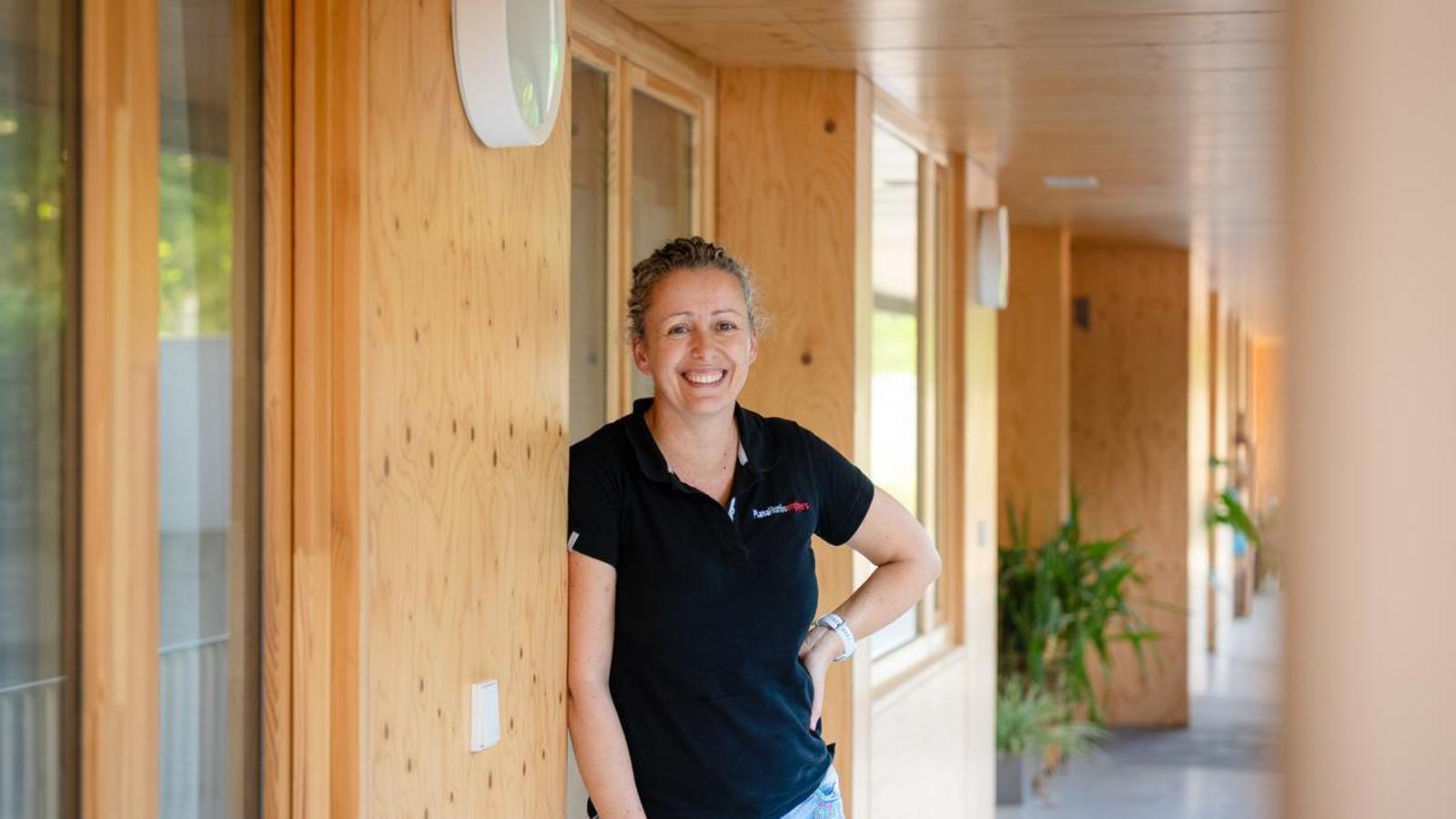
One of the residents of the block is Gemma Estruch, an engineer, who has owned one of the ground-floor apartments for four years. She is delighted with it: "The concept of it being all open works very well for me. And the wood of the walls, inside and out, gives a very warm sensation, a lot of light enters, and, moreover, you can't hear absolutely anything, it insulates extremely well," she explains.

"You spend half as much as in a normal apartment"
Estruch is very satisfied with the energy efficiency. Although each home behaves differently depending on the height and sunlight, she assures that it has a direct impact on the bill. "Now, in the summer, cross-ventilation helps, although, logically, it doesn't work miracles with the temperatures we have and we have to use air conditioning. Then, in winter, the glass balcony heats up the apartments a lot and there are families that hardly turn on the heating. You spend half as much as in a normal apartment," she assures. To generate the natural airflow, each apartment has different ventilation grilles, so you don't need to open the windows to ventilate or remove bad odors.
There is also a very good atmosphere in the building among the neighbors, especially with those who arrived as soon as the development came on the market: "There is a lot of community. At first, everyone would grab their beer and we would meet in the gallery, like in the villages before, or the other day, for example, we got together to celebrate Sant Joan," Estruch continues.
The neighbor arrived at the building without fully knowing the work and the ethical principles of the studio of architects Ramon Bosch and Bet Capdeferro. Once she had the keys, however, as an engineer, she became interested in how aerothermal energy worked and came into contact with the project's ideologues: "At first, since it was all new, we had to solve some problems with the installation of the cold batteries. I met Bet and Ramon and I informed myself a lot. As a result, I prepared a dossier to help new neighbors adjust the basic parameters of the system according to their needs," concludes Gemma Estruch.
Concrete generates CO₂ and wood stores it
The 6x6 condenses all the philosophy and work of architects Bosch and Capdeferro, always concerned with achieving a harmonious triad between architecture, people, and the environment. "This building has allowed us to culminate and put our convictions into practice. It's not about trying to go against the climate, but about working with it. Architecture should be a second skin, a second suit, and as such, it must adapt to the changing needs of summer and winter," argues Ramon Bosch.
Furthermore, the two members of the Girona-based studio not only seek to minimize the environmental impact of homes once life begins in them, but also from the embryonic moment of their construction. "The construction sector is responsible for approximately 40% of the planet's greenhouse gas emissions. Therefore, as architects, we have the responsibility to respond to this from the very beginning of the process," argues Bosch. And here, the choice of wood is fundamental: "Building one cubic meter with concrete generates approximately one ton of CO₂ emissions, while one cubic meter of wood stores one ton of CO₂ captured by the tree during its growth, transformed into cellulose. The difference is enormous," assures the architect.
However, out of ignorance, building the walls and structures of an apartment block with wood might seem unstable or not very resistant. But nothing could be further from the truth: "We are accustomed to trusting buildings made of brick without any brick having undergone a test. In contrast, each cross-laminated timber panel has been tested and certified. It is a very reliable technology. We have the stigma of the Three Little Pigs, but this wood is very resistant. And furthermore, it retains that almost atavistic quality of living matter, which brings a lot of well-being," argues Bet Capdeferro. And this, ultimately, according to the architects, is the most important thing: "Beyond kilowatt-hour calculations, we want to create memorable, comfortable, and transcendent spaces for people, without ever losing contact with the environment," concludes Capdeferro.
A new public housing development
The 6x6 is the result of a private development driven by a construction company that took a risky bet on this architectural model after the economic crisis. Of the 35 homes, four are officially protected. And the result has been so satisfactory that the public administration has wanted to continue it. A few meters away, the Girona City Council has promoted a new development of 50 publicly protected homes for young people, which will soon be completed. The architectural project has been developed by the Bosch Capdeferro studio, with a very similar typology and the same axes of sustainability and efficiency. All this in a neighborhood in the southwest of the city that in the coming years will undergo a major transformation based on all the urban development planned around the future new Josep Trueta Health Campus.
