Ceuta has begun to bury the first 18 victims who died trying to enter Ceuta. The dream of a better life was cut short for at least 141 immigrants. There are still about eighty unidentified bodies in the makeshift morgue at the military hospital, which had to be opened because the cold storage rooms were overflowing. Given Morocco's refusal to accept these unidentified bodies, the decision has been made to bury them following Muslim rites, that is, burying them directly in the ground. A group of people wanted to bid farewell to the deceased with a collective prayer, also seeking spiritual comfort in the face of so much suffering.
The fear of being deported makes immigrants return to the beach: "We don't want to go back to Morocco"
This morning there has been a second eviction, while the 1,800 places opened for reception are insufficient
21/08/2026 - 20:10 h
-
CAT -
CAST
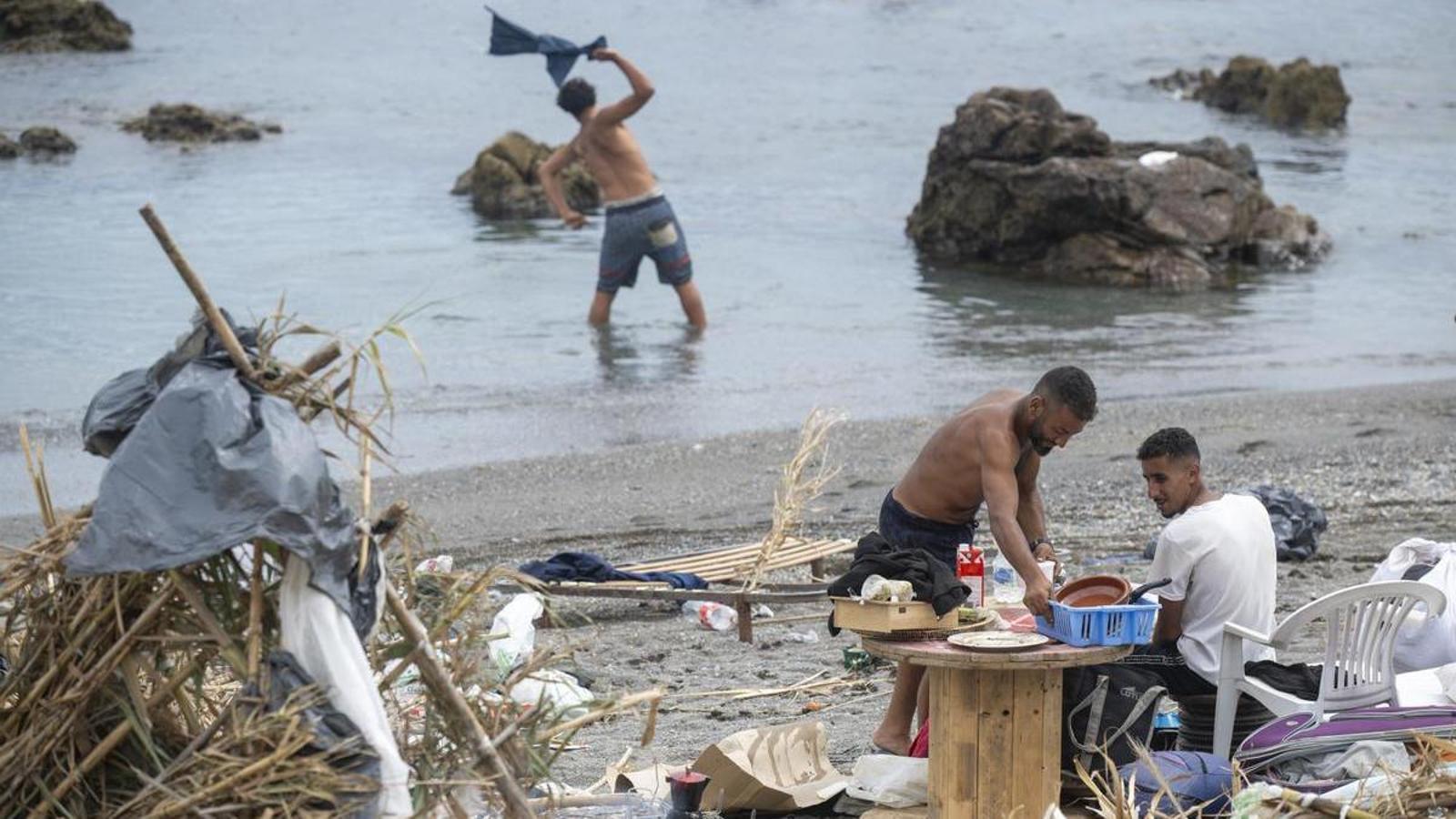
Barcelona / MadridThe intention of the public administrations to clear El Trampolín beach in Ceuta clashes with the fear of many immigrants of being forcibly deported to Morocco. Twice (Thursday morning and Friday morning) they have been evicted to be transferred to temporary reception centers, and on both occasions they have returned to occupy the sand. Added to the fear that they will be sent to the other side of the border is the evidence that the 1,800 places opened by the Spanish government in two locations are entirely insufficient to attend to all immigrants, the number of whom remains an unknown. Faced with this situation, many of those who were evicted from the beach camp on Thursday have returned this Friday as they have nowhere to take refuge.
If on Thursday afternoon the return of 500 people to the beach forced the cleaning tasks to be stopped to remove the waste left by up to 3,000 people who were camped, this Friday a second group has returned. On this occasion, however, the police presence has helped the brigade workers to finish recovering the space, full of plastics and wood with which the immigrants have tried to build themselves a shelter and gain some privacy. At the moment, the beach remains occupied and, more or less, clean.

"Some, predominantly of Moroccan origin, have returned to the beach for fear of being returned to Morocco, especially those who were relocated to a space near the border," Ramsés, a social educator from the Elín organization in Ceuta, tells ARA, recounting the general uncertainty of knowing whether the spaces set up for reception will also be used for asylum procedures. For sub-Saharan Africans, the motivation for returning to the beach from which they were expelled is different: on Thursday they reached the reception points, but they did not manage to get a place to stay and, faced with the alternative of wandering the streets, they have opted to return to the beach. Ramsés recalls that there are people from different African countries: "Sudan, Yemen, Egypt..." Therefore, it is not a new consolidated settlement, but a temporary return of people who had been relocated.

Regarding the plan to transfer 500 immigrant girls to the Peninsula, the Ministry of Childhood and Youth has not provided new details, beyond pointing out that it sees it as "feasible" to begin the operation "in a few weeks," although it has not yet sent a formal proposal to the president of Ceuta, Juan José Vivas, as confirmed in an interview with RNE by the Secretary of State for Youth and Childhood, Rubén Pérez. For now, Sira Regon's department has not explained how this transfer will be carried out, nor the criteria it has followed to choose the children who will be transferred, nor to which social entities (and not the autonomous communities, as is usual in compliance with competencies) the care and custody of the girls and adolescents will be entrusted, as guardianship will be held by the government of Ceuta.
Torres, coordinator of ministries
On the other hand, three weeks after the massive influx of immigrants on July 30 and 31, the Spanish government has appointed the Minister of Territorial Policy, Ángel Víctor Torres, as coordinator of the different departments involved in managing the humanitarian crisis. Sources from the executive have explained to Efe that Torres is well acquainted with migratory issues, as during his presidency of the Canary Islands he had to deal with large arrivals of people, while also pushing for the modification of the law that allows for the relocation of unaccompanied migrant minors when a self-governing community's reception capacity exceeds by 300% what is provided for by law.
This Friday, CGPJ member José Antonio Montero met with the president of the autonomous city, Juan Jesús Vivas, to whom he conveyed the willingness of the president of the General Council of the Judiciary, Isabel Perelló, to meet with him "as soon as possible" in light of the migratory crisis, in response to a request made by the Ceuta leader by letter. According to the judiciary's governing body, the offices of the presidencies of both institutions are in contact to coordinate their schedules and facilitate the meeting, whether in the African city or in Madrid.

The first 18 bodies recovered from the sea are buried

