Ink with microchips: the new nightmare for counterfeiters
Catalan researchers develop microscopic silicon chips that can be incorporated into inks to authenticate documents, works of art, and high-value products

-
CAT -
CAST
Mr. X is a renowned designer who has recently achieved considerable success with t-shirts featuring witty and poignant phrases about current social issues. So much success that on the black market they are valued well above their price and counterfeits have already begun to appear. This worries him, but he has found a solution: in the pigment of the short text on the t-shirts, he has left chips that are invisible to the naked eye, but which, when viewed under a microscope, carry an unmistakable pattern. Imitating and placing these chips is beyond the reach of potential counterfeiters.
The story is fictional, but in time it could very well resemble reality. José Antonio Plaza, Juan Pablo Agusil, and Marta Duch, researchers at the Barcelona Institute of Microelectronics (IMB-CNM-CSIC), have designed an authentication system based on customizable chips that can be integrated into almost any type of ink. It should be clarified that these are not, as immediately comes to mind, chips with integrated circuits where electronic components have been mounted, but rather pieces of silicon that carry nothing more than the requested inscription or drawing.
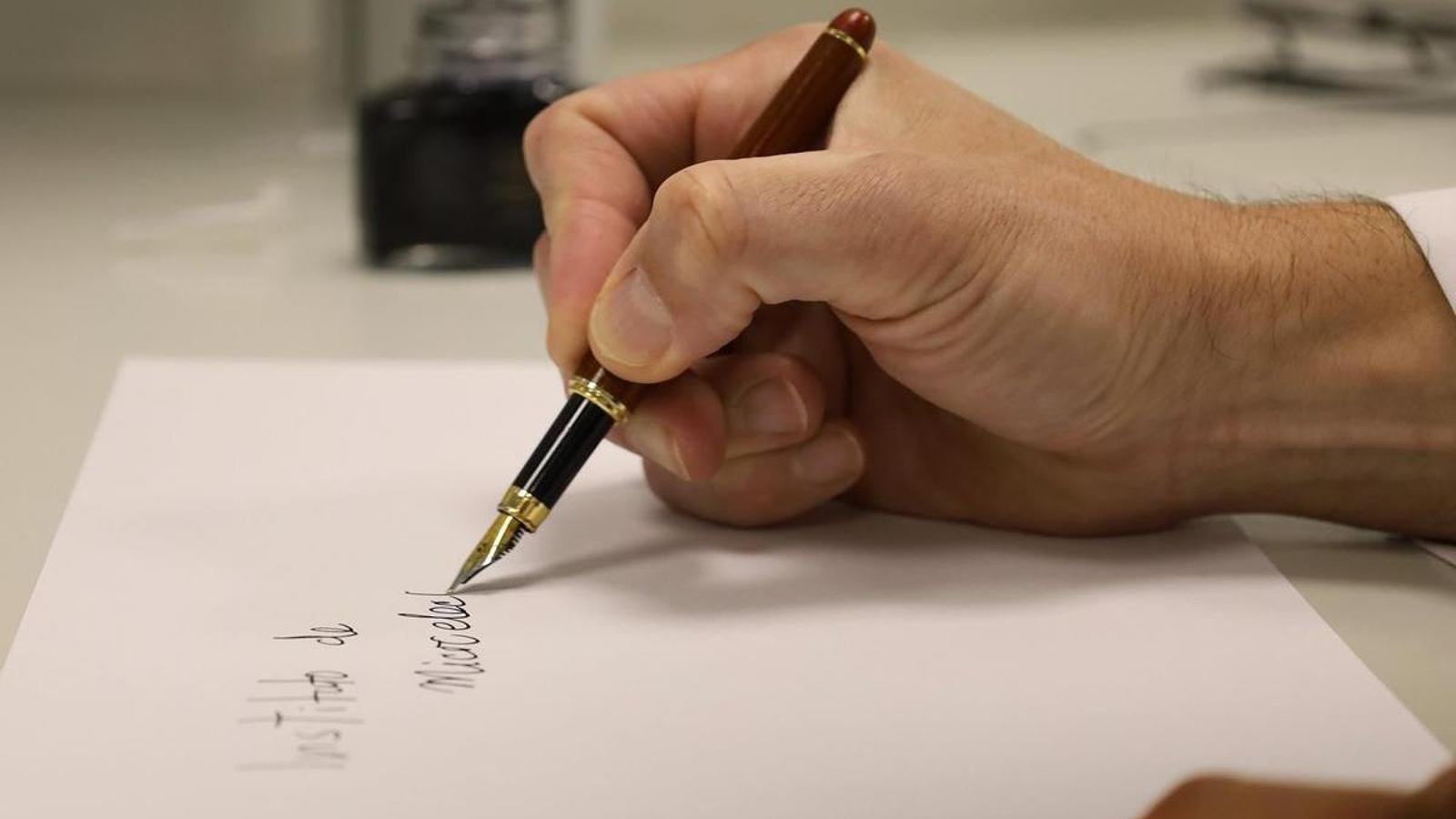
They are very small chips, about ten times thinner than a human hair. They have a size of about 20 microns –millionths of a meter– and a thickness that is measured in nanometers –thousandths of a micron–. That is why a good quantity of them can be introduced into any type of ink. And if we write a text or make a drawing with this ink, whether with a ballpoint pen, a fountain pen, or even a brush or a printer, the microchips will remain adhered to the fibers of the paper or clothing and scattered throughout the image.
Therefore, whether it is a t-shirt designed and manufactured by Mr. X, an official document, or another high-value product, it will carry an inimitable and non-transferable signal that will validate it.
The authors' motivation for the work is to provide a tool against the counterfeiting of works, products, or documents, a practice that is growing and being carried out with increasingly sophisticated techniques.
A barrier for counterfeiters
Marks based on optical effects or chemical markers can be imitated with advanced imaging and printing tools. And if the tools of counterfeiters advance, so too must the tools of those fighting these crimes, and if possible, even faster. In this case, the researchers came up with the idea of designing and manufacturing chips that could be dispersed and integrated into inks, from the most common ones to highly specialized security formulations.
The project, however, goes beyond microchips that carry a specific image or text, because they can also store unique, optically readable information. This, they explain, allows for secure authentication and traceability regarding an item that is non-reproducible using traditional methods.
They give an example. When we perform a banking transaction, we receive confirmation requests through various channels, such as a mobile phone or email. A banking document –or a notarial one, or any other type– can incorporate a chip that carries a tiny QR code. Viewed under a microscope and scanned with a mobile phone, it allows, like any QR code, to offer diverse information about the person who signed the document. Among other things, it can notify a mobile phone where to confirm the identity. This will result in high security, because even if someone were to think of photocopying or scanning the document, there are no machines with enough resolution that could also reproduce the image contained in a chip that is just a few microns wide. Therefore, imitation is practically impossible.
Furthermore, the chips used in this research were developed in the micro and nanofabrication clean room at the IMB-CNM. This infrastructure must maintain strictly controlled parameters: air particles, temperature, humidity, airflow, internal air pressure, lighting... For this reason, as the research authors explain to ARA, although the cost of manufacturing the chips is not very high, the need to obtain them in clean rooms represents a very significant barrier for counterfeiters: they would either have to assume an investment in infrastructure likely far exceeding the potential profit from the forgery, or they would have to resort to specialized facilities, where the traceability of the manufacturing processes would greatly hinder any illicit activity.
The field of application for this innovation will be very broad. A high-value object, for example a painting, could carry an inscription with this ink somewhere on it. Very high-priced and exclusive products—handbags, garments—can carry this mark. It is true that people cannot take out a microscope when they see these objects for sale, but it can be a very important tool for pursuing fraud.
For the moment, the researchers have conducted resistance and flexibility tests to verify that it is feasible to introduce them into the ink without them being altered. They have also applied for a patent. The project is moving forward, and it may be that in a few months these inks will write an important page in the history of the fight against fraud.
