Why are Spanish judges almost never sanctioned?
The disciplinary file on Judge Peinado evidences the historical difficulties in punishing the irregularities of the judiciary
-
CAT -
CAST
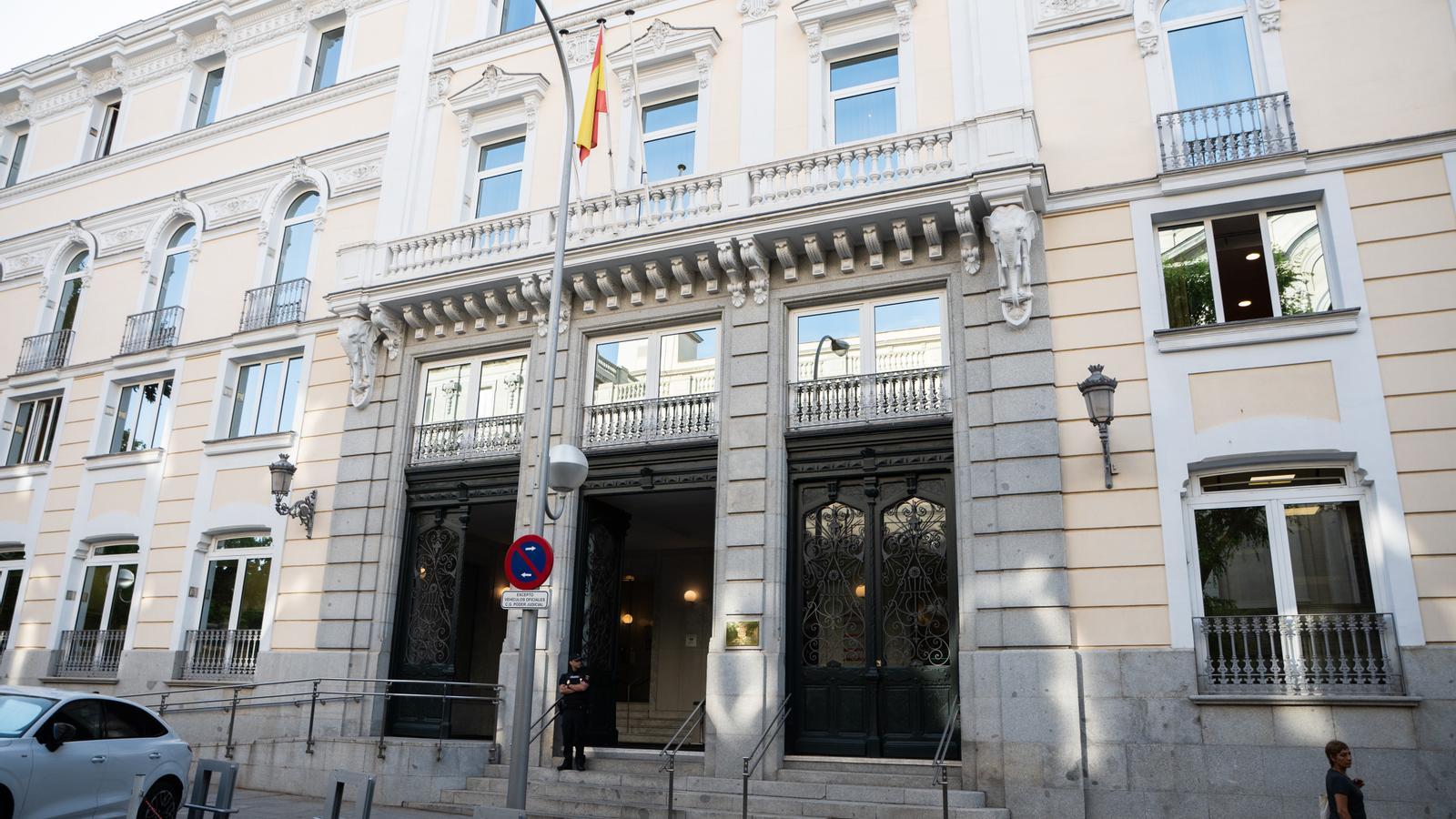
BarcelonaThe General Council of the Judiciary (CGPJ) has opened the way to open proceedings against judge Juan Carlos Peinado, arguing that the bodyguards of the president's wife, Begoña Gómez, could help her flee. Despite the media noise, history shows that sanctioning a magistrate is almost a pipe dream. Recent examples support this: in 2024, the CGPJ ended up filing the proceedings against a judge who called the Spanish Prime Minister Pedro Sánchez a "psychopath", and in February 2026, the conservative majority turned a blind eye to magistrates Eloy Velasco and Manuel Ruiz de Lara, who called the president's wife "Barbigoña", invoking freedom of expression.
who called the Spanish Prime Minister Pedro Sánchez a "psychopath", and in February 2026 the conservative majority turned a blind eye to magistrates Eloy Velasco and Manuel Ruiz de Lara, who called the president's wife "Barbigoña", invoking freedom of expression.
What future does Peinado's case hold? Consulted by ARA, both Fermín Morales and Rafael Rebollo, professors of criminal law at the Autonomous University of Barcelona, believe the consequences will be practically nil, mainly because the magistrate is retiring this September. "The possibility of this progressing is debatable and the impact it will have on him will be absolutely nil," states Rebollo. Morales agrees and predicts that "he will reach retirement without the process being resolved," although he emphasizes that the opening of proceedings – initiated for stating in an order that the police "would surely" facilitate Gómez's escape – already indicates that some members have seen "notorious relevance" in it.
Untouchables in robes?
Opening a case against a judge is an unusual practice in Spain. According to Rebollo, for a complaint to overcome the disciplinary commission of the CGPJ is "something absolutely exceptional," as these "almost always end up being archived." Rebollo asserts that "surely no complaint would be found in the last ten years that has succeeded against a magistrate reporting facts like this or similar." The technical difficulty in cornering them is immense. As Josep Lluís Martí, professor of philosophy of law at Pompeu Fabra University, points out in conversation with ARA, "as long as the ruling has provided a few arguments," the judge manages to "cover himself formally regarding any disciplinary proceeding," effectively shielding the content of his investigation.
This extreme complexity in demanding accountability paints a historical picture in which, according to Martí, "there has been excessive flexibility or tolerance regarding the actions of judges." In Spain, there are more than 5,000 active judges who, like any other professional group, "can commit abuses or do things that are irregular." Despite this, the Spanish disciplinary system suffers from a chronic structural deficit: "We have not had good practice in disciplining judges, neither through the CGPJ nor through the justice system itself," a lack of oversight that, according to the UPF expert, must be urgently reformed from the root.
This shielding is the ideal breeding ground for the expansion of the lawfare, where the border between the judiciary and political offensive becomes blurred. Martí argues that "the aroma that emanates from this is that we have judges who lean towards the lawfare", and states that Peinado's offensive against Moncloa's circle evidences "a political motivation from the judge himself that goes beyond what a state of law should allow". The expert, however, underlines the importance of technically separating the wheat from the chaff: while the investigations by the National Court in the Zapatero case or of the Supreme Court in the Ábalos case are based on "more professional interlocutory proceedings, with arguments", the cases opened against Begoña Gómez or the Attorney General of the State respond purely to “a political instrumentalization of justice”.
The culmination of this architecture is an internal control system profoundly marked by its own partisan nature. As Rebollo recalls, the disciplinary commission has members with a conservative profile who "inexorably vote, time and time again, against the complaints that are filed". Martí's analysis concludes with a statement that summarizes the distrust towards the institution: "No one unfortunately expects the decision made there to be absolutely pure of law, based on law, and to have no political connotations".
