Who loves the Spanish flag the most?
Sánchez recovers the symbol in the rallies so that the right does not appropriate it
-
CAT -
CAST
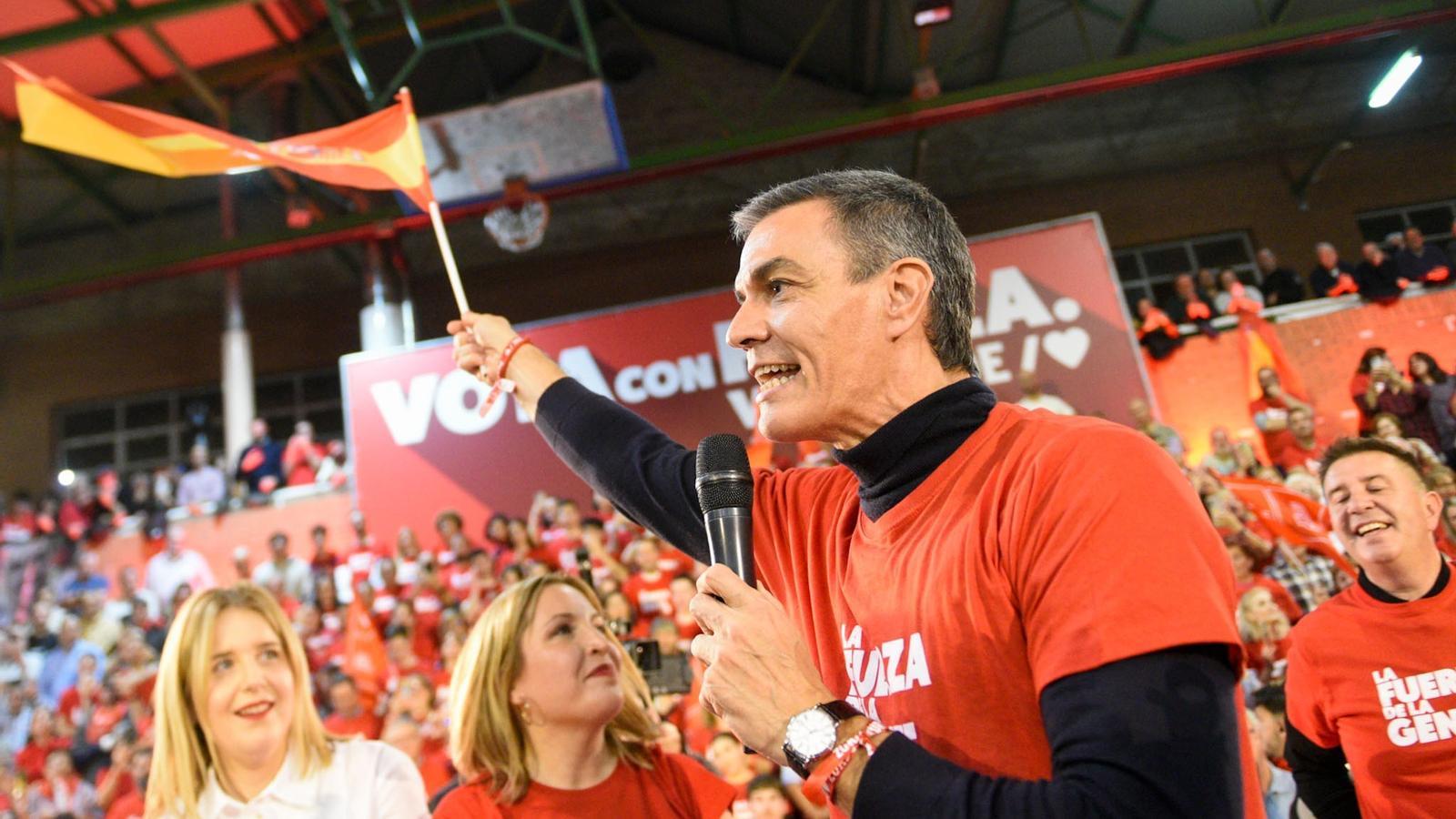
MadridPedro Sánchez plants himself on the stage, with the music blasting, and grabs the microphone and a Spanish flag: “There are those who believe it is theirs. But it is also ours. With this flag, we have conquered rights, freedoms, and democracy in this country. We are very proud of Spain and of being Spanish,” he recites. This is the episode that took place this Tuesday in Albacete, where the PSOE managed to pack the venue with about 6,000 people, a good portion of whom remained outside the grounds, and which now forms part of the ritual of all of Pedro Sánchez’s rallies in this campaign. The Spanish flag has now been added to the LGTBIQ+ flag or the ‘Strength of the people’ t-shirt, which he now displays with the signature of the Brazilian president, Lula da Silva, who has supported him in this campaign.
What is Pedro Sánchez seeking with this strategy? Two things. To reach electorates that traditionally position themselves more toward the center or that could even go so far as to vote for the PP in some elections, that is to say, the swing electorate that may still remain in a context of polarization. And also to resignify the Spanish flag, which historically the left has found difficult to make its own. The right has seized it despite the attempts at the beginning of the transition by Santiago Carrillo. In fact, even now Ada Colau, of Frente Amplio, uses the republican tricolor at rallies.
Be that as it may, this is not the first time that Pedro Sánchez has used this strategy. Beyond the fact that in 2015 he presented himself as a candidate for the presidency with a giant Spanish flag in the background, throughout this legislative term he has already attempted to reconceptualize it. It was when he stood up to Donald Trump with the 'no to war' following the attack on Iran: he used the flag at a party event as a symbol of national sovereignty so as not to bow to the demands of the United States.
The strategy was summarized by the Valencian journalist Paco Cerdá in an opinion piece titled “Rejecting Donald Trump has turned me into a patriot” which the New York Times put on its front page. It perfectly described what Sánchez was seeking: that a person who had never felt identified with the symbology of the flag or the Spanish national team, would have a pride of belonging to Spain awakened in them following Sánchez's clash with Trump. It is the perception that the PSOE wants to replicate now when, at rallies, it says that with the Spanish flag, “rights have been conquered”. In their view, like those that are being “shielded” in the extraordinary council of ministers before the elections: the “increase” in pensions, in the minimum wage...
The vision of the right
While seeing a left-wing leader waving the Spanish flag is news, the right doing so is part of normality. Therojigualda is part of the usual landscape of PP events and, even more so, of the staging that Vox performs. In the case of Santiago Abascal's party, their rallies become a sea of Spanish flags. Unlike Sánchez's, those in the audience do not have the constitutional coat of arms. The far-right party's organization places one, made of plastic, on every chair. This was the case at the campaign kickoff at the Plaza Colón in Madrid. In this space, furthermore, the image, deliberately symbolic, was completed by the 294-square-meter flag that is permanently located in this spot in the center of the Spanish capital.
Vox also distributes wristbands with the Spanish flag at information points with its campaign slogan, “Common sense”, and in an attempt to project an institutional image, it also places a Spanish flag, in this case with the coat of arms, in a corner of the shot of the speeches made from the lecterns. In Vox's campaign spot, Abascal also appears sitting at a desk with a Spanish flag behind him, and the framing of the official images distributed by the party also often incorporates this element. It is not the only symbol of the State that Vox makes its own. At the end of the events, they play the anthem of Spain.
As for the PP, the presence of the Spanish flag is not as overwhelming, but it is also waved at events and is part of the popular brand. In the design of the 29-N campaign lecterns, next to the slogan “The necessary change”, there is a Spanish flag. It is a detail that occupies a small part of the space, as it also does on the electoral poster, and which, depending on the territory being visited, may be shared with other flags. This Tuesday, the Basque flag was added at the Eibar event, and at events in Galicia or Catalonia, one can see flags with the colors of the Galician flag or a 'senyera' being waved.
The defense and even appropriation of the Spanish flag by the right is also perceived in the reaction to the gesture of the socialist leader. “Wave it in Ceuta if you have guts”, tweeted the official PP account. Furthermore, the Spanish flag has prominence in the electoral programs of both parties. The PP has included a point in which it proposes a legal reform “that rehabilitates and protects the symbols of the State” and, for its part, Vox proposes increasing the penalties for “offenses and outrages” to “the flag, the coat of arms, the anthem, and the crown”.
