Up to 549,596 applications for regularization in the first month and a half
The Supreme Court stops Ayuso and Vox and rejects paralyzing the process

-
CAT -
CAST
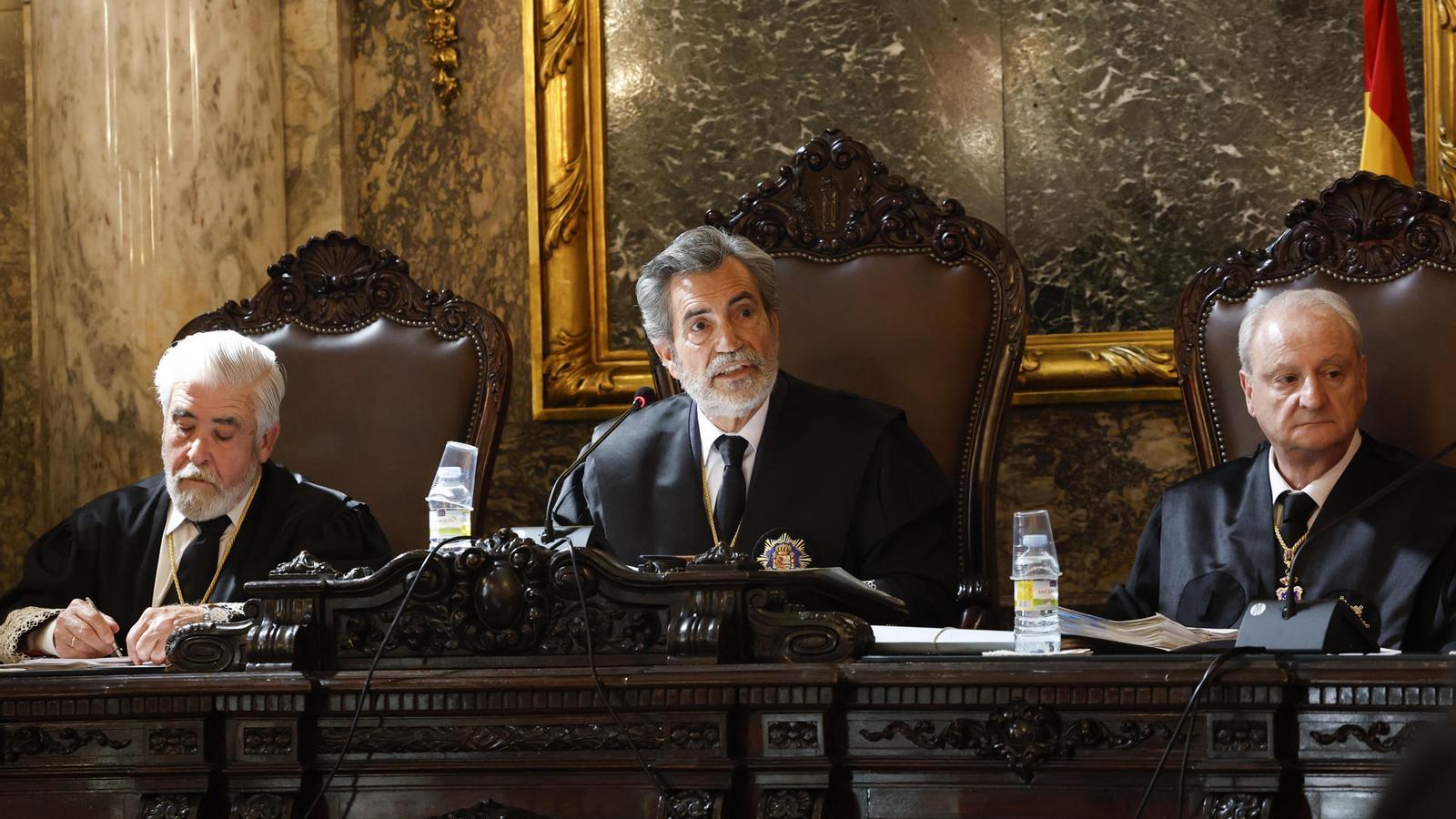
MadridThe Supreme Court has put a stop to the government of Isabel Díaz Ayuso and Vox, and has rejected temporarily paralyzing the extraordinary regularization of immigrantswhich began a month and a half ago. The Contentious-Administrative Chamber decided this after five hearings held this morning, which served for the Madrid executive, the far-right party, and three ultra associations to launch attacks against the regularization process promoted by the Spanish government after an agreement with Podemos. In one of them, the State Attorney announced that as of May 21st, 549,596 applications had been submitted and 91,905 had begun to be processed. Those who passed the first filter received a provisional authorization to work. In many cases, these were people who had jobs: they were working illegally and now do so legally, or they have found work elsewhere. "We are not talking about entry, but about a radically different issue. We are talking about a group of people who were in Spain, who can prove five months of residence, and who had deficits in accessing rights," argued the State Attorney. He also highlighted that the regularization serves to "respond to labor market challenges" and seeks to offer "effective and rapid integration" to people who have "roots" and an "inseparable bond of coexistence" in Spain.
Far from these arguments, the lawyer for Isabel Díaz Ayuso's executive urged the court to "empathize" with the public managers who will have to face the consequences of the regularization and warned of what he considers to be the dangers it entails: "These are people who will be claiming benefits, which must be scaled up abruptly. Immediately, the collapse that this will mean for social services can be intuited and presumed," he stated. Likewise, he acknowledged that the population "must be attended to" to avoid "social conflict".
For their part, Jorge Buxadé, a Vox lawyer, boasted that Santiago Abascal's party "has made the fight against illegal immigration an essential element" of its political approach and assured that regularization will cause a "brutal increase in social spending," affect "the electoral structure," and "modify" Congress and the Senate. However, the State lawyer – on behalf of the Spanish government – has discredited his argument. "No matter how much one wants to rush, in no case will these people be able to vote in the next elections, it's as simple as that," he justified. The reality is that the Civil Code sets the period for obtaining Spanish nationality at ten years of legal residence, which is what allows voting in Spanish elections and which is not obtained through regularization. Only in exceptional cases, such as people marrying Spaniards or citizens of Latin American countries, can the waiting period be shorter, but there will also not be enough time before 2027. Some foreigners can vote in municipal elections, but in 2023 only 12,000 immigrants applied for it.
Patricia Fernández, a lawyer for the Association Pro Human Rights of Spain and the Neighborhood Coordinators, argued that suspending regularization would have a "direct impact" on the 147,000 children who could benefit from it. And Javier Moreno, a lawyer for the Jesuit Migrant Service, argued that it would cause "great harm" to the Spanish economy, especially in the construction, agriculture, and care sectors, where a large part of this labor force is employed. For their part, Javier María Pérez-Roldán, a lawyer for Hazte Oír, demanded that regularization be stopped to prevent "consolidated rights" that are irreversible from occurring. And he gave the example of return or expulsion files: "The archiving or revocation will be final because they cannot be reopened," he argued. The Supreme Court, however, has blocked the ultracatholic entity and has dismissed its appeal due to lack of standing.
Criminal records
The State Attorney's Office has also had to address statements regarding criminal record antecedents. "Talking about the possibility of regularization with a lack of criminal record antecedents is simply not reading what the decree finally is," he stated. In the first draft, in the absence of an official document proving that one has no criminal record antecedents, a responsible declaration could be submitted. In fact, Junts and the PP wanted to ally in Congress to reverse it, but the Congress's Board prevented it. Finally, after the opinion of the Council of State, the Spanish government qualified it to make it mandatory. "Thousands of people are making an extraordinary effort requesting criminal record antecedents from their countries of origin. This, without a doubt, demonstrates the strict filter that exists," emphasized Javier Moreno.
