Adania Shibli: "Being born Palestinian already entails that you are punished in every possible way"
Writer. Publishes the novel 'Deception'
-
CAT -
CAST
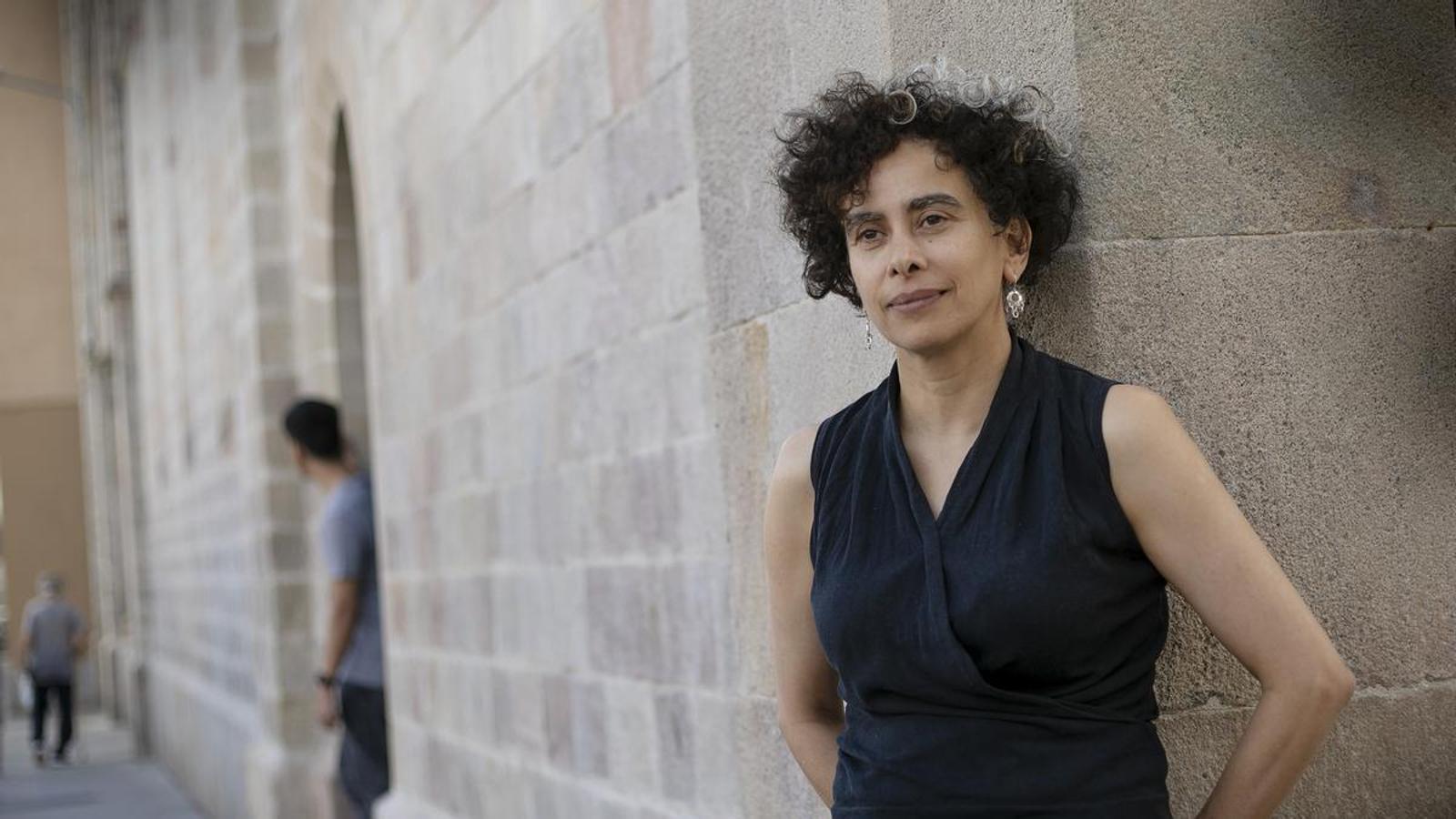
BarcelonaAdania Shibli (Arab al-Shibli, Palestine, 1974) asks that her books not be read from a political angle but rather a literary one, yet it is practically impossible to decouple the stories she recounts from the current situation in Palestine. With her previous novel, Minor Detail (Navona, 2024), Shibli was a finalist for the National Book Award and the International Booker Prize. She also experienced the controversy firsthand, when the Frankfurt Book Fair cancelled her. Her new book, Deception (La Magrana / Random House, translated from Arabic to Catalan by Mohammad Bittari) travels to the Palestine of the 90s through the hands of two nameless young people. Each of them carries out a clandestine action: the boy is caught and locked in prison, the girl is never caught. Based on these events, Shibli traces their existences and constructs a poignant story that reflects on the search for an individual future in a situation of oppression and collective exclusion.
Deception arrives nine years after Minor Detail (originally published in Arabic in 2017). What relationship does one work have with the other?
— Each book is driven by a different force. Minor Detail emerged driven by linguistic and narrative concerns that, after working on it, propelled me towards Deception. I feel that writing is a continuous process, rather than a disconnection between one work and another. In Deception, the central question was: to what extent do human beings (and also nature and animals) occupy a central place or are they relegated to the background in the face of an occupation? What kind of characters emerge after being displaced to the margins?
Language is a central issue in all of his work. How do you use it in this story?
— The girl is forced to learn Hebrew at school. This was the case for all Palestinians until the early 90s. Afterwards, some were exempted. But they teach you a language so that you cannot use it. You continue to be marginalized. They make you feel inferior regarding the use of the language, and this difference is enough of a reason to marginalize you. This marginalization also happens in Europe with migrants: language is used as an excuse to exclude them. The only difference between the Palestinians and the migrants is that they are native, and that adds another layer of colonization.
You write in Arabic. Is it an ideological choice?
— No, I do it because of the intimate relationship I have with the language. I am in love with it. Writing in Arabic is, simply, my way of being in the world. It is an incredible, extraordinary language, with 1,500 years of history. When I read a poem from 1,400 years ago, I feel that I connect with someone through the same language and time compresses. In Arab culture, there is no tradition of visual arts as we find in other cultures. The strength, beauty, and contribution to humanity of Arab culture reside in the language and in the literature expressed within it.
The narrative tension builds up through humiliating and violent yet normalized situations, such as, for example, when soldiers board the bus, look for Palestinians, and make them get off. How did you work on the management of this violence, which influences the characters but leaves no physical marks?
— Israeli violence is exercised upon you even in the most insignificant act. You do not need to be a rebel or an activist. You do not need to go looking for confrontation, the violence will pursue you everywhere. These are forms of punishment with which you grow up under colonial conditions. Being born Palestinian already entails being punished in every possible way. And it is this that turns you into a revolutionary. It is a constructed and brutal violence that goes unnoticed. Humanity itself is being dismantled, you are punished for the simple fact of living. And all this becomes the normality of Palestinian life. All of this harms the characters, deforms them, leads them to lie and hide, to shrink, to be relegated to a second or third plane.
And when she tries to raise her voice and denounce the situation experienced, they tell her it is not enough.
— This moment raises the question of which pains are recognized and which are not, even on a global scale. Oppressive forces treat many groups poorly, but they treat one a little better. In this way, they create a division between groups and your pain remains marginalized, even though you are deeply wounded. Instead of thinking that no one should have to go through this, you start comparing yourself to the worst cases, feeling shame, and thinking that you should stay silent. You end up closing yourself off. We often see news about Israelis suffering abuse in some European countries. But in fact, these abuses and others similar or worse are also directed against migrants and no one pays attention to them. Are you able to see that an Israeli is not well received in a restaurant, but you do not notice what happens to refugees, who are not even allowed to enter the country? Considering that one life is worth more than another, or that one experience has more value than another, is a perversion.
In the novel, a voice often appears saying that the situation is getting worse and worse. Is there any hope for the Palestinians?
— In Palestine we do not talk about hope, we cannot even afford that possibility so as not to end up disappointed. We try to function from the determination not to give up, we try to find strength because we know that they are not only attacking our hopes, but also our strength to survive. In the novel, there is a moment of hope during the peace negotiations. But those negotiations turned hope into a manipulative force. Now, Palestinians have realized that the issue is not to be annihilated and to conserve strength. Many are disillusioned. Given the criminality and the level of monstrosity that is exercised against us, hope has been one of the victims.
