The Court of Auditors amnesties Puigdemont, Junqueras and Mas for the Government's expenditure during the Process
Declares the acquittal of all the defendants for the accounting responsibilities of 1-O and the foreign action of the Generalitat

-
CAT -
CAST
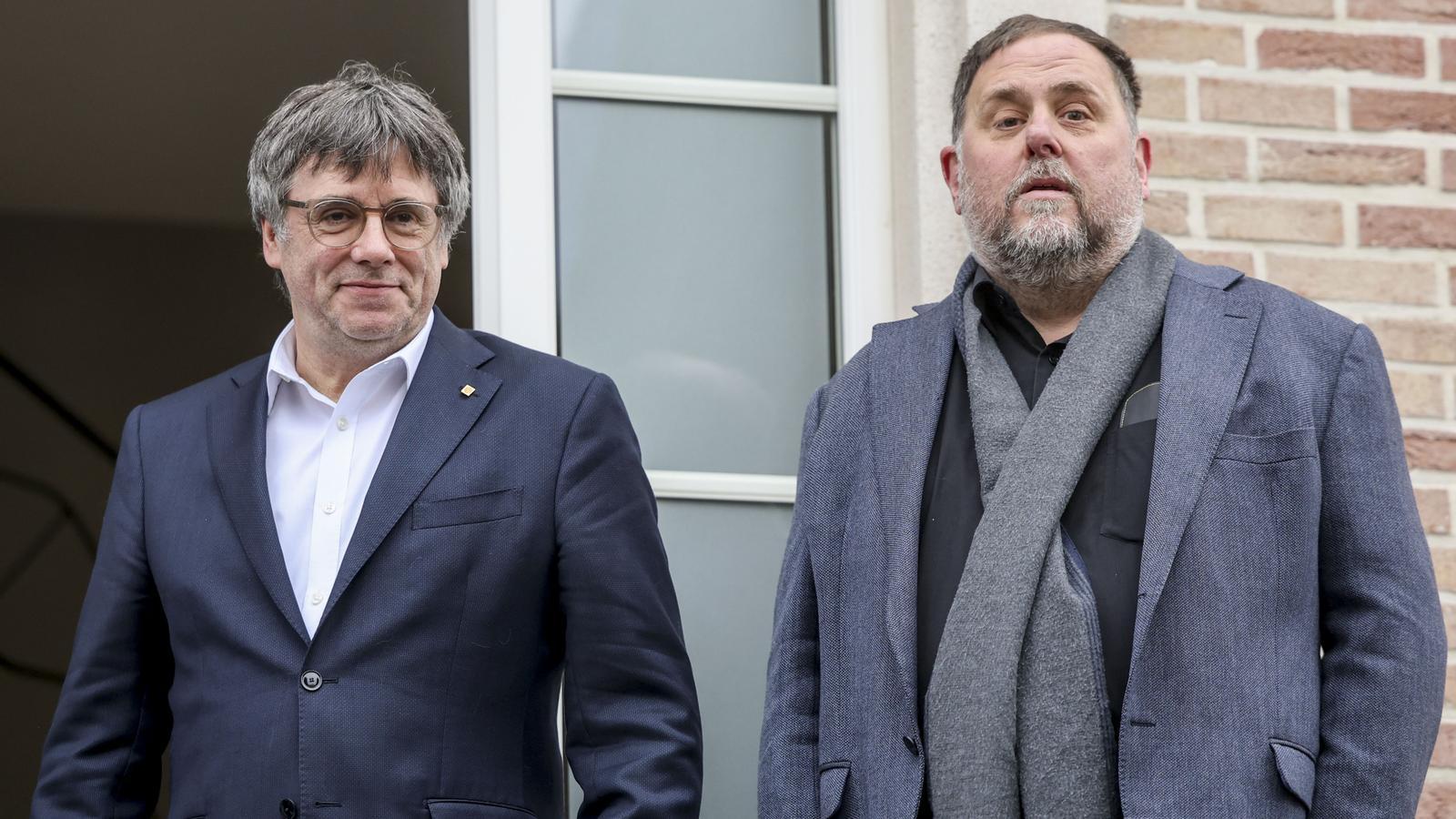
MadridFinal point. The Court of Auditors has finally applied the amnesty to all the leaders of the 'Procés', including former president Carles Puigdemont, former vice-president Oriol Junqueras and former president Artur Mas. This was ruled by the court this Wednesday in a sentence, to which ARA has had access, and in which it absolves of accounting responsibilities all the former ministers and members of the under-government of the Generalitat between 2011 and 2017 who participated in expenses related to the October 1st referendum and the external action of the Government. It does so after the resolution of the Court of Justice of the European Union –which considered that there was no impact on the financial interests of the community club in the 2017 vote– and in application of article 1.1 of the amnesty law, which rendered without effect the criminal, administrative and accounting responsibility of all acts related to 9-N and 1-O from November 2011 to November 2023.
This is a very relevant decision in political and judicial terms, since it is the first time since the amnesty law was approved more than two years ago that Puigdemont and Junqueras, the top leaders of 1-O, have been effectively amnestied. Until now, the leadership of the 'Procés' had not yet benefited from the application of the rule, since the different courts that were steering their cases had found loopholes to avoid it.
The Court of Auditors is a clear example: it had decided to raise a preliminary question to the CJEU asking if it was contrary to European law to apply the amnesty in the case of 1-O. The response of the CJEU, however, was categorical: last July it already said that it had no link, but it also defended the spirit of "reconciliation" between Spain and Catalonia of the law agreed upon for the investiture of Pedro Sánchez. Months later, the Court of Auditors has been forced to apply the law and now considers in the judicial resolution that it has not been "proven" that the expenses of 1-O and the external action of the Generalitat affected the financial interests of the EU, following the wake of European justice. The court remarks that the amnesty law made it clear that accounting responsibility clearly fell within the scope of the rule, since the legislator itself considers that it falls outside the "purpose of enrichment" that does condition the amnesty in the criminal path. It decrees, therefore, the total extinction of the case and the acquittal of the accused.
With this decision, the main case remaining to be amnestied is the main referendum case in the Criminal Chamber of the Supreme Court, which must decide in the coming days whether to definitively release Puigdemont and Junqueras from criminal liabilities; as well as the National Court in the case of the CDRs. Whoever seems to still need time is the High Court of Justice of Catalonia (TSJC): it has raised a preliminary ruling question to the CJEU regarding the cases of the republican leaders Lluís Salvadó and Josep Maria Jové.
The consequences
Among the accused and now amnestied individuals are not only Puigdemont, Junqueras and Mas, but also former ministers and numerous former officials of the under-government of the Generalitat,since under scrutiny was all the expenditure of the Generalitat's foreign action from 2011 to 2017 and of the October 1st referendum. The list of names of those affected is long and reaches 35 people: apart from Puigdemont, Junqueras and Mas, also acquitted are former ministers Jordi Turull, Dolors Bassa, Toni Comín, Francesc Homs, Neus Munté, Andreu Mas-Colell, Clara Ponsatí, Lluís Puig and Raül Romeva, as well as all the former delegates of the Generalitat abroad during the Process, such as Roger Albinyana, Amadeu Altafaj, Martí Anglada and Luca Bellizzi, and a good part of the intermediate officials who, due to the powers they held, the Court of Auditors placed in the eye of the storm: Antoni Molons, Albert Royo –who developed public diplomacy from Diplocat–, Josep Ginesta, Joaquim Nin and Aleix Villatoro, among many others.
For all of them, all precautionary measures are also rendered void, which had forced the accused to provide multi-million euro guarantees as bail for all the expenses that the Court of Auditors considered related to independence. To have clear figures of what was being discussed, Societat Civil Catalana asked the accused to pay a total of 4.9 million euros –2.8 million for the expenses of October 1st and 2.4 million euros for foreign action–, while the public prosecutor's office claimed a total of 3 million euros, 1.2 for October 1st and 2.2 for the activity of the Generalitat abroad. As a result of this, the Court of Auditors had requested bail comparable to these amounts pending the sentence.
As the resolution itself from this Wednesday states, there was already money deposited for this alleged accounting responsibility. To guarantee the responsibilities of the provisional liquidation of October 1st, a deposit of 2.1 million euros had been made from the bail paid to the Supreme Court for October 1st (largely defrayed by the Solidarity Fund) and 2 million that the Solidarity Fund paid directly with contributions from civil society to the Court of Auditors. Regarding the expenditure of foreign action, the accused opted for a different solution: guarantees from the Generalitat that were devised during the pro-independence government of ERC and Junts in 2021.
The then head of Economy, Jaume Giró, worked on a decree-law to economically protect Generalitat officials against accounting liability as long as there was no firm sentence. In this sense, through a decree-law that was subsequently endorsed by the Statutory Guarantee Council, the possibility was established to request a guarantee from the Catalan Finance Institute to deal with the multi-million euro bails and thus avoid the seizure of the assets of about thirty officials. Now, with the application of the amnesty, the Court of Auditors is also returning these guarantees to the Catalan government, while the money from the Solidarity Fund must be re-entered into the account, according to legal sources. Its managers will have to decide what to do with it.
