The number 2 of Fernández Díaz said that Puigdemont's lawyer had offered him to enter the amnesty
Boye explains that he met with him but emphatically denies that he offered him anything related to the pardon

-
CAT -
CAST
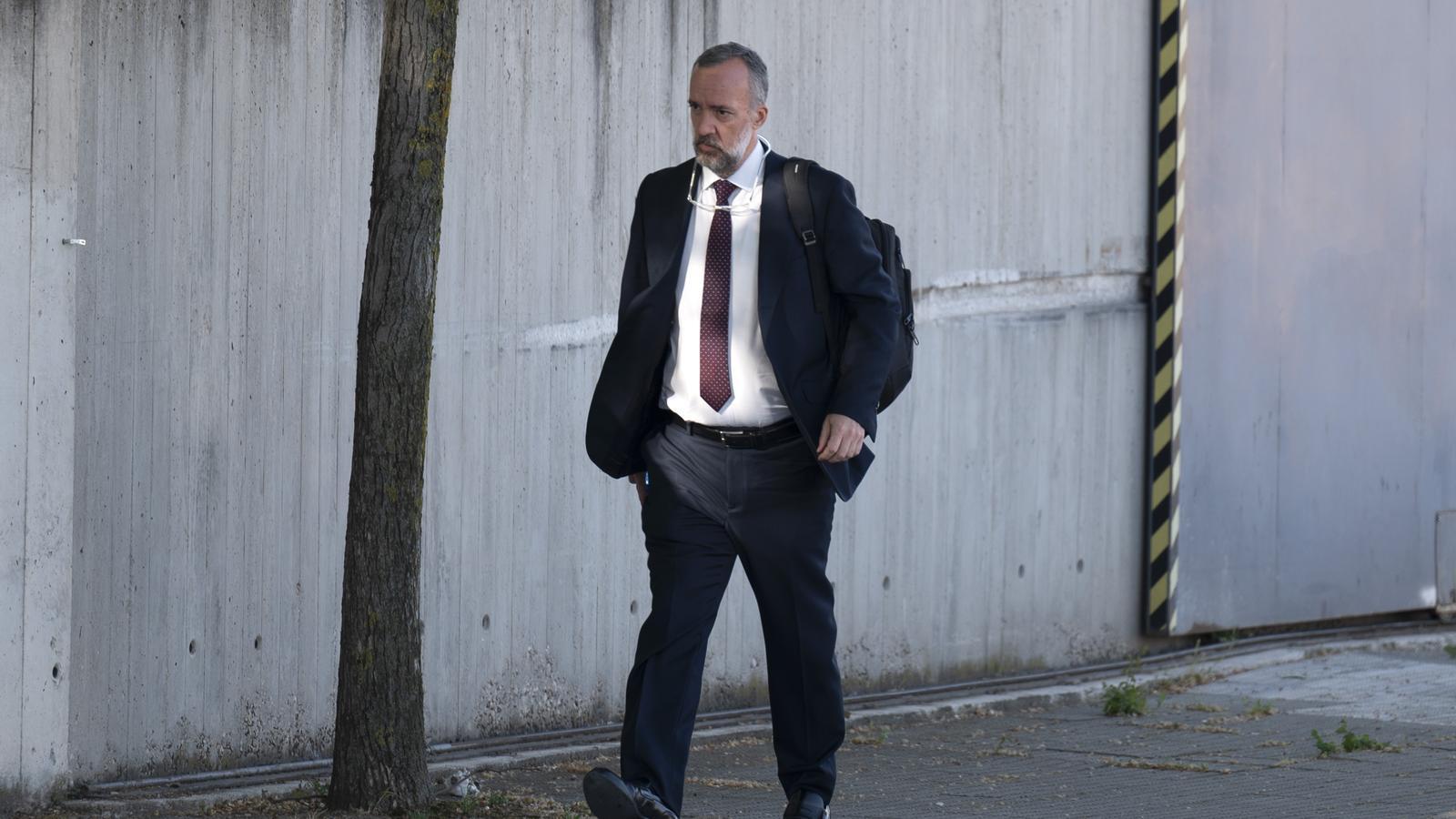
MadridThe summary of the Leire Díez case, which is being investigated in the National Court, includes the recording of two meetings held by the so-called PSOE's plumber with Francisco Martínez, who was the number two to minister Jorge Fernández Díaz as Secretary of State for Security and who is currently sitting on the defendant's bench for the Kitchen case. On July 15, 2024, he himself told Leire Díez how Gonzalo Boye – Carles Puigdemont's lawyer – and Javier Pérez Dolset – who is also under investigation – had offered him to be included in the amnesty law. As can be heard in the recording to which ARA has had access, it was the businessman who contacted him to put on the table a "collaboration" under which, in return, he would have to "give explanations" and "recognize the authenticity" of some documents to the investigation commission on Operation Catalonia. He was surprised by it all: "It seems strange to me, I didn't see any possibility that I could be included in the amnesty in legal and political terms, but I thought I had nothing to lose by sitting down. And I sat down many times with the businessman Javier and the lawyer Gonzalo," he explained.
Although the result was "disappointing" in the end, during the parliamentary processing of the law, he said he had held conversations about the drafting of the norm: "They showed me draft amendments for me to enter the amnesty and they even asked me for some input. And they even told me 'This is coming out tomorrow' or 'This is coming out next week'". He, at all times, wavered between hope and prudence: "Nothing made me think that it wasn't progressing, but I was always very skeptical". Even, the day before the amnesty was approved, Javier Pérez Dolset would have assured him that everything was going well: "I've seen it and it's going great", he recalled him saying. But the next day he found out there was "nothing at all" and that, as he feared, his case was not included. "I always thought it would be impossible and in the end it was impossible", Francisco Martínez concluded before Leire Díez.
In conversation with l’ARA, Gonzalo Boye denies everything categorically: "It's impossible because neither he nor Dolset ever saw the amendments". The lawyer acknowledges that he did meet with Francisco Martínez to prepare for the appearance before the Congressional investigation commission on Operation Catalonia, but makes it clear that they did not talk about the amnesty "neither before nor after" it was approved. "He has declared things in the National Court that no one believes, I give him no credibility", he concludes.
A deal with the Prosecutor's Office
Right after, in the same conversation, Martínez acknowledged that at that table "there was no one" from either the PSOE or Moncloa. Leire Díez's response was that his case "could not go" to the amnesty law: "You would have to make an amnesty as big as Cibeles square, it was impossible," she joked. And she argued that the solution had to be through an agreement with the Prosecutor's Office: "So that things remain as minimal as possible, free and trying to get out of all this as soon as possible." "We are starting a path that is not like going for discounts, but I don't see any more problems either," she concluded.
A little while before, she had tried to calm the waters: "I know you may feel deceived [...] Now we will set the clock to zero. This is not about Gonzalo, this is about me". In fact, at the beginning of the conversation, she had boasted about her lineage: "The PSOE puts me at the head of this, [...] I have the best interlocutors in this world - she had said -. If you reach an agreement with me, it is not futile. That is why I have the mandate, and that is why I have the order to do it", she argued, while diminishing the influence and intervention capacity of Puigdemont's lawyer. At another point, the PSOE "plumber" explained to him that, if he saw it favorably, she would convey that he could "collaborate with information" to "unravel all this". Who were they? "They are in Ferraz street connected to the Moncloa Palace, there are very intense communicating vessels", she made clear.
Operation Catalonia
Shortly afterwards, both addressed Operation Catalonia. Francisco Martínez, who has always publicly denied its existence, admitted maneuvers to pursue independence: "There were actions in the police sphere aimed at generating cases or uncovering corruption cases of individuals relevant to the independence movement with a certain prospective search for information - he acknowledged -. The machine was forced to obtain information from the Pujols, of course. But largely the information about the Pujols was true", he added.
"My goal is to clean"
At another point in the conversation, Leire Díez explained to Francisco Martínez what her objective was: "I am not here for anything other than to clean up - she proclaimed -. We cannot have people like that in institutions. [...] If there is a commander or a police officer who has made a false report, they must be removed," she maintained. She also appealed for "fair play" and assured that she wanted to do things well: "Let's see if we can put this puzzle together without any hammer blows, because so far everything I've seen has been done with strange things," she said.
Likewise, the former PSOE militant urged Francisco Martínez, whom he nicknamed "the weak link", to place himself on the "right side of history" to "help unravel all this". At the end of the conversation, the former number two of the Interior acknowledged that his approach was different from what Puigdemont's lawyer had offered him:
