Kallas warns of the consequences of the war in Ukraine also in the Mediterranean
The UfM focuses on “the horror that Gaza is unjustly suffering”

-
CAT -
CAST
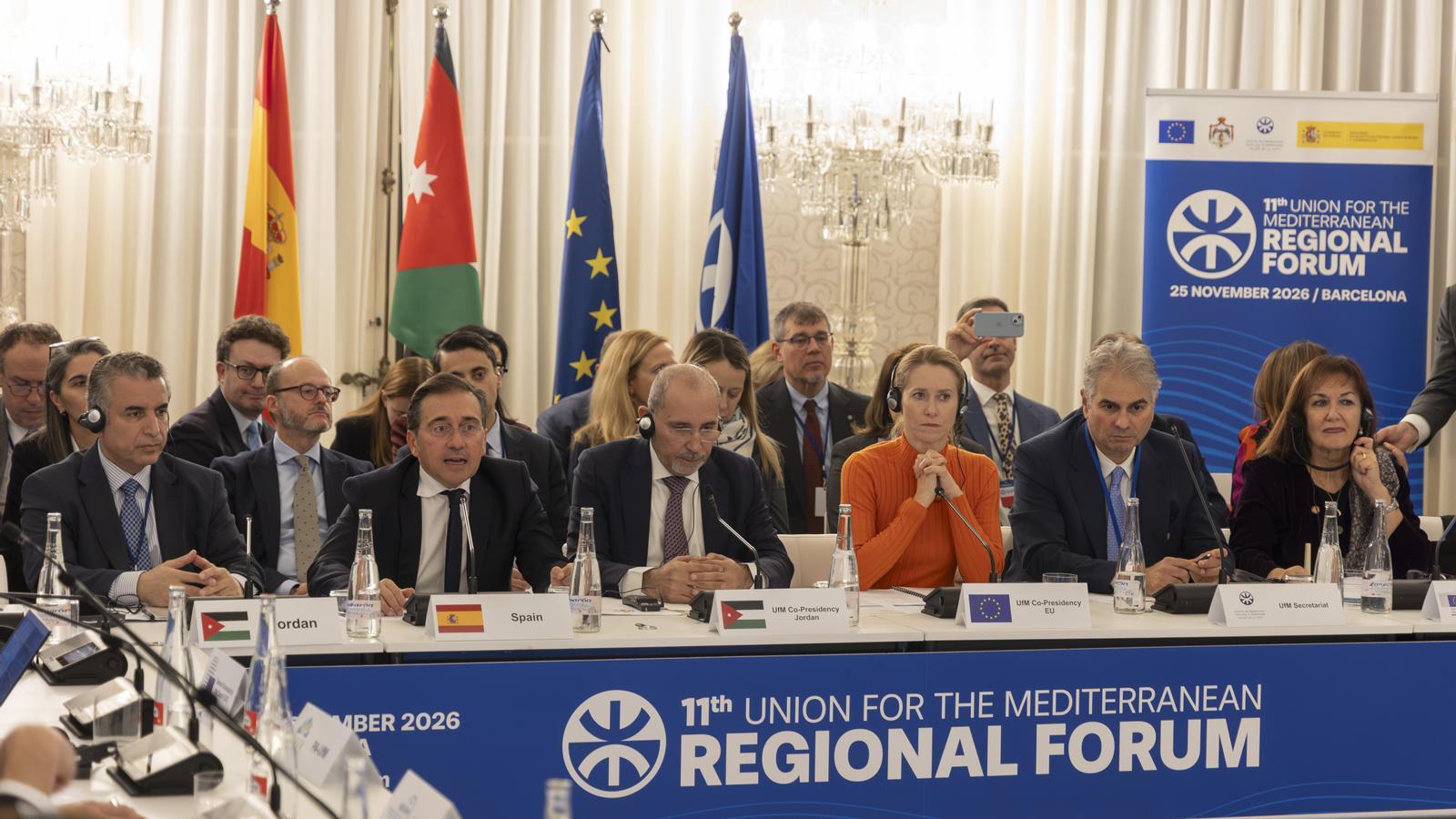
BarcelonaBorn on the shores of the Baltic, the Mediterranean is not the terrain where the head of European diplomacy, Kaja Kallas, feels most comfortable. But the Ukrainian attack against a Russian warship this Monday in eastern Libya has allowed Kallas to do what has sometimes been so difficult for the countries of Eastern Europe: to convey to the southern European partners the concern about the Russian threat and the need for it to be a European priority.
“We have seen that the conflict has an impact on the Black Sea, [waters] that have become the deadliest. We have seen it also in the Baltic and now we see it in the Mediterranean,” said Kallas this Wednesday after the summit of the Union for the Mediterranean (UfM), which brought together in Barcelona the foreign ministers of the 43 countries from both shores of the Mediterranean that are part of it. “I am very worried because the war continues and it has consequences for everyone,” she added when asked about the Ukrainian attack against the Russian vessels in Libya.
Facing a winter that is expected to be very harsh for Ukrainians, the head of European diplomacy has warned that Moscow is making Ukrainian civilians pay for the lack of progress on the battlefield. That is why she has asked to dedicate “all efforts to stopping the war.”
Despite Kallas' words about the war in Ukraine, the UfM summit at the Palau de Pedralbes in the Catalan capital has focused on the conflicts and challenges that directly affect the Euro-Mediterranean region. In a context of growing concern about security threats in the Mediterranean, the head of European diplomacy also highlighted the extension until 2029 of the operation to reinforce the protection of maritime strategic infrastructures, such as submarine cables, gas pipelines, and oil pipelines. “We cannot defend international law only with words, we must also do it with physical protection,” she said.
An “unbearable” situation in Gaza
The situation in Gaza has once again been at the center of the summit. The European Commissioner for the Mediterranean, Dubravka Suica, has denounced that the Gaza Strip is in an "unbearable" situation and has reported that Israel is making access to Gaza impossible. "The EU will always stand by the Palestinians," the European Commissioner remarked.
Jordan's Foreign Minister, Ayman Safadi, was one of the most outspoken on the situation in Gaza. "They are losing their lives and their hope. We must all act," warned the Jordanian Foreign Minister, who also denounced that violence by Jewish settlers against Palestinians is increasing in the West Bank. In the same vein, the Spanish government's Foreign Minister, José Manuel Albares, claimed that it is necessary to "put an end to the horror that Gaza is unjustly suffering." "It is urgent to redouble our efforts," he warned.
In a time of geopolitical turmoil and "complex realities," the acting secretary of the UfM, Fadi Hajali, claimed that the Euro-Mediterranean region can be "an epicenter of stability." "Despite our differences – he said – we share the responsibility for the future of our region."
The UfM representative also warned of the organization's financial difficulties, with a budget that has not increased for over a decade and has seen its value "eroded" by "30%" due to inflation. Hajali warned that this is a risk and has an impact on the UfM's capacity to fulfill its mandate. The organization – he stated – is studying funding formulas, as he explained, but has asked member countries for "more robust financial support."
The organization adapted its roadmap last year to adapt to the new challenges of the region and Hajali defended that, despite the difficulties, the body has maintained its "ambition" in its actions to promote dialogue and cooperation in the Euro-Mediterranean region.
