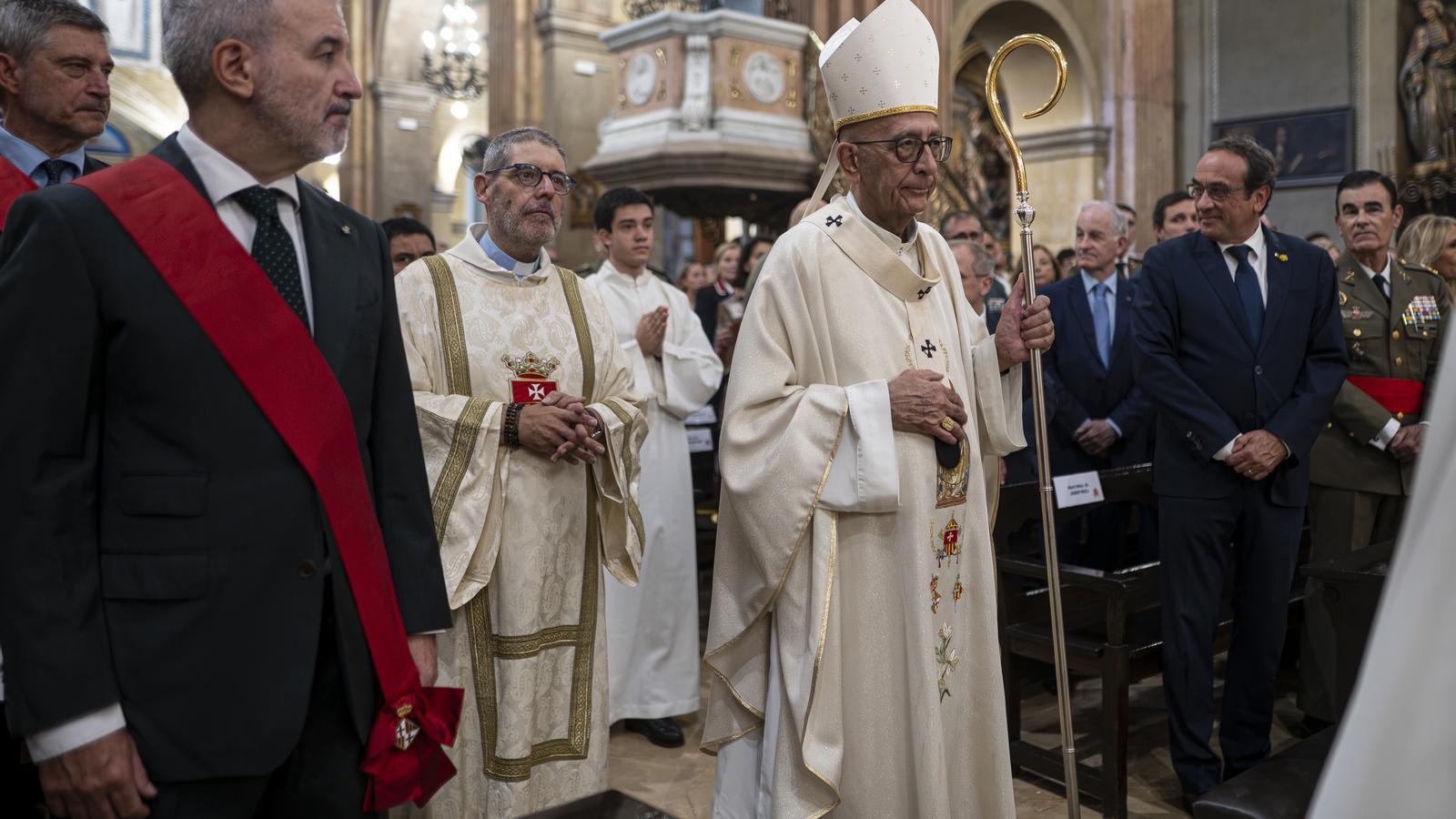
BarcelonaIt is a done deal. It only remains to be officially confirmed who will replace Cardinal Joan Josep Omella as Archbishop of Barcelona and when. Before it is made public, however, the apostolic nuncio to Spain, Piero Pioppo – the envoy of Pope Leo XIV – was in Tarragona last week, from Tuesday to Friday, to meet with the archbishop of the diocese and primate of Catalonia, Joan Planellas.
The first three months of grace after the Pope's visit have already passed, and ecclesiastical sources familiar with the situation point out that this Vatican “decorum” has already been exceeded and that, therefore, Omella's replacement is imminent. And even more so after having celebrated the festivities of the patron saint of Barcelona, the Virgin of Mercy. It should also be taken into account that the Spanish Episcopal Conference meets next Tuesday and Wednesday.
Faced with the change, as this newspaper has been able to verify, among the Catholic, clerical, and secular Catalanism there is no longer a fear that a parachutist will land in the Principality to occupy the episcopal see, as happened in 2015 with the Aragonese from the Franja, Joan Josep Omella, who at the time of being appointed was Bishop of Calahorra. By “parachutist” it is understood someone alien to the ecclesiastical tradition proper to Catalonia.
This confidence is reflected in the fact that, despite the secrecy surrounding Omella's succession, the future replacement is being experienced with “absolute tranquility” in the Archbishopric of Barcelona, according to various sources consulted. This indicates that the name has been known for some time, that it has been accepted, and that only the public announcement is missing. Various ecclesiastical voices point out that this is a symptom of total agreement and, therefore, that the future archbishop is to Omella's liking, in addition to meeting the requirement of speaking Catalan. Some recall that Omella is a member of the Dicastery for Bishops, which is in charge of appointments.
The situation contrasts with the usual nervousness in Barcelona regarding recent appointments: “In the replacement of Cardinal Jubany there were many nerves and many candidates, as also happened with Ricard Maria Carles or Lluís Martínez Sistach”, report ecclesiastical sources, in addition to the recent case of Omella, which also came as a great surprise. But now, they say, “a parachutist would be very strange; it would be surprising”. In any case, ultimately, the decision depends on the Pope, no matter how many shortlists have been requested and how much influence Omella may have had.
Catalanist impression
Beyond the strictly ecclesial sphere, the former director general of Religious Affairs and director of the pro-Catalan Joan Carrera Foundation, Carles Armengol, points out that “there are enough candidates for there to be a Catalan bishop with an understanding of the local reality”. He also says that, at this moment, “there are no conditions for anything strident”. Furthermore, he recalls that “the Pope's visit and the commitment to Catalan that he assumed were very significant”, and, therefore, he rules out “a parachutist”, even less so in a context where “the changes in the appointment of bishops in Spain are leading to a rebalancing and they are not so conservative” within the Spanish Episcopal Conference, but also due to the fact that “the Vatican is more aware of the reality of Catalonia than at other times”.
The president of the also pro-Catalan Spiritual League of the Virgin of Montserrat, Joan Maluquer, says that “the Pope's attitude during the visit gives positive signs”. “It is not enough to master Catalan, it is necessary to understand how the country works and the importance of the Church in the country”.
The names
ARA has already reported on the profiles of the candidates for the succession, but by now the list has been simplified. Even so, a “surprise candidate” can never be ruled out, some sources say, along the lines of the appointments in Lleida and Girona of two people who were not bishops. In fact, at one point the Abbot of Montserrat, Manel Gasch, was mentioned in ecclesiastical circles, which would be an unprecedented change of pace in the Catalan capital.
In any case, as prominent names there are still the auxiliary bishops, as happened in Madrid with José Cobo. They are David Abadías and Javier Vilanova. The former is seen as very young –he is from 1973–, but highly valued because he is a doctor, organized the pontiff's trip well, and has dealt with delicate cases of abuse. The latter is the one who carries the weight of the curia with skill. Both are Catalan and enjoy Omella's trust. The Bishop of Tortosa, Sergi Gordo, is also well regarded and was an auxiliary bishop of Barcelona with Omella, but the fact of removing him from the Ebro see only three years later would work against him.
The person who was the great favorite from the beginning is Francesc Conesa, now Bishop of Solsona. Conesa could be a consensus name, but he is Valencian, even though he has always been among the most present names due to having pacified the diocese –stained by Xavier Novell– and for having led the synod within Spain. In any case, some ecclesiastical sources, who are betting on the surprise effect, maintain that “you cannot undress one saint to dress another,” referring to the episcopal sees. The option of the Archbishop of Tarragona, Joan Planellas, would be a pleasant surprise for the most pro-Catalan faction, but it is highly unlikely.
More bizarre would be to appoint the Bishop of Pamplona, the Aragonese Florencio Roselló –it would be an operation copied from Omella's, that of someone who knows Catalan because he trained in Catalonia– or the Archbishop of Seville, José Ángel Saiz Meneses –he was Bishop of Terrassa and learned Catalan despite being Castilian by origin– or the Bishop of Ajaccio, Javier Bustillo. The Archbishop of Valencia, Enric Benavent, is also not seen as a plausible option.
Finally, no matter how soon the appointment is made official, they will not be able to take office before Christmas or Epiphany, as there is always a two-month margin for the succession. At this moment, there is the highest number of Catalan bishops of the modern era.
A significant visit to Tarragona
The pastoral visit of the nuncio Piero Pioppo to Tarragona last week took place, without a doubt, at a key moment. However, it is true that, beyond what he may have discussed with Planellas, it had already been agreed upon with the previous nuncio, but had not been carried out.
Consulted by ARA, the archbishop expresses, limiting himself exclusively to this trip, that it has been "extraordinarily positive" due to the four days in which he coincided with Santa Tecla and was able to meet with religious figures, gave lectures to priests, and celebrated masses, such as the one at Mas d'Enric for La Mercè. "He was able to take the pulse of the Church in Tarragona," maintains Planellas, "sharing the pastoral plan" to "strengthen ecclesial communion," in addition to experiencing "an endearing day with the prisoners."
This has been the first major pastoral visit to a diocese among those assigned to Pioppo, after he went to Andorra to preside over a mass. In Tarragona, Pioppo made an effort to speak in Catalan –the language of the liturgy– including parts of the homilies.