The president of the judiciary asks judges not to yield to “influences, pressures or interferences”
The attorney general denounces that there is a "systematic disqualification" against the public prosecutor's office: "Spurious motivations are attributed gratuitously"
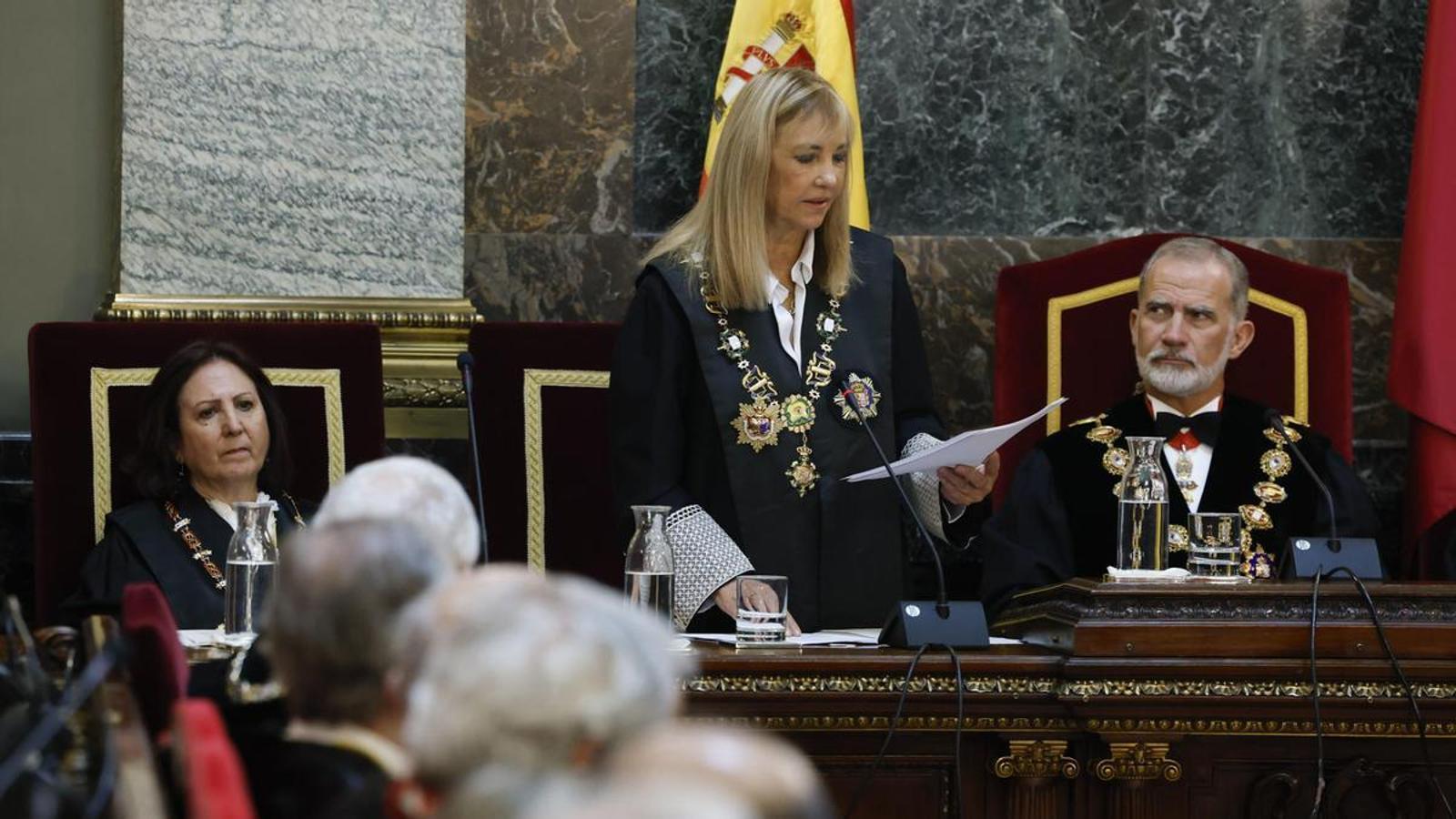

MadridOnce again, the Supreme Court has hosted a solemn ceremony to kick off the judicial year. It did so the same week that Pedro Sánchez's judicial nightmare was reactivated at the National Court, and just a few meters from where the former director general of the Civil Guard, under investigation in the Leire Díez case, was testifying. Everyone knows – in Ferraz, in Génova, and in Moncloa – that the pace of justice will mark the next steps and the final twists and turns of the legislative term, both due to the cases implicating the PSOE and the application of the amnesty. And one of the great protagonists has been the rebuke for political criticisms of judges: “It is not admissible for public disqualification to become an instrument of pressure,” proclaimed the president of the General Council of the Judiciary (CGPJ), Isabel Perelló. “If the disqualifications come from those who exercise institutional responsibilities, the severity is greater,” she added. Without saying it openly, she was alluding – for example – to the successive and repeated criticisms expressed by Pedro Sánchez or the Minister Óscar Puente against the judges in the cases of Begoña Gómez and David Sánchez. And she sent a message directly to the judges: “Our independence is the best guarantee that, when making a decision, we will do so without yielding to influences, pressures, or interference of any kind.”
The president of the CGPJ has demanded that the Spanish government respect the Judiciary as a “true counterbalance” to the other powers of the State and has called for “respect” for judges to be “preserved” even when there are disagreements: “Trust in justice is a value that concerns us all and criticisms based on partisan interests are not acceptable,” she insisted. Just this week, Óscar Puente openly said that he distrusts the role of María Tardón, the judge who will investigate the mass entry of migrants into Ceuta at the National Court: “She comes from the political world [she was a PP councilor at the Madrid City Council from 1999 to 2003]. So far, she has shown signs that lead us to doubt her impartiality, of course,” he said. However, Pedro Sánchez acknowledged that María Tardón's “conjunctural political commitment” is “not at odds” with her duties as a judge.
Likewise, Isabel Perelló has warned that accusations of lawfare could be criminal: “Generalized express accusations that judges make certain decisions for political reasons is an imputation of extraordinary gravity that may lead to the attribution of criminal conduct,” she warned. Finally, she sent a message that can be understood as an implicit reproach to Juan Carlos Peinado, who has investigated the wife of the Spanish president for more than two years and has left her one step away from the dock. Months after his decision to withdraw her passport, the president of the CGPJ has asked judges to have “restraint,” to think about the “transcendence that their decisions can have” and to have “prudence” with their public interventions.

A “systematic disqualification” against the Public Prosecutor's Office
The one who has debuted is Teresa Peramato, who has been Attorney General of the State since the month of November. Working in tandem with Isabel Perelló, the president of the General Council of the Judiciary, it has been the first year in history in which two women have intervened in the opening of the judicial year. During her speech, she denounced that corruption “erodes citizens' trust in institutions” and “distorts the proper functioning of public powers” and demanded the “maximum rigor, independence and determination” of the public prosecutor's office to investigate and prosecute these behaviors, “particularly when they affect authorities or officials who take advantage of the responsibilities inherent to their position”. She did not mention him, but the name of José Luis Ábalos resonated on the walls of the Supreme Court's plenary hall.
The Attorney General of the State also addressed the criticism received by some prosecutors. The PP, for example, has long been attacking the prosecutors of the Begoña Gómez and David Sánchez cases, who from the first day have been in favor of archiving the cases against the wife and brother of Pedro Sánchez, which have only moved forward with the impulse of the popular accusations. She lamented that a “systematic disqualification” is being made and that an “image that does not correspond to reality” is being projected onto the institution. “Spurious motivations are gratuitously attributed where only a legal assessment exists, a distinction is made between good and bad prosecutors depending on whether the procedural position they adopt suits one side or the other,” she said.
On the other hand, Teresa Peramato has called for strengthening "all the mechanisms for prevention, detection, protection and assistance to victims" of gender-based violence and creating the "necessary conditions" so that they can "report with safety and confidence". The words come a month after it was learned that in Andalusia the PP has left the assessment service for victims of sexist violence in the hands of Vox. And she took the opportunity to shower praise on the reforms promoted by Minister Félix Bolaños, which place Spain, in her view, before a "historic opportunity". After celebrating the implementation of the instance courts, she showed her "firm support" for the Prosecutor's Office to be assigned the direction of criminal investigations and stressed that the proposal for a new Statute for the Public Prosecutor's Office is an "important step forward" and a "bold bet". However, it is highly unlikely that both projects will see the green light in Congress.
