"They were three horrible days": hundreds of young migrants tour Ceuta capots a week later
A swarm of young migrants walk hunched over the Maritime Promenade, most of them not knowing where they will spend the night

-
CAT -
CAST
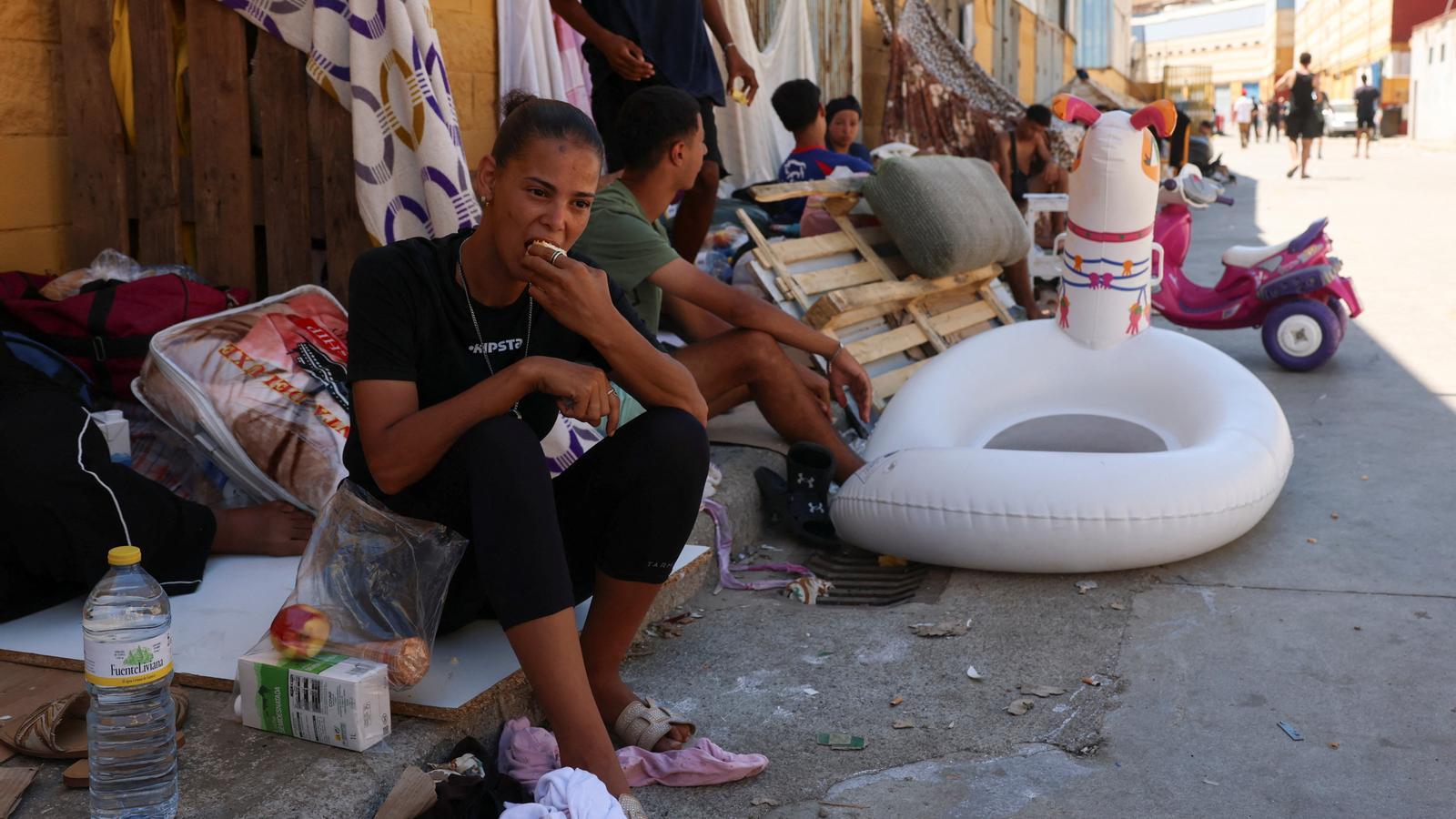
CeutaThe last rays of sun in Ceuta heat up as if it were midday. Walking along the Maritime Promenade, bordering the beaches of La Ribera or El Chorrillo, you can feel the sea's humidity clinging to your skin. In the distance, the daylight fades behind the silhouette of Morocco. Soon, however, a swarm of young migrants, the vast majority boys, can also be seen, walking with their heads down. Others contemplate the sea by which they arrived in Ceuta. In the eyes of most, you can read the exhaustion of those who haven't slept well for days. Of those who don't know where they will sleep. The clothing they wear is practically identical: flip-flops, shorts or swim trunks, and a t-shirt. The luckiest ones have a mobile phone or a bottle of water in their hands. Others have nothing. Almost all, however, went between 3 and 4 days without eating since they arrived.
This is the case of Mourand, originally from Marrakech. He is 19 years old. He arrived swimming last Thursday, the same day that thousands of people – mostly Moroccans – crossed the border from Morocco into Spanish territory. He is sitting on the wall of the Maritime Promenade, contemplating the sea and the last bathers of the day, citizens of Ceuta trying to regain their routine, as well as tourists seeking tranquility, however cosmetic, after days of tension. He doesn't master English or French well. Nor Spanish. We opt to use an online Catalan-Darija translator, the dialect of Arabic spoken in northern Morocco, to understand each other. This way he can explain that he crossed the border spurred on by messages flooding social networks, but that he went three days without eating. "They were three horrible days," he explains.
Now he has been able to recover a little. He was one of the few fortunate ones who could call his mother to tell her he was okay with a borrowed phone. But he has no intention of retracing his steps home: he is confident he can go to Spain to look for "a job contract". But he still doesn't know how to do it. The only thing he is clear about is that he doesn't want to return to Morocco, where he claims it is impossible to make a living. That the salary in his country is low. For now, he feels alone. He doesn't have much of a circle in Ceuta because, he says, most migrants come from Castillejos, Tetouan, or Tangier, cities closer to the autonomous city.
"It will be difficult for normality to return to Ceuta," Rayan tells me. She is walking with her friend Mariem. They are going to the beach to finish the day. They are from Ceuta, with Moroccan parents. "It is impossible to give them everything they need. We don't have the resources," she denounces. The young women explain that in some neighborhoods they have organized by making large pots of food to distribute among the young people; also that some houses have even opened their doors so they can shower or use the toilet. "There are no public toilets. Where are they supposed to relieve themselves?" she asks – authorities have only just begun to install showers on the beaches.
It saddens her to see young people wandering, lost, not knowing where to go in their city. For now, the Spanish government and the Ceuta government have only set up one school where there will be 100 girls, and the second is scheduled to open this Friday. However, time is already running out, considering that the school year begins in September. Many other unaccompanied minors, who are mainly in the El Príncipe neighborhood, are waiting to be accommodated. "The border was a place where you entered and exited daily. You went to Morocco and came back. Today it is very different," she laments. Reality supports this: there is still a 4x4 Civil Guard vehicle patrolling every few meters or members of the National Police and the army walking around.
