Sánchez places Cuerpo as vice-president and the Valencian Arcadi España as Minister of Finance
Give more political weight to the Minister of Economy and sign a "convinced federalist" to resolve the financing model

-
CAT -
CAST
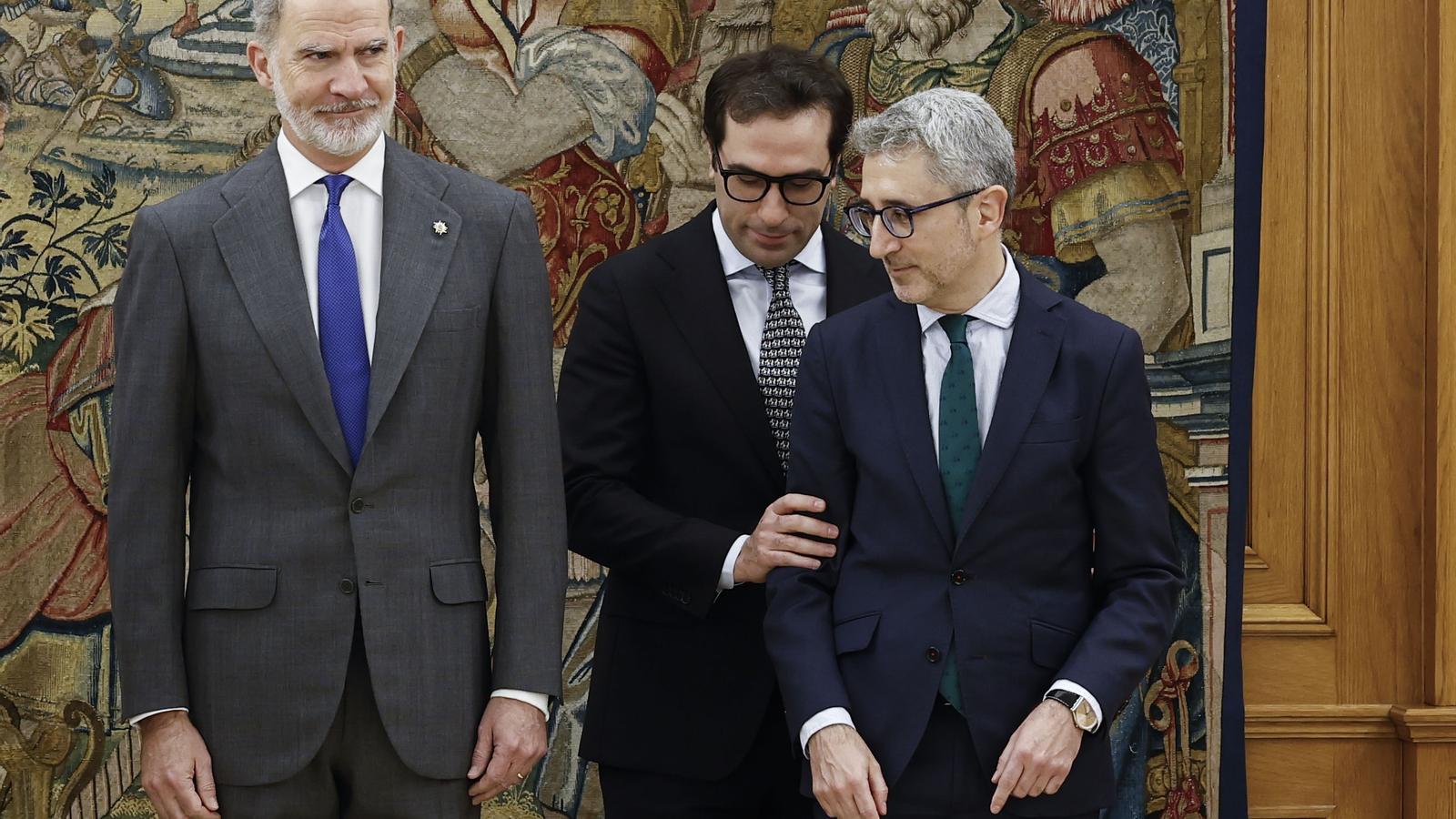
MadridWith the departure of María Jesús Montero, the Spanish Prime Minister, Pedro Sánchez, has opted to reinforce the political profile of the Minister of Economy, Carlos Cuerpo, as well as to recruit from outside the Ministry of Finance for the new person in charge of this portfolio. On the one hand, Cuerpo will assume the first vice-presidency. On the other, the reins of public accounts will be held by the Valencian Arcadi España, current Secretary of State for Territorial Policy. The changes were communicated by Sánchez himself this Thursday afternoon in an institutional declaration from Moncloa. The government loses the parity it had until now: there will be 12 male ministers and 10 female ministers.
As announced, the government crisis has been resolved surgically, affecting only the responsibilities that Montero had until now, who is heading to Andalusia to be the PSOE's lead candidate in the elections on May 17. In fact, before announcing the moves, Sánchez wanted to thank Montero for her role in the last eight years in government: "She is one of the best politicians, for me the best I have known. She has been a fundamental pillar. [...] She has ensured that Spain has the [public] resources necessary to face unprecedented crises; reinforce public services and drive transformation," said Sánchez. The Spanish Prime Minister has conveyed his "enormous gratitude" and has valued that she will continue to carry out this task from now on in her homeland: "She will bring her experience and talent to her land and will do what fulfills her most: help build a more prosperous Spain and Andalusia," he said.

The political rise of Body
To begin with, the rise of Carlos Cuerpo (Badajoz, 1980) as first vice-president and, therefore, number 2 in the government once again places the Ministry of Economy at the forefront –Nadia Calviño, his predecessor, also took on this role–. The move coincides precisely with the day Cuerpo had to defend in Congress the decree of measures by the Spanish government to address the economic impact derived from the war in the Middle East and which has progressed with the 'yes' of Junts and the abstention of the PP.
The truth is that his name has been mentioned not only for this position but also for taking on the Ministry of Finance: "If I am included in the predictions, it means they believe that a good job is being done in the field of economic policy," Cuerpo reflected this week when the press asked him about the information that placed him as Montero's successor.

When Cuerpo took the reins of Economy in December 2023, it was seen as a technical and continuing handover from Nadia Calviño. Over time, he has assumed a more political prominence – with the first vice presidency, he has gained even more –, but his calm and cordial demeanor, as well as his dialogue-oriented tone, continue to be highlighted, something that clashes with a context of strong political polarization. "He is doing an exceptional job in the Ministry of Economy and I am convinced that he will be a fantastic first vice president of the Spanish government," Sánchez highlighted.
A "convinced" federalist
For his part, although the appointment of Arcadi España (Carcaixent, 1974) as head of Finance has been sought outside the ministry –some voices pointed to a promotion of the current Secretary of State for Finance and Montero's right-hand man, Jesús Gascón–, he is not a profile unfamiliar with public accounts, nor with the different territorial sensitivities that have an impact on the State's distribution of resources. In fact, España was currently Secretary of State for Territorial Policy and has participated in bilateral negotiations with Catalonia or the Basque Country. "He is intelligent, committed and will continue the work done so far by Montero," Sánchez has highlighted.
"He is not only a federalist, but a firm believer in the decentralization of the State," summarizes a good friend of his who has worked closely with him for years. His moderate tone and dialogic character are also highlighted. With España's temperament, the President of the Generalitat, Salvador Illa, gains an ally, express sources close to him.
An economist by training and a cycling enthusiast, beyond his time in the Spanish government, Arcadi España stands out for his career in the Valencian Generalitat. He is considered, in fact, a "man of Ximo Puig" whom he regards as a reference, in addition to Vicent Soler, a historical figure of the PSPV. Now, the brand-new Minister of Finance will have to unblock issues such as the new regional financing model –the Valencian Country is, precisely, one of the most underfunded communities–. "I am convinced that he will push for it to move forward," says someone who knows him firsthand.
It is in his native land where he forged his path within the socialist ranks. Between 2013 and 2015 he was Head of Cabinet for the PSPV. Later, he made the leap to become Director of Cabinet for Ximo Puig. In 2019, the former Valencian president hired him as Counselor for Territorial Policy, Public Works, and Mobility, and in May 2022, with the first major reshuffle of the Botànic government, he took over the Valencian Department of Finance and Economic Model.
With this backpack, Spain undertakes the commitment to present general state budgets for 2026, but above all the commitment to try to make a reality two of Montero's major pending tasks: the reform of the regional financing model, already underway after tough three-way negotiations between the Treasury, the PSC and ERC, and the write-off of part of the regional debt, a measure that is barely being processed in Congress.
With Thursday's change, Pedro Sánchez's government only retains three of the ministers who entered in 2018 with his first term: the Minister of Defense, Margarita Robles, the Minister of the Interior, Fernando Grande-Marlaska, and the Minister of Agriculture, Fisheries and Food, Luis Planas. "Experience, integrity, and technical solvency. This is the profile of this government," Sánchez summarized when he finished giving the details of the announced changes with which he is resuming the final stretch of the legislature.
