Sánchez surpasses Aznar and is already the second longest-serving president in democracy
Sánchez overtakes Aznar and becomes the second longest-serving president since the Transition
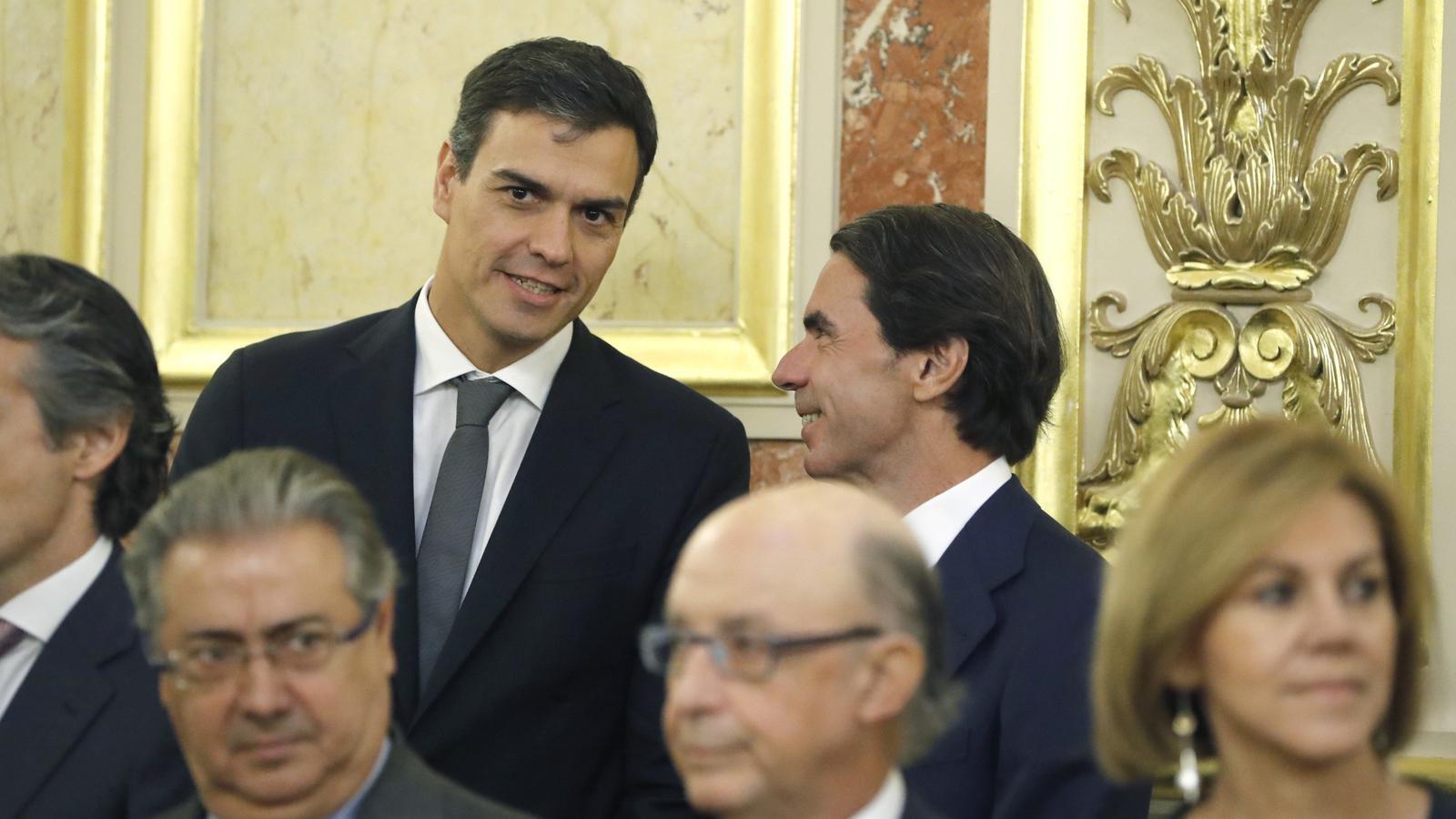
BarcelonaAll presidencies have had their ups and downs, but few have gone through moments of such precariousness as that of Pedro Sánchez (Madrid, 1972), the first Spanish president since the Transition to govern without being the most voted in the polls and also the first to embrace a coalition government out of necessity. The coronavirus pandemic —and now the hantavirus episode with the landing in the Canary Islands—; the cases of alleged corruption affecting some of his closest political officials and also direct relatives such as his wife and brother; the DANA in the Valencian Country; the volcanic eruption on the island of La Palma; the great electrical blackout, which left the Iberian Peninsula in darkness; the fatal derailment in Adamuz; the Cercanías crisis in Catalonia... And, despite everything, since this Friday Sánchez is already the second longest-serving president in Spanish democratic history.Sánchez, who came to the presidency on June 2, 2018 after a historic motion of no confidence against former popular president Mariano Rajoy —the first to succeed in Spanish democracy—, has achieved a milestone that few foresaw that summer. This Friday marks seven years, eleven months, and thirteen days at the head of the government, a figure that surpasses that of José María Aznar and leaves him just behind Felipe González. Of the 56 ministers who have served in his cabinets, only three remain from the beginning: Margarita Robles (Defense), Fernando Grande-Marlaska (Interior), and Luis Planas (Agriculture).Aznar governed for seven years, eleven months, and twelve days between May 5, 1996, and April 16, 2004, spread across two legislatures (the VI and the VII). While the Popular Party enjoyed a second term with an absolute majority that gave him almost granite-like stability, Sánchez has had to navigate four different legislatures (XII, XIII, XIV, and XV), often with extremely fragile parliamentary balances and unprecedented coalition governments.However, the top spot in the rankings still seems impregnable. Felipe González marked an era with thirteen years, five months, and three days of uninterrupted government between December 2, 1982, and May 4, 1996. González strung together four legislatures (II, III, IV, and V), two of them with absolute majorities. For Sánchez to even cast a shadow over González, he would have to remain in Moncloa well into 2031.
The European horizon
If we look towards Europe, Sánchez's seven years seem almost anecdotal next to the great figures who have shaped continental politics. The clearest mirror is former Chancellor Angela Merkel, who led Germany for sixteen consecutive years, almost equalling the record of former German Chancellor Helmut Kohl, also with sixteen years in power. On the scale of longevity that shatters Western standards, we find, however, cases like Urho Kekkonen, who presided over Finland for twenty-six years (1956-1982), or current examples like Alexander Lukashenko, at the head of Belarus since the creation of the office in 1994 (i.e., thirty-two years), and Vladimir Putin, who since 2008 has maintained absolute control of Russia by alternating the positions of president and prime minister.

And in the State? His main rival now in Spanish politics, Alberto Núñez Feijóo, governed Galicia for thirteen years (Manuel Fraga governed for fifteen), but both fall short compared to the longest-serving president of Catalonia: Jordi Pujol was in power for 23 years between the 1980 and 2003 elections. However, there is still an autonomous president who surpasses him in years at the head of the executive, Juan Carlos Rodríguez Ibarra, who was president of Extremadura for 24 years.
