Sánchez announces that he wants to present the 2027 budgets in the midst of a judicial storm
Page again claims the socialist leader to undergo a vote of confidence or call elections
-
CAT -
CAST
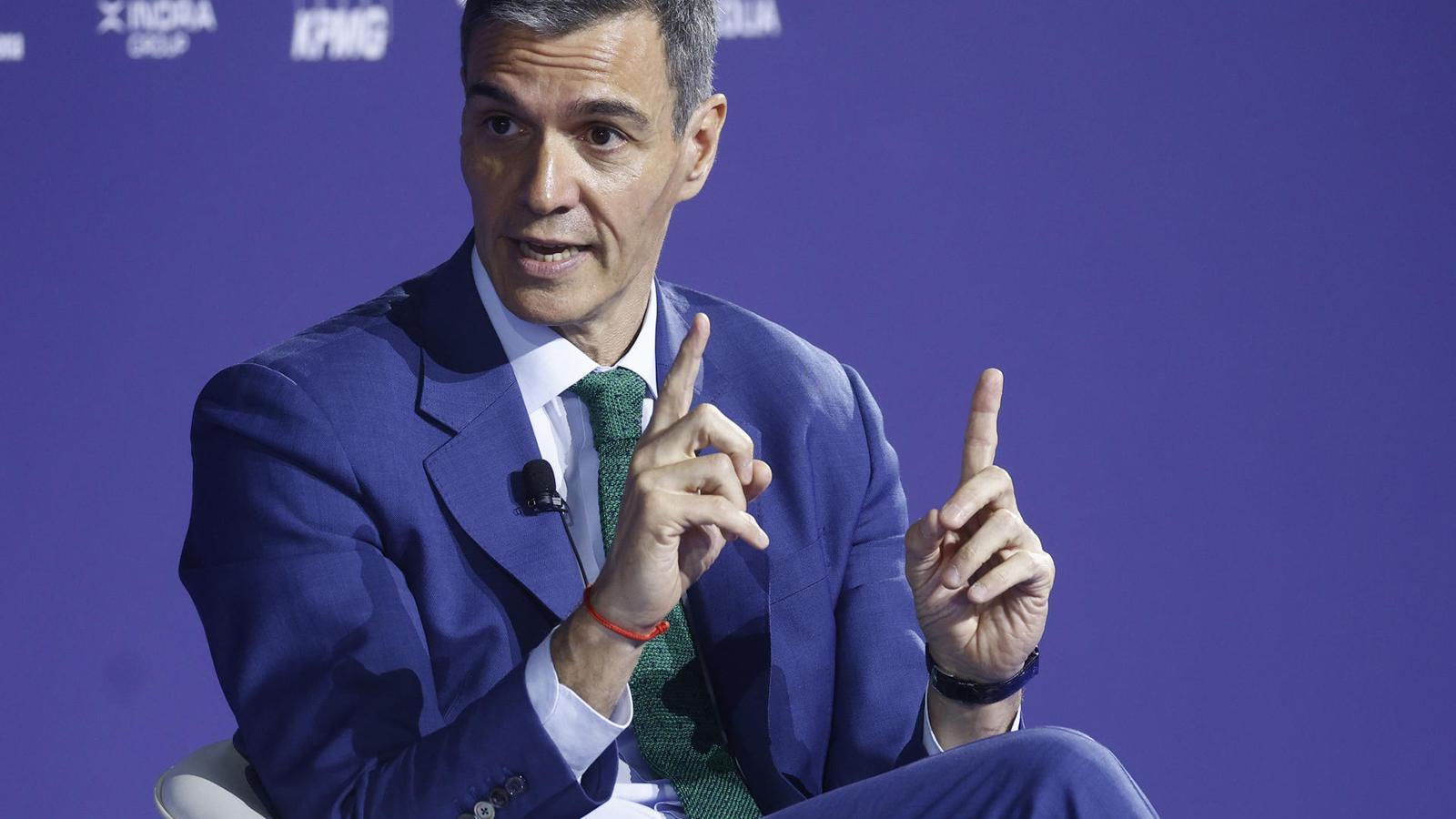
BarcelonaWithout any reference to the judicial cases surrounding his environment, but with an announcement that is the message itself, Pedro Sánchez is pushing the legislature forward and this week will begin the process of presenting the 2027 budgets. The announcement was made before Catalan business leaders and also the President of the Generalitat, Salvador Illa, at this year's conference of the Cercle d'Economia in Barcelona. Sánchez has claimed the need for state accounts, which would be the first of the legislature and would arrive at the most delicate moment of the term, when cases of alleged corruption are increasingly besieging the environment of the Spanish president.
However, Sánchez is stepping on the gas and this week, he said, the Spanish government will publish in the "Official State Gazette" (BOE) the order from the Ministry of Finance to move forward with the budgets, and throughout this June it will update the macroeconomic framework. Two steps that the state executive already took in 2025 to try to move forward with public accounts for this 2026 that have ended up being shelved, even though it had committed to presenting them. For the second half of this year, the Spanish president plans to take them to Congress to try to approve them "as soon as possible." It is here where he will again have the problem: obtaining the support of the investiture partners who already closed the door on him for the 2026 accounts.
The Spanish president thus responds to the opposition's calls for early elections and vows to try to finish the legislature with accounts that, as he said, will be "social," in which housing will have an important role and in which the government will commit to continuing to reduce the public deficit to end the legislature with a public debt below 100% of GDP. Sánchez, furthermore, intends for the budgets to channel the application of the new regional financing model. A model that, on the other hand, is still pending processing in Congress, where he also does not have guaranteed support —Junts has not given his yes—. However, Sánchez has assured that he wants to approve the new financing model before the end of the year. "With these budgets, we will be able to resolve the regional financing problems," he added.
To seduce independence again
To try to ensure his promise can be fulfilled, Sánchez is once again looking towards Catalan independence at a time when one of his investiture partners, Junts, is demanding elections and has distanced itself from the majority that allowed him to reach Moncloa in 2023. The Spanish president, in this regard, has once again defended the amnesty law as the tool to reset the clock in Catalonia and has called for the measure to be made fully "effective" during this legislature.
In fact, Sánchez has gone even further by showing his willingness to "address and resolve the political conflict" in Catalonia. "We must address the root of the territorial conflict," he stated, after committing to comply with the agreements signed with Junts and ERC for his investiture. "We must claim these agreements and the stability derived from these agreements. And we must continue the work in the coming years," he added. "This understanding with the different nationalist and independentist forces is working well for the State as a whole, and the economic figures prove it," he defended.
the call for the snap general election in the StatePage looks to a post-Sánchez era
While Sánchez tries to get out of the judicial mire by pushing forward the legislature, within the PSOE the usual critical voices are not letting up either. Emiliano García-Page, president of Castilla-La Mancha, one of the most critical socialist barons, has once again lashed out at the Spanish president. At a press breakfast organized this Wednesday morning by Europa Press, Page stated that the party's future after Sánchez "will inevitably be better". In his opinion, despite retaining power, the current head of the state executive represents a "very dark era for the party" and, although when he ceases to be secretary general there will be a "difficult and painful transition", the scenario that will open up will be "better".
Page, who is convinced that the plots affecting the socialists will continue to grow, has reiterated the call for early elections in the State. "From my point of view, they should have been called a year ago. We are already late. [Sánchez] should have called them a long time ago," he said, making it clear that, in the current circumstances, "it is evident that one cannot govern". Aware that the Spanish president has vowed to resist in Moncloa, however, he added that the most "urgent" thing would be for him to submit to a vote of confidence in Congress and, if he lost it, to resign. He did not want to support, on the other hand, the instrumental motion of censure proposed by the PP to call elections, which he sees as doomed to failure.
Regarding his party's reaction to the judicial cases, the regional president has indirectly accused Ferraz of lukewarmness. In this regard, he argued that the party should file a lawsuit against former militant Leire Díez, at the center of the alleged plot to dismantle cases affecting the PSOE and the government. "The PSOE should sue her and all those who are tarnishing the party's name. I think it's textbook. They are hurting us," he argued. After defending the presumption of innocence of those investigated but also making it clear that "the accumulation of evidence is immense", Page did want to consider it "possible" that the alleged plot under investigation was launched without Sánchez's knowledge. "Sincerely yes, it is possible," he said.
The socialist baron, who had already expressed disappointment with the indictment of former president José Luis Rodríguez Zapatero in the Plus Ultra case, has reiterated his pain over the details of the case that are pointed out in the summary. He assured that he would never have imagined the former head of the Spanish government "in this role" and, in fact, said he remembered him "little concerned" about his expenses and even "a bit of a disaster". Awaiting Zapatero to clarify everything in his statement at the National Court in mid-June, Page did not refrain from throwing a dart at him for his ties to Venezuela: "If you get involved in a regime that is a corrupt dictatorship, right from the start you have many possibilities that people will think badly".
