Joint front of Sánchez, Illa and independence for demanding immediate amnesty from the courts
The ECJ's endorsement unites the defenders of the rule and maintains the rejection of the PP and Vox
-
CAT -
CAST
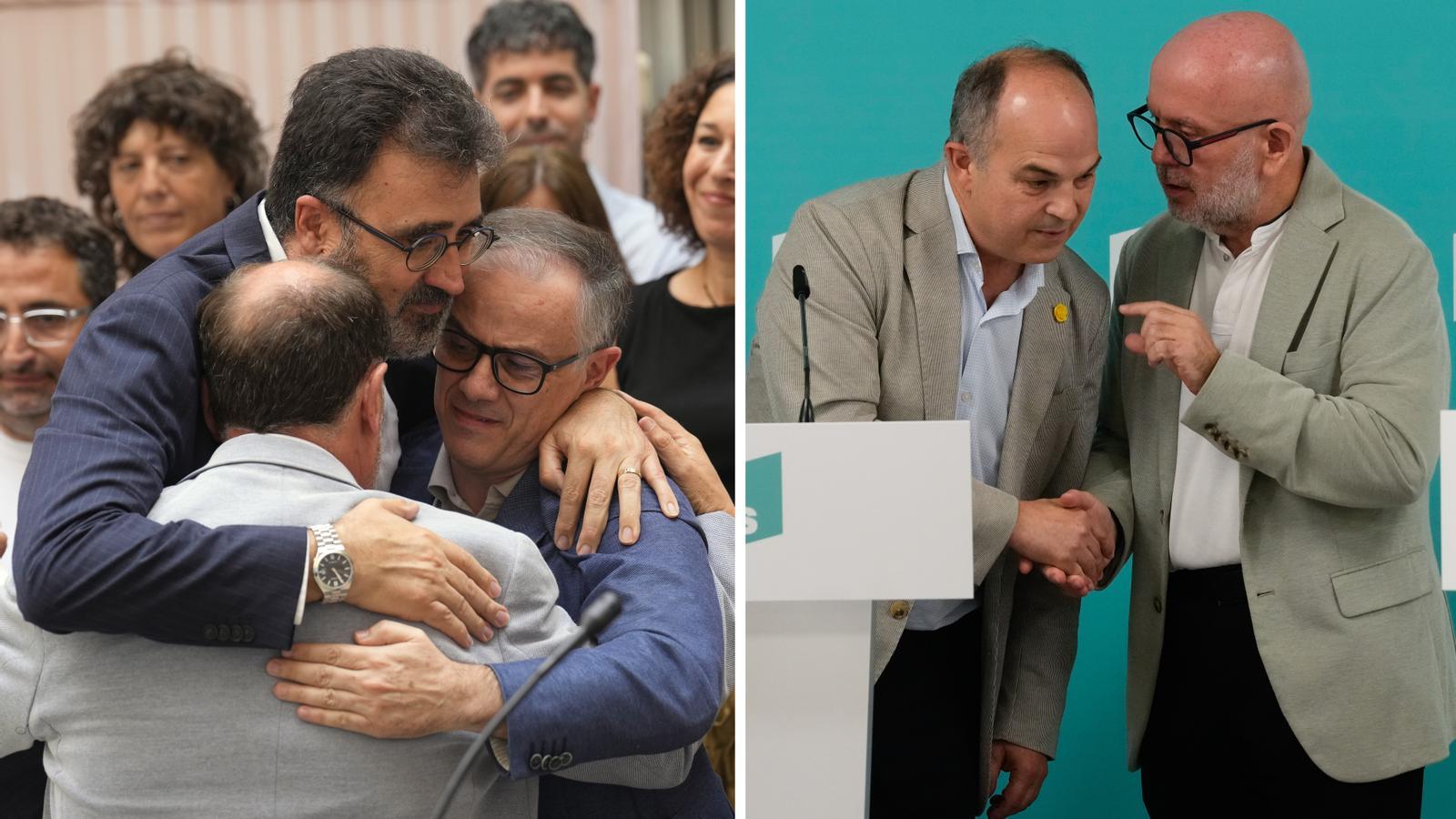
BarcelonaThe Court of Justice of the European Union (CJEU) has given a clear endorsement to the amnesty law this Thursday, which has triggered a wave of reactions uniting the independence movement and the Catalan and Spanish governments in a single demand: the immediate application of the law by the Spanish judiciary. The ruling has been received as a "resounding victory", although with the caution of knowing that the final executive decision rests with the state courts. In the words of former president Carles Puigdemont, "the game will no longer be played in Europe but at the Bernabéu, with the referees and the crowd leaning to one side".
One of the first to react was the president of ERC, Oriol Junqueras, who questioned "Spanish democracy" if the courts continue to refuse to apply a law now endorsed by the CJEU. The Republican leader praised Europe for "setting limits on abuses" and demanded that the Spanish justice system apply the law "without further delay" in order "to definitively remove the shackles from the independence movement". While warning that the amnesty "does not close the conflict", he expressed a clear wish: "I hope to soon be able to hug President Puigdemont in the streets of Girona or Barcelona". In the same vein, former Parliament president Carme Forcadell celebrated the European endorsement and assured that the decision "puts the Supreme Court and the National High Court in their place", while former president Pere Aragonès briefly reiterated the core debate: "Exercising political rights is not a crime".
The return to the Bernabéu
At Junts' headquarters, Jordi Turull has celebrated "a great victory for Catalonia" against the "activists in robes" of the Spanish justice system. However, he has tempered the euphoria about Puigdemont's return and warned that "Spanish justice is not European." The next step to certify the president's return is for the Constitutional Court to resolve the appeals for protection regarding the amnesty and issue a clear ruling obliging the Supreme Court to apply it. "May they not go on vacation," Turull asked the members of the TC, who do not plan to rule at least until September. Lawyer Gonzalo Boye has insisted that the decision "closes the legal debate" and there is "no longer any excuse" not to apply the amnesty, while the president of the Parliament, Josep Rull, has urged the Supreme Court to "abandon its path of rebellion."
For his part, former president Carles Puigdemont has claimed the ruling as a "resounding victory" and a "political triumph" against the State, although he has not changed his pessimism regarding the attitude of the Spanish high judiciary: "The amnesty is European, the repression is Spanish." MEP Toni Comín has also joined this argument, demanding that the Spanish justice system "stop prevaricating": "After nine years, it's time to return to Catalonia." In contrast, the leader of Aliança Catalana, Sílvia Orriols, has stated that "hopefully he will return to Catalonia," referring to Puigdemont, "so that political repression ends" and also "so that the myth falls."
Institutional joint front
For his part, the president of the Generalitat, Salvador Illa, has described the ruling as "very good news for Catalonia" which, in his opinion, "confirms the will of the immense majority of Catalans to move forward into the future." Illa, who repeated the speech in Catalan, Spanish, and English, urged the courts to comply with the ruling immediately, and recalled that "its application is mandatory."
From Moncloa, the Minister of Justice, Félix Bolaños, has argued that the law is "impeccable" and that "there is no longer any doubt" about its European legality. The Spanish government claims its "risk" to "resolve the political crisis" and wishes for the amnesty of Puigdemont and Junqueras "as soon as possible." In a harsher tone, minister Óscar Puente has called judicial resistance a "European ridicule" and has stated: "It would be convenient for democracy, which crossed the Pyrenees a long time ago, to reach all the institutions of the State."
"The seditious aggression" by Aznar
From the popular ranks, former president José María Aznar has led the rejection of the European resolution and stated that "the seditious aggression against the law must not go unpunished, far from being rewarded". Despite Genoa's "absolute respect" for the ECJ, the PP accuses Sánchez of exchanging "power for impunity". Along these lines, Cayetana Álvarez de Toledo, a popular deputy in Congress, has argued that the amnesty "disarms Spain", and Lorena Roldán, spokesperson for the PP in Parliament, has remarked that "it was not a state decision", but rather "the price to buy votes" for Pedro Sánchez's investiture.
From the far right, Vox MEP Jorge Buxadé has railed against the ECJ's endorsement, calling Sánchez's pact with "the coup plotters" to stay in power "immoral" and warning that Vox "will reverse" the amnesty law if it comes to govern. In parallel, Societat Civil Catalana has stated that it "respects" the ruling, but has denounced it as an "auto-amnesty" – even though the ECJ denies it – that "whitewashes embezzlement" for "personal and partisan interest".
Entities and left-wingers
Alerta Solidària has been the first to react, requesting the "immediate dismissal" of the CDR case at the National Court, and has warned that the "final victory" will only be effective with real amnesty. Òmnium Cultural has described the ruling as an "unappealable endorsement" against Spanish courts acting for "political" reasons and has demanded that the TC apply the rule "without delay". Likewise, the ANC has celebrated this "important legal victory": it has demanded "immediate" application for leaders and anonymous activists, has warned that the first cycle of the Process is "politically exhausted" and has called for a "renewed strategy" towards the "Catalan Republic".
From other parties, Jéssica Albiach (Comuns) has celebrated "a new setback" for the Supreme Court on a "good day for democracy". The CUP has called for a "new strategy of democratic confrontation". And, finally, Sumar has celebrated the decision by stating that "the attempts by the right and part of the judiciary to boycott this legislature by sabotaging the amnesty have failed".
