What is the Libertas forum and why does Feijóo label Sánchez as an "authoritarian president"?
The president of the PP considers that the PSOE government is a "threat to democracy"
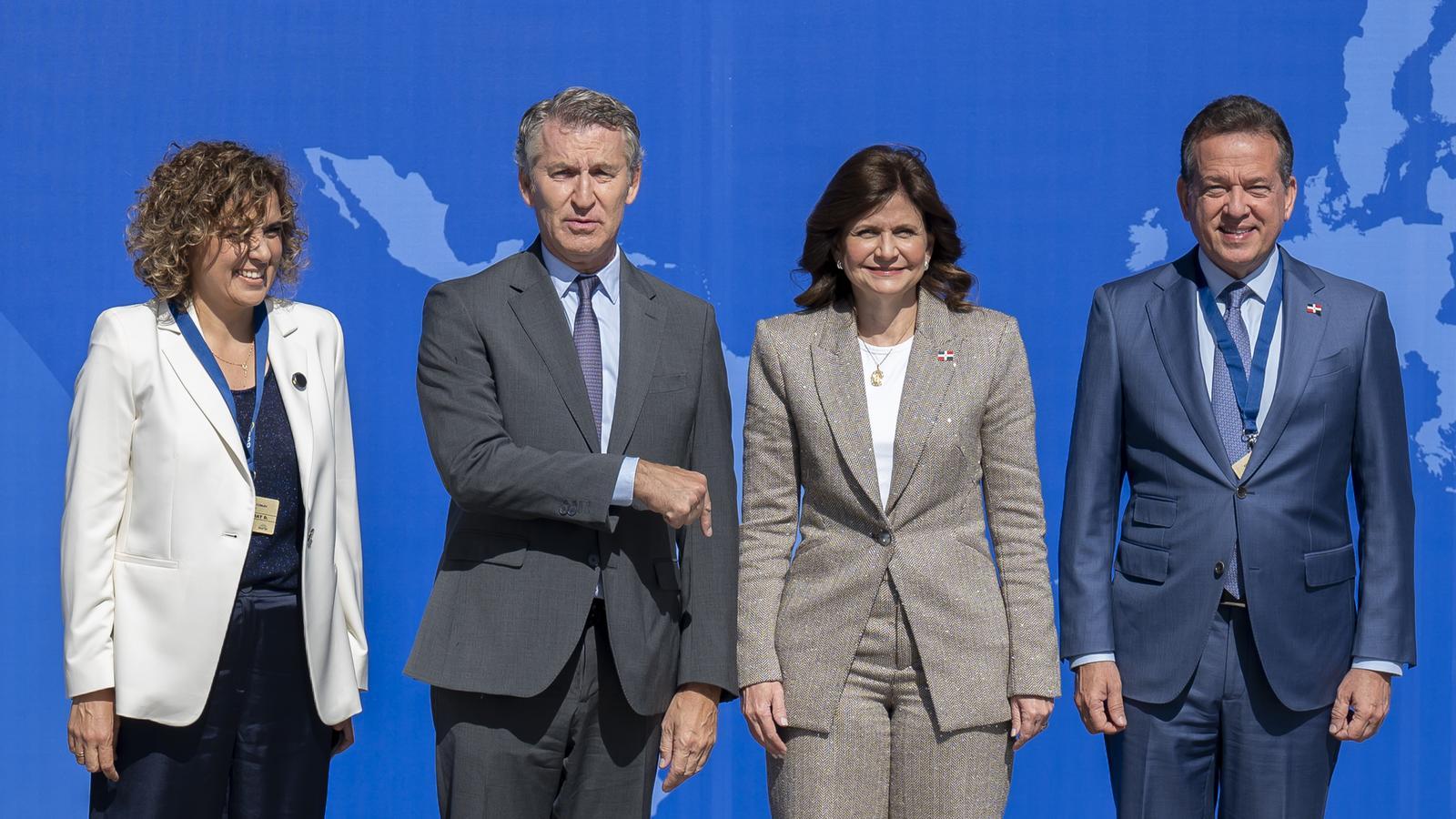

MadridThe Libertas Forum is an initiative of the European People's Party that aims to build bridges of dialogue between Europe and Latin America and is made up of right-wing and center-right organizations, with a total of 60 parties from more than 40 different countries. And it was within the framework of the summit held in Madrid this Wednesday, before European and also Latin American leaders, that Alberto Nuñez Feijóo defined Pedro Sánchez as an "authoritarian president". In an inaugural speech in which he claimed "Western values" and the alliance with the United States against other states like China, Feijóo accused Sánchez, without explicitly naming him, of wanting to "control" key elements of the State and "threaten" democracy.
"If a president distrusts judges, despises parliamentary majorities when they do not favor him, substitutes merit for state dependence, and fears the ballot box when it does not guarantee him power, he is an authoritarian president," he proclaimed. Feijóo made these statements the day after the conviction of Pedro Sánchez's brother, David Sánchez, to 9 years of disqualification and the Spanish government openly criticizing the judicial resolution. The Minister of Transport, Óscar Puente, even said that it was part of an attempt to bring down the executive, while the spokesperson for the PSOE in Congress, Patxi López, said it was a "barbarity" of a sentence and that it was "unbearable to have to abide by one after another," after former minister José Luis Ábalos was also recently sentenced to up to 24 years in prison.
Before Feijóo, the president of the European People's Party, Manfred Weber, who is one of the strong allies of the Spanish Popular Party in their battle for the narrative against Pedro Sánchez within European institutions, also spoke, as did the Italian Foreign Minister, Antonio Tajani, and the president-elect of Peru, Keiko Fujimori, albeit remotely. Finally, the day will also feature a speech by the Venezuelan opposition leader, María Corina Machado, who is a symbol for the PP, and the Prime Minister of Portugal, Luis Montenegro, is present. "Faced with authoritarianism, more freedom. This is more than a political family," summarized Feijóo, in an attempt to rally for conquering governments on a transnational scale. In fact, this forum aims for the right-wing, just as the far-right has already done and as the left-wing did in the summit organized by Pedro Sánchez in Barcelona, to form alliances beyond their respective countries. in the summit organized by Pedro Sánchez in Barcelona, to form alliances beyond their respective countries.
"The current international order is in transformation, a change of epoch. This context generates risks [...]. Liberal democracies face a challenge, authoritarian projects try to gain ground, but we are not afraid, we know the strength of our societies and the capacity of freedom to forge its way," summarized Feijóo, in addition to advocating for Europe as the "greatest space of freedom" in the world, as the ultimate exponent of the right-wing and center-right project. In his opinion, the fact that the European People's Party is now the leading force in the European Union countries is an indicator that the population trusts its political project based on "freedom, prosperity, and the rule of law".
In this regard, he highlighted the shift in Ibero-American countries as well, citing Javier Milei's Argentina, Abelardo de la Espriella's Colombia, Peru with Keiko Fujimori, Antonio Kast in Chile, or Daniel Noboa in Ecuador. He cited these new leaders even though they follow the ultra trend more through their policies than what could be considered a traditional European liberal right. Kast himself has defended Pinochet's dictatorship; Milei is characterized by his public administration cutback policies, while Fujimori has returned to power 26 years later after her father, Alberto Fujimori, convicted of crimes against humanity, governed the country.
Be that as it may, Feijóo has claimed them as his own, and has wished that Venezuela, Cuba and Nicaragua will soon join in "freedom." "Many citizens have woken up from a great lie and have said enough is enough," he concluded. Whoever carries the flag of progress – he assured – "always brings material and moral poverty." According to Feijóo, until now the left and "populism" have united against liberal democracy, and now it is also their turn to "unite" in favor of "the person, freedom and the law." In fact, he spoke of a "new center-right political enlightenment," although the current trend also includes an electoral rise of new far-right formations like Vox in the State.
The CIS gives good results to the PSOE
Despite the situation of alleged corruption cases, this Wednesday's CIS survey assures that the PSOE is widening the gap with the PP and would win the elections if they were held now throughout the State. Despite the judicial cases that splash the party, the socialists would get 33% of the votes and are eight points ahead of the PP, which falls two. The poll was conducted between July 1 and 6 on a sample of 4,020 interviews and is the first after the conviction of former minister José Luis Ábalos for the case of masks. For its part, Sumar drops three tenths in voting intention, to a support of 6.1%, while ERC rises eight (to 2.7%). Junts, on the other hand, falls to 0.7% of the votes. The main novelty also concerns the far-right party S'ha Acabat la Festa, which would achieve up to 2.6% and would make the overtaking to Podem —reports Marc Toro.
