Ayuso is left alone boycotting the Fiscal and Financial Policy Council
The organization will endorse the financing model despite the opposition of the communities governed by the PP
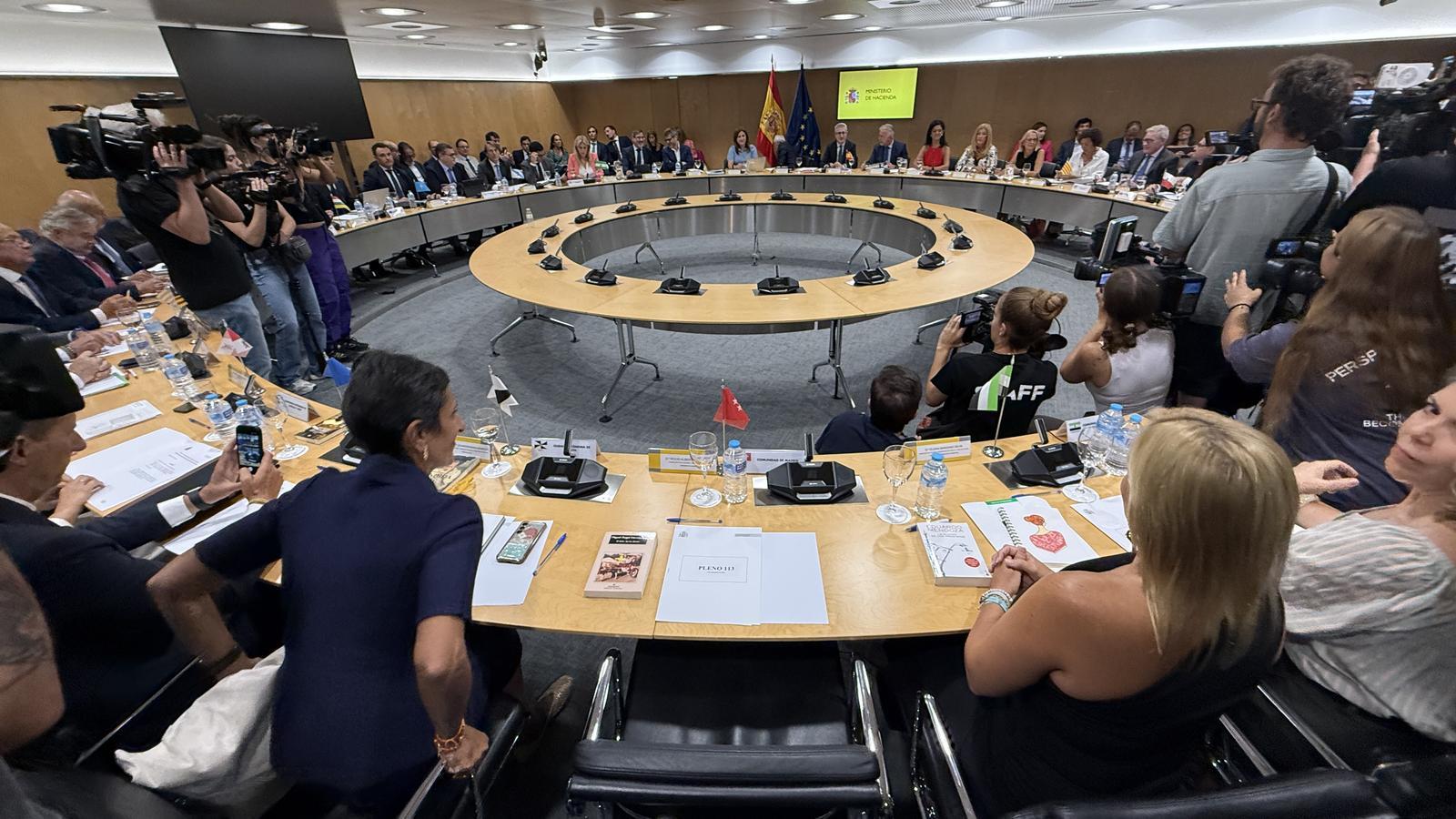

MadridThe Community of Madrid called for a "boycott" of the Fiscal and Financial Policy Council to prevent the financing model from being approved this Friday, which will now begin its journey in the Council of Ministers and the Congress of Deputies. If the PP-led communities had followed her lead and skipped the appointment, the meeting could not have been held due to a lack of quorum, effectively vetoing the approval of the system. However, this has not been the case: the regional leaders of the Popular Party have not followed Isabel Díaz Ayuso, and Madrid has remained alone in its absence from the meeting, as the rest of the regional finance ministers, despite the fact that they will vote 'no' to the financing system, are indeed at the meeting. In other words, there is only one empty chair at the table presided over by the Minister of Finance, Carlos Cuerpo, with all the representatives of the autonomous regions, including Catalonia, this Friday in Madrid. Only the Madrid finance head, Rocío Albert López-Ibor, is missing.
How have the PP-led autonomous regions justified their decision to attend the meeting? Before entering the Fiscal Policy Council, which is being held at the Ministry of Finance's premises on Paseo de la Castellana, they had already stated that they would attend the meeting and that, however it is expressed, the underlying message is the same. "We all oppose the system," each of the ministers who stopped to make statements has been repeating. "We express respect for the Community of Madrid," said the head of Finance of Murcia, Luis Alberto Marín. "The position is the same, but we express it in a different way," added the representative of Galicia, Miguel Corgos. "We believe that there is freedom for all communities to decide [...]. We understood that we had to come here to explain why we were voting no," said the Andalusian Carolina España. All of them, however, have expressed their rejection of a new model that they consider is only designed to guarantee the "survival" of Pedro Sánchez.
The negotiation in Congress
The system is expected to move forward at the meeting of the Fiscal and Financial Policy Council with the votes of the State, the Generalitat, and also the Canary Islands, which reached an 'in extremis' agreement with the Treasury. The Minister of Economy and Finance of the Generalitat, Alícia Romero, in statements to the media, expressed her satisfaction with the new model, which she assured "respects ordinality" and that Catalonia comes out a winner with additional funding of 4.7 billion euros. The Generalitat's thesis is that the system benefits all autonomous communities because they gain more resources and the funding gap between them is reduced; a view not shared by either the PP autonomous communities or those governed by the PSOE, which also oppose the model. In fact, Castilla-La Mancha and Asturias will say 'no' today, aligning themselves with all the PP autonomous communities.

For its part, the Ministry of Finance is attending the meeting with a "constructive spirit" and a desire for "dialogue" to reform a system that, they recall, has been expired since 2014 and that no Spanish government has dared to reform until now. Regarding the absence of the Community of Madrid, ministry sources remark that they already postponed the Fiscal Policy Council meeting in favor of dialogue at the end of July and that throughout the summer the Finance Ministry's mood has been to negotiate. "They have not accepted any of our proposals," complain, however, the PP and PSOE communities, who see that the system is already closed due to the pact between the PSOE and Esquerra.
Be that as it may, the Finance Ministry does assure that during the processing of the law in the Congress of Deputies they are willing to change aspects of the model. They have no other option: even if it is approved this Friday at the Fiscal and Financial Policy Council, it must then be approved by the Council of Ministers (in ten or fifteen days, according to sources) and then the processing in the Congress of Deputies must begin. At this point, the government and Esquerra will need the support of Junts, which until now has shown itself to be against the agreed system because it believes it is insufficient.
Minister Romero has asked Carles Puigdemont's party this Friday to sit down and negotiate, since Catalonia would come out a winner—she said—and that at least they should not "block" its passage through Congress. Junts sources clarify that their position is that the financing model should pass the first step in the Spanish chamber (they would present their own amendment to the entirety that would not prosper), but that if the "economic agreement" is not incorporated—that the Generalitat can collect all taxes—during the processing, their vote will be against it in the final vote. Esquerra has been negotiating the delegation of personal income tax (IRPF) collection with the Finance Ministry for months, but until now the ministry has resisted accepting it, despite it being a 'sine qua non' condition for the investiture of Salvador Illa.
