University makes us more left-wing

-
CAT -
CAST
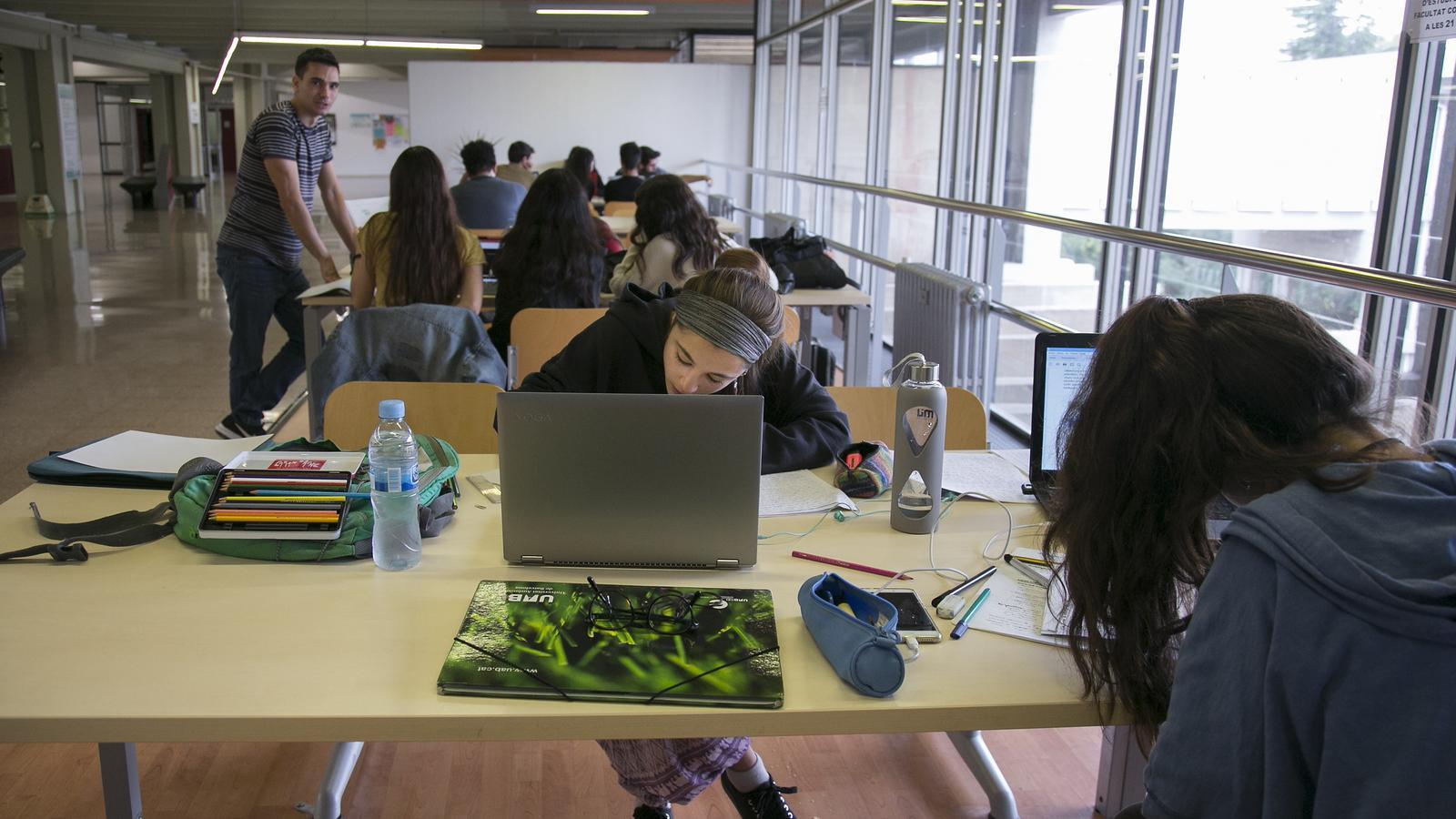
The new academic year for undergraduate students in Catalonia has already begun, or is about to. Some will go to university for the first time: this year, nearly 60,000 have pre-enrolled in one of the Catalan public universities. Mind you, only 6 out of 10 will study at the center they had chosen as their first preference, a structural challenge that has been dragging on for years. When they finish (and the majority will), they will be part of the nearly 40% of people aged 15 or over in our country who have higher education, including university degrees or higher vocational training.
The university stage is usually situated in a vital period known as secondary socialization. Beyond childhood, which has already forged part of our character, values, and our way of being, the way we think, including our ideology, still has to receive a push in the post-adolescent stage. After all, as some studies indicate, a good part of the acquaintances we make in life occur when we are under 25 years old. The university phase, which usually goes from the end of adolescence to the first adult years, also coincides with a period known as the "impressionable years." The attitudes and values we acquire there sculpt our political self. This does not imply that after university a person cannot change their mind, but it is precisely during this vital stage that people fill an ideological bag that they can carry for a long time.
But what ideology are we talking about? Does the university stage politicize? It is true that participation at the polls does not reach its peak, on average, until we are between 50 and 65 years old, and that the most common pattern for university students in elections is abstention. However, political activation can occur in many forms, from associationism to protest.
A non-random choice
The evidence gathered so far indicates that the time spent at university modifies, even if only slightly, our values and attitudes. On the one hand, however, it should be noted that the choice of a university degree is not a random event. Students will enroll in studies they have chosen, but, for sociological, economic, political reasons, or all of them at once, they will have peers who resemble them. For example, if we look at the data from Catalonia, we observe that some stereotypes hold true. Although the university student, compared to the general population, is located further to the left, it is observed that students in economics and business or law degrees are the most conservative. At the opposite end, we find students of architecture, political science, communication, and life sciences, who are more left-leaning. In contrast, other specialties, such as education and computer science, have students with more moderate positions and a less politicized profile.
Research conducted in other countries shows us that, even taking this self-selection into account, the time spent at university can slightly modify people's ideology. In the United Kingdom, for example, it has been shown that levels of racial prejudice or authoritarianism decrease during the time spent at university. Likewise, in a pattern that has been confirmed in the United States, university students who choose specialties related to the natural sciences or the social sciences and humanities become more left-leaning than they already were, while those in economics and law take precisely the opposite journey.
In our country, the lack of data prevents us from performing a similar exercise. However, if we focus on the effect of the LOGSE, the education law that was approved in 1990 and which extended compulsory education until the age of 16, we observe a similar pattern. Thus, while the law was being implemented, those who completed two additional years of compulsory education ended up being more left-leaning than those who were of a similar age and finished their education earlier. Mind you: for the moment, we do not know if this shift to the left is the result of the content studied, the effect of the relationships formed, political action within the university, or all of these combined.
The curious chart of the week
What do we pay in taxes and what do we receive from institutions? A classic question that perhaps many readers ask themselves when it is time to file their tax returns, take the Rodalies train, or visit the doctor. The answer, beyond anyone's ideology, also depends significantly on our age. The difference between what we pay and receive follows a life-cycle trajectory: an average individual is a net recipient during old age and in the stage that goes from childhood to the immediate post-adolescence. According to calculations made by an EsadeEcPol report, the fiscal balance of an average individual reaches its peak around the age of 50: at this age, a net contribution of about €11,000 per year is made. In contrast, around the age of 70, the deficit is about 16,000 euros per year. In a normal year, around 41% of the population is a net contributor. A figure that, given demographic trends, is on its way to continuing to fall.
