Maria Barbal: "They even wrote that I was the Heidi of Catalan literature"
The life and work of Maria Barbal motivates 'Words for the silence', by Carme Arenas, where she is described as a humble, tenacious and free author

-
CAT -
CAST
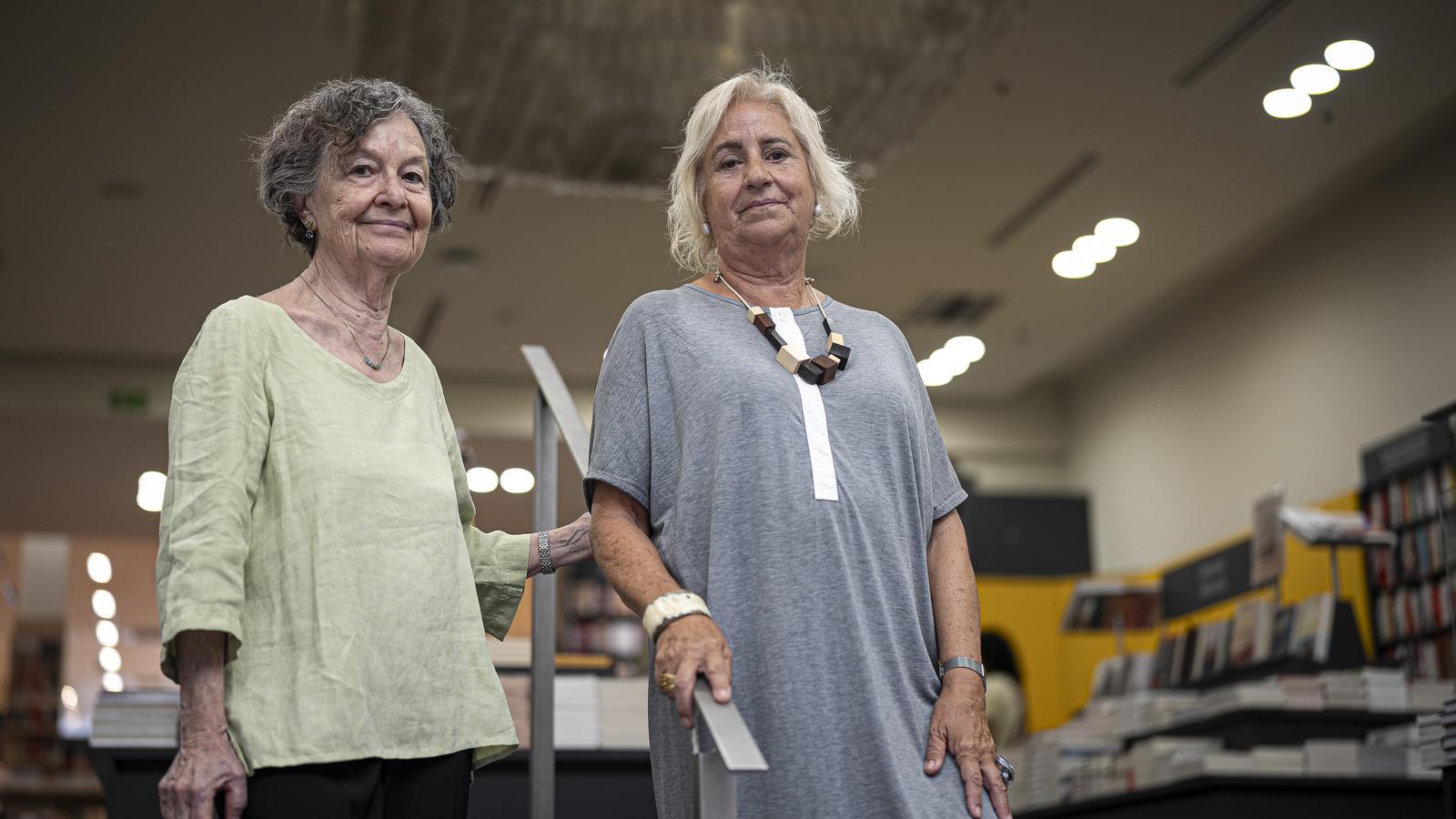
BarcelonaAlthough the humility and shyness that have always accompanied him make it difficult for him to express himself with much expansiveness, Maria Barbal (Tremp, 1949) is happy to have, since this September, a literary biography like the one dedicated to her by Carme Arenas (Granollers, 1954), Words for silence (Column). "Carme took an interest in my writing from very early on, and I am grateful to her that it was so. In the end, I ended up becoming one of the sources of documentation for her book —she admits with a minimal smile—. Although at first I resisted the project a little, I must recognize that I have ended up drawing benefits from it. It has helped me to become aware of the trajectory I have had, and also to remember from which people I come".
Born in Tremp during the early post-war period, Barbal and her older brother grew up in "a family that needed to work to eat". The writer recalls that recently, during the birthday of a friend who was turning 80, she "had the courage to explain" that she had gone hungry. To the author of Stone of scree (Laia, 1985) her voice breaks and she says: "I had been through it too". Words for silence traces Barbal's childhood in Pallars, her arrival in Barcelona to complete her higher baccalaureate at the Institut Montserrat, her philosophy and literature studies at the University of Barcelona during the second half of the 60s—the city, Arenas recalls, was bursting then "with a desire to open up and participate in everything that was happening in the world," despite the obstacles placed by the Franco regime—and, once she had graduated, her entry into teaching, first by giving vocational training classes in Besòs and, later on, as a Catalan language teacher for second-year BUP and COU at the Institut Joan Maragall in Barcelona.
"Writing Words for silence I have confirmed several issues regarding Maria —says Arenas—. The first is that she is a great worker, and that like other people of her generation, she had to build an entire world, first that of teaching and then that of literature, which now run the risk of being lost again". The second issue that Arenas highlights about Barbal is the "freedom and tenacity" with which she has always worked. "Barbal's work emerges with Stone of scree, which she published in 1985 after winning a youth literature award, the Joaquim Ruyra —she comments—. For more than 40 years, the novel has had many readers, both in Catalan and other languages, especially German. It has been a success that has been maintained throughout all this time. Unlike other authors who have made themselves known by winning a prize that has become a burden for them, Barbal has gone on writing what she wanted".
A life that wants an extension
With the cycle of novels about Pallars, consisting of Pedra de tartera, Mel i metzines (La Magrana, 1990) and Càmfora (La Magrana, 1992), Barbal's literature was labeled as rural. "They even wrote that I was the Heidi of Catalan literature," she laments many years later. "Sometimes when I was signing books, a reader would approach me asking if the novels were set in a village, as if that somehow sullied them." Barbal celebrates that reading literature set outside of large cities is no longer seen as a problem. "In the 80s there was a very strong desire for modernity and books by authors like Maria Barbal and Jesús Moncada were out of place," recalls Carme Arenas. "Now there are many novels that value origins, whether they are rural or not."
Barbal has also set several novels in Barcelona, among which are Emma (Columna, 2008), En la pell de l'altre (Columna, 2014) and Tàndem (Destino, 2021), winner of the Josep Pla award. "Although my first novel has always been the best regarded, I have continued writing. I haven't been completely discouraged," says Barbal. "I wrote because I needed to. I have always been moved by the interest in discovering how the stories I had in my head continued. I needed to write to live being who I am, and I have been lucky enough to share 50 years of life with someone who did not find it strange that I dedicated myself to it." At this point, she refers to her husband, Miquel Embodas Farriols, with whom Barbal had two children and who died in 2022, only a year after the author was recognized with the Premi d'Honor de les Lletres Catalanes.
"I would like to be able to add an extension to this biography of mine that you can now read," says Maria Barbal. A year and a half after publishing Peripècies (Columna, 2025), the writer is working on a new novel. "I'm doing it without much rush," she admits. "I cannot reveal any details." The author then falls silent, as the characters in her books often do, because the silences there are as important as, or more important than, the words spoken.
