Anti-fascism points to Aliança Catalana as the great enemy to be fought in the streets
Demonstrations against the extreme right have marked the Diada

-
CAT -
CAST
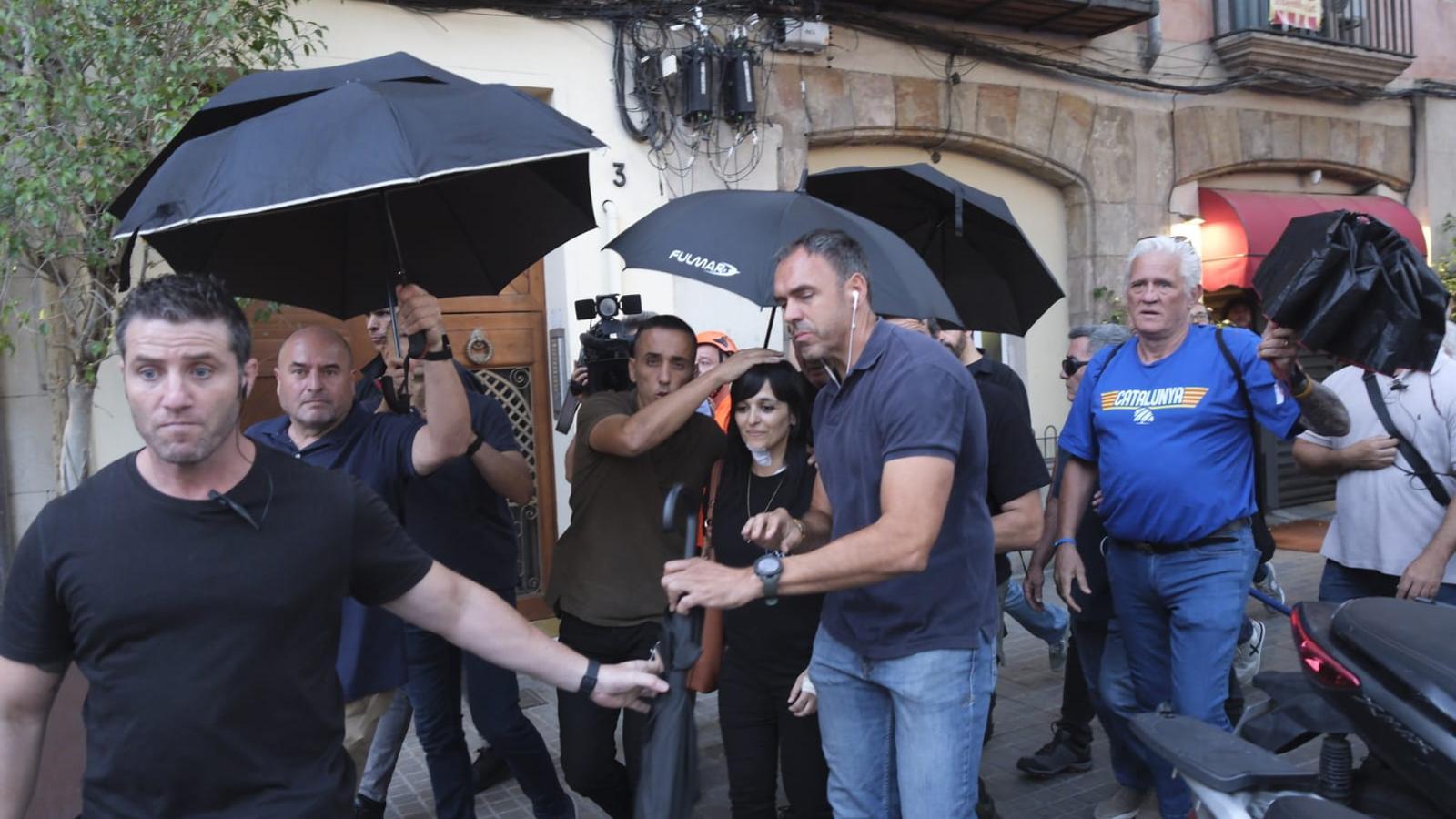
BarcelonaThis Friday, hundreds of anti-fascists demonstrated against the Vox event in Barcelona, where their leader, Santiago Abascal, had not appeared for two years. This has been the third mobilization by the far-left in just seven days. On Thursday the 10th, they took to the streets en masse to boycott the Aliança Catalana event at the Fossar de les Moreres, and the following day they did so again against the ultra-right group Núcleo Nacional, which held a rally with fascist salutes and slogans. In all three counter-demonstrations, incidents occurred and the Mossos d'Esquadra charged to prevent clashes with those organizing the events. But what are both sides seeking with their calls to action?
The pro-independence left believes that the presence of the far-right on the streets cannot be normalized. "Fascism is not and will not be welcome in our home, neither when it dresses in Spanish nationalist flags, nor when it exhibits an exclusionary and racist Catalan identity based on reactionary discourses," commented Sofia Peris from Arran at a press conference on Thursday at the Fossar to denounce the police action of the Mossos. She was accompanied by the CUP spokesperson, Su Moreno, who, in conversation with ARA, ratified the same position: "The far-right must be fought in the institutions and on the streets, and we cannot grant them any space."
The CUP leader also recalls that it was the PSAN, one of the founding parties of the pro-independence left and which is at the antipodes of Aliança, that reclaimed the events at the Fossar: "Stoking identity-based and exclusionary hatred in this space is a provocation." From Sílvia Orriols' party, they counter that no party can appropriate a space like the Fossar, where the martyrs of 1714 lie, because it is a symbol of the country. "The Fossar is not and will never be theirs, but rather belongs to all of us who fight for the independence of Catalonia," underline sources from the far-right pro-independence movement.

Oriol Gès, organization secretary of Aliança, argued on Wednesday that his party "has the same rights as other parties to hold a public event." In an interview on El matí de Catalunya Ràdio, one of the party's key figures did not spare criticism for the program's host, Ricard Ustrell, who on the eve of the Diada recalled that members of the Boixos Nois had offered to act as security for the event. "His statements were regrettable and he should rectify and apologize to the Catalans who trust in Aliança because we have the same rights as others to hold an event without having to suffer insults, boycotts, attacks, and threats from the extreme left like those we suffered on the Diada," he snapped without mentioning the presence of this Barça ultra group, which assaulted photojournalist Jordi Borràs. "Pointing out precisely those of us who suffer this violence is deeply unfair and irresponsible," he said, and insisted again that the violent ones are the anti-fascists. Anti-fascism, for its part, accuses them of promoting violence with their discourse.
Fight for independence
The CUP and Aliança have two ways of conceiving independence that clash. "Nowadays, independence is in a certain dispute due to Aliança's desire to associate it with the right and the bourgeoisie when it is of the left and the working classes," notes Moreno. Aliança Catalana, on the other hand, considers that the pro-independence parties do not have the legitimacy to fight for their own state after the failure of 9-N and 1-O. "Catalonia will only be able to be independent with a nationalist party that prioritizes the interests of the Catalans because the country suffers from their erratic, "woke and far-left policies," Gès never tires of repeating.
But who gains the most from the incidents? The journalist specializing in the far-right Xavier Rius Sant has no doubt that it is Aliança: "Counter-protests reinforce it because it plays the victim and it does not take votes away from it." The author of the book Aliança Catalana: els nostres ultres (Icària Editorial) states that counter-protests are "counterproductive" because "mediatically they give it a prominence it would not have without protests." In this sense, he reveals that neither the CUP in Vic nor in Ripoll organize acts against Josep Anglada or Sílvia Orriols because they are aware that "the tension benefits both leaders."
Xavier Torrens, author of Salvar Catalunya (Editorial Pòrtic), the other book that has been written about Aliança, also corroborates Rius' words: "Holding a counter-protest is a gift to Aliança's political communication campaign without any harm." The professor of political science at the University of Barcelona also believes, however, that it is also positive for the CUP: "Mobilizing their base helps them to have a prominence and strengthens them in a context of electoral decline, but at the same time it favors the growth of Aliança." Moreno claims that mobilization strengthens the pro-independence left, but that above all "it is good for the country" because Aliança "makes it impossible to advance in national liberation."
