50 years of demonstrations for the Diada: “The police behaved well. They must have thought that soon we would be in charge”
The Generalitat commemorates the first authorized demonstration for the National Day after the death of Franco

-
CAT -
CAST
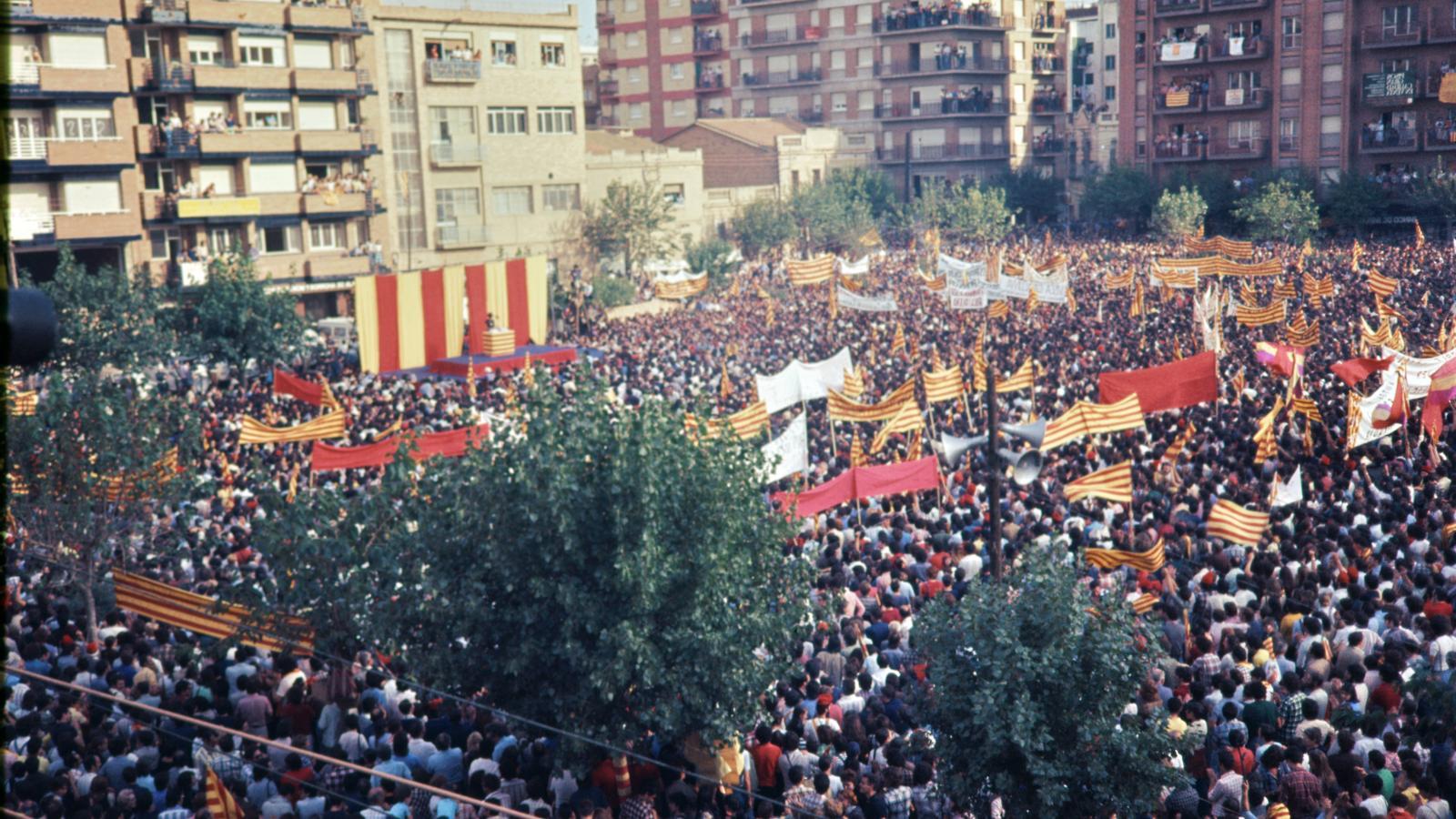
BarcelonaPeople of all sensibilities united with one goal: to organize without incident the first authorized demonstration after the death of the dictator Francisco Franco on the National Day of Catalonia. Fifty years ago, on September 11, 1976, figures from the PSUC, from Jordi Pujol's circle, from the pro-independence republicanism, and, among many others, from socialism set aside their differences to take a giant step in the national and democratic freedoms of the country. A spirit, that of democratic unity, which the president of the Generalitat, Salvador Illa, has now set as a model in the face of the rise of the far-right, both Spanish and Catalan.
Miquel Sellarès, who among many other things was one of the founders of the Assembly of Catalonia, was also involved in the organization of that mobilization. In conversation with the ARA, he recalls that the ideological divergences were substantial among the organizers. "There was everything from the Carlist Party to some eleven Marxist or Leninist formations, laugh at the current CUP," ironizes the man who was also one of the founders of Convergència –and collaborated with ERC–. Despite the parallels that might be drawn with the current situation, fifty years ago there was still a dictatorship even after Franco's death, and freedom of assembly was not very common. Sellarès highlights the willingness of such diverse people to work hand in hand: "The involvement of the PSUC was key. It had great convening power and, in fact, it was known as The Party," he recalls.
The initial intention was to call the demonstration at the Parc de la Ciutadella in Barcelona, but when the Francoist regime saw the posters, it stopped it. "They didn't want it to be in Barcelona or for it to say National Day," recalls the lawyer Magda Oranich, who also attended the protest. In the end, they received the authorization, although they had to hold it in another location. It was then that Sant Boi was put on the table, where Rafael Casanova, the chief councilor of 1714, is buried. "At that time, Sant Boi was not connected as it is now and it seemed to us that it was far from everything," indicates Sellarès.

Despite the new location, the protest was massive. The organizers quantified that about 100,000 people had attended, although subsequent studies –taking into account the images and the space– lowered the figure to about 30,000. "Be that as it may, there were a lot of us and it was very symbolic," remarks Oranich, who highlights that it also served as a prelude to the great demonstration of the Eleventh of September of the following year: with the slogan "Freedom, amnesty and Statute of Autonomy", it gathered nearly a million Catalans in the center of Barcelona.
Oranich recalls that, in the protests a few months earlier, the Francoist police had still charged and repressed the demonstrators without mercy. Even so, the lawyer assures that they already went to Sant Boi "without fear", because that demonstration was already authorized. In fact, Sellarès explains that the Spanish police "behaved well" and attributes it to the fact that they must have thought that "soon we would be the ones in charge".
Neither Oranich nor Sellarès see parallels between that Diada of half a century ago and the one of now, as the Government does. And they do not see the spirit of unity among Catalanism there either. "There is no common project nor the leaderships of before. Discouragement reigns," laments Sellarès.
Illa dreams of the “unity” of '76
Despite the current polarization, Illa continues to appeal for the “unity” and “consensus” that was felt in Sant Boi de Llobregat. At the commemoration event for the half-century of that demonstration, he urged the "democratic Catalanism" this Thursday to recover the "lesson" of the protest from 50 years ago, and to emulate the "unity" and the "consensus" that reigned back then. Before it was to stand up to Francoism and now to the far right that is reviving.

The head of the executive has remarked that the protagonists of the demonstration half a century ago did not have an "easy path," and has called for inspiration to be drawn from their "spirit" and to "roll up our sleeves" to "preserve" Catalan and democratic institutions. "We must fight to maintain them," insisted the president of the Generalitat.
He also defended an "integrating" Catalonia and recalled that at the protest fifty years ago there were above all senyeres, but also Extremaduran, Galician, or Basque flags. "The freedom that was demanded in Sant Boi was not for a few, it was for all those who dreamed, lived, and worked in this land, wherever they came from," added the socialist leader, who will precisely travel to Extremadura next week to celebrate the Diada there again.
Various authorities attended the event in Sant Boi de Llobregat, such as the president of the Parliament, Josep Rull, the mayor of Sant Boi, Lluïsa Moret, and a good number of ministers, as well as the former president José Montilla, and one of the fathers of the Constitution, Miquel Roca, who spoke at the 1976 demonstration. The presenters of the event were the journalists Manuel Campo Vidal and Àngels Barceló.
