All the celebrities of Maricarmen
The housing cause has achieved a lot of adhesion in recent days on the part of certain types of celebrities, but very little on the part of others: the 'influencers'
-
CAT -
CAST
BarcelonaTraditionally, artists who earned a living performing concerts at local town festivals tended to bite their tongues on political issues. Taking a public stance could lead some vengeful mayors not to hire them for the festivals in the towns they governed, and this could harm them greatly. That is why in a Spain where the musical offer is vast, the market is limited, and city councils are very important hiring agents, it is so common for artists—with some exceptions...—to have always been very politically discreet.
This has happened and continues to happen especially to the most famous ones, who are the ones with the most media impact when they speak out on political issues. That is why their silence is especially painful: they are a reference point for many people—who listen to them more than to sociologists or political scientists...—and what they said would have a much greater impact. But despite having a greater capacity to resist than other smaller artists, in their case the revenge could be double, since in addition to losing contracts from some councils, they could also lose opportunities with public television stations here, there, or everywhere for prolonged periods depending on who governs them. In times of low activity, competing in Masterchef, being a judge on some talent show, or performing the televised New Year's Eve concert is a good extra dose of oxygen to weather the storm.
However, that professionals are hired or not hired based on their thoughts rather than their talent is a sad reality against which only a very few personalities can fight. For example, those who earn their living abroad. A very clear example of this is Pedro Almodóvar, who, with an already well-consolidated wealth and earning money from all over the world with his productions, is not as vulnerable to possible boycotts at home. While his habitual statements in favor of more disadvantaged groups are invaluable, it is clear that he can make them from a calm that many others in his profession do not have. In the same way that this can be argued, it must also be recognized that the director from La Mancha has never held back much when it comes to taking a stand against the interests of powerful people.
In all scenarios
The case of the eviction of the elderly Madrid resident Maricarmen Abascal, however, has brought out of their homes many more well-known people than one might have expected, since in the face of injustices similar to this one, many of those who have now publicly positioned themselves against real estate speculation are not remembered for any contribution. Whether it was because of the anti-eviction device that the Madrid Tenants Union set up at the door of her building or the subsequent encampment at Puerta del Sol to pressure political parties to approve the decree that bears the octogenarian's name, the trail of well-known faces that have been seen is very broad.
The singers Rozalén and Ismael Serrano, the actors Alberto San Juan and Juan Diego Botto, and the comedian Facu Díaz are some of the names that have joined this cause. Also, comedian Ignatius Farray and the singer-songwriter and poet Marwan have shown their solidarity with her and with what she symbolizes, something that has also been done by actor Carlos Bardem, director Sergio Peris-Mencheta, communicator Samantha Hudson, actress Aitana Sánchez-Gijón, actor Daniel Guzmán, and presenters Inés Hernand and Alba Carrillo. The singer-songwriter from Badalona Miguel Poveda, the footballer Borja Iglesias, and the musical group Amaral have also had their say, even if it has not been in person. All of them in the wake, as always, of an indefatigable Ana Belén, who is decades ahead of them in this regard and who was one of the first to come to support Maricarmen at her doorstep.
Amaia of Spain
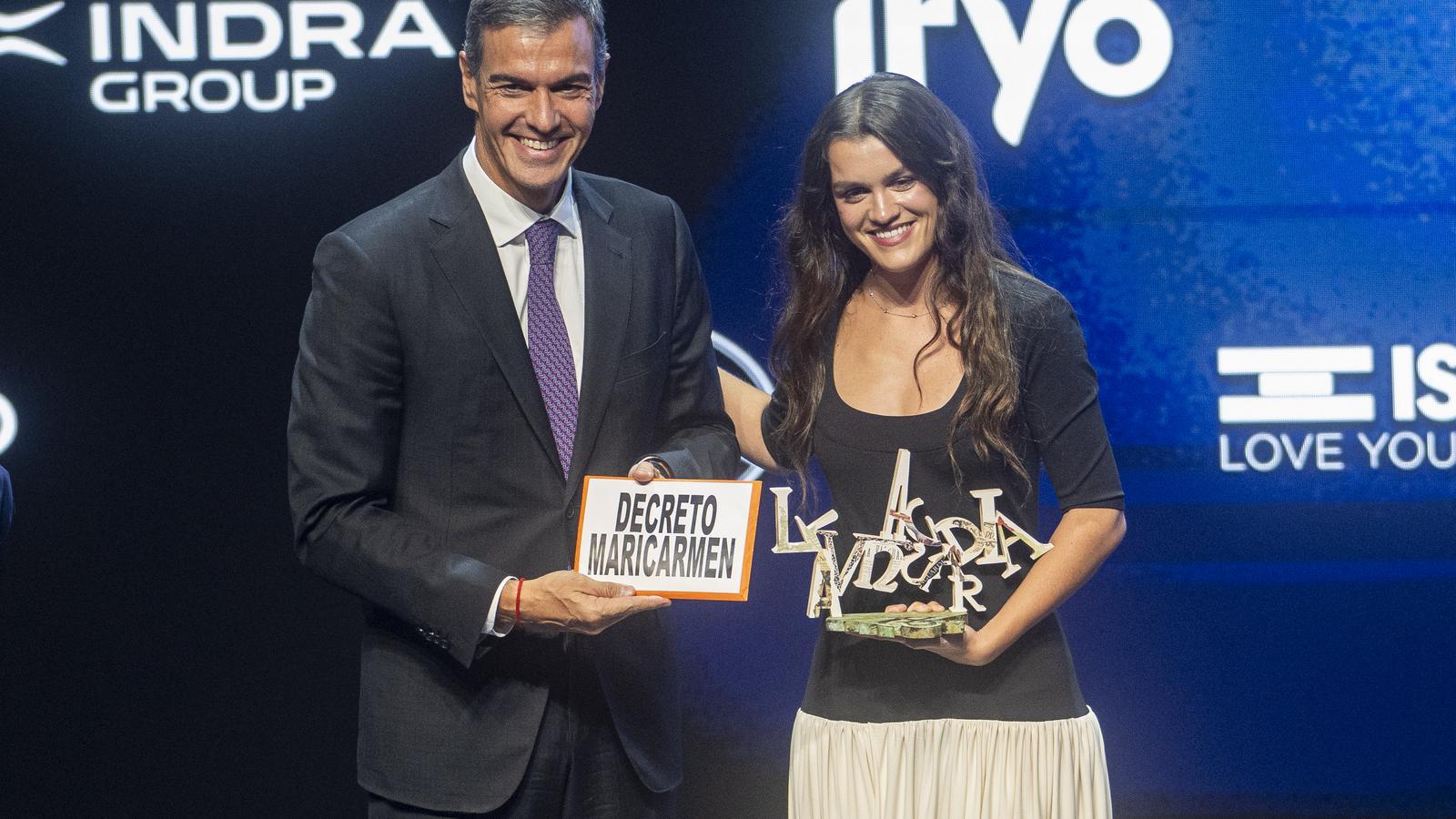
Also noteworthy is the contribution of singer Amaia Romero, who stood out significantly above the rest at the Vanguardia Awards ceremony this week. When she went up to accept her award, the Navarrese artist handed the President of the Spanish Government a card on which two words were written: Decreto Maricarmen. This gave a lot of visibility to the cause and somewhat overshadowed the recognition being given to the artist. But Romero did not mind this at all, something that few would have wanted to happen if the award had been for them.
Altogether, these celebrities represent a significant group of well-known faces of all kinds who are rarely seen publicly supporting any cause. But it is true that this mix of celebrities is missing those of the latest generation: influencers, those who have the most impact among young people, who are the most affected by the housing problem.
To put it elegantly, the shyness with which the millionaire social media profiles have approached this popular outcry has been pathetic. The role models for the youngest on Instagram and TikTok have not found the time to make their contribution—a very small one compared to the privilege in which they live—to this cause. We assume that it is mainly because they earn so much money from such an early age that by the time they reach the age of having a housing problem, they already have the apartment bought and, perhaps many times, also paid for. In fact, this is so true that some sometimes take the opportunity to create content with the second homes they acquire or, in cases of greater insensitivity, even explaining the good business they plan to make with them.
Look away
And this does not mean that young people who work as influencers are nearsighted and do not see the world around them. On the contrary, they are very aware of it, since everyone who is part of their teams and their real friends have the same problems as the bulk of society. But it is true that if the celebrities of the past –the artists– could live off their shows if they had the support of the public despite occasional boycotts, influencers cannot. No matter how much the people who follow them might applaud their openly political content if they were to make it, their economic activity is directly linked to the advertising campaigns they post on their networks. That is why they are much more vulnerable to the pressures of economic power, and that is why they are so cautious. It is not, however, that this justifies silences that turn out to be glaring, because it is understood that at a minimum they should be able to take a stand. Especially in such basic causes.
To the extent that they remain silent, they teach the young people who idolize them that staying silent is a valid option in the face of certain injustices. Something that the generations who idolized artists never learned from their idols. As long as this continues to happen, certain interests that are not those of the working classes are making headway more comfortably than ever. For now, this model stands tall, but at the rate that the precarization of everything is advancing, these silences will not be tolerated by young people, who will see how all their likes for certain internet figures never translate into a bit of empathy in return.
