Winter is coming (politicolinguistic)
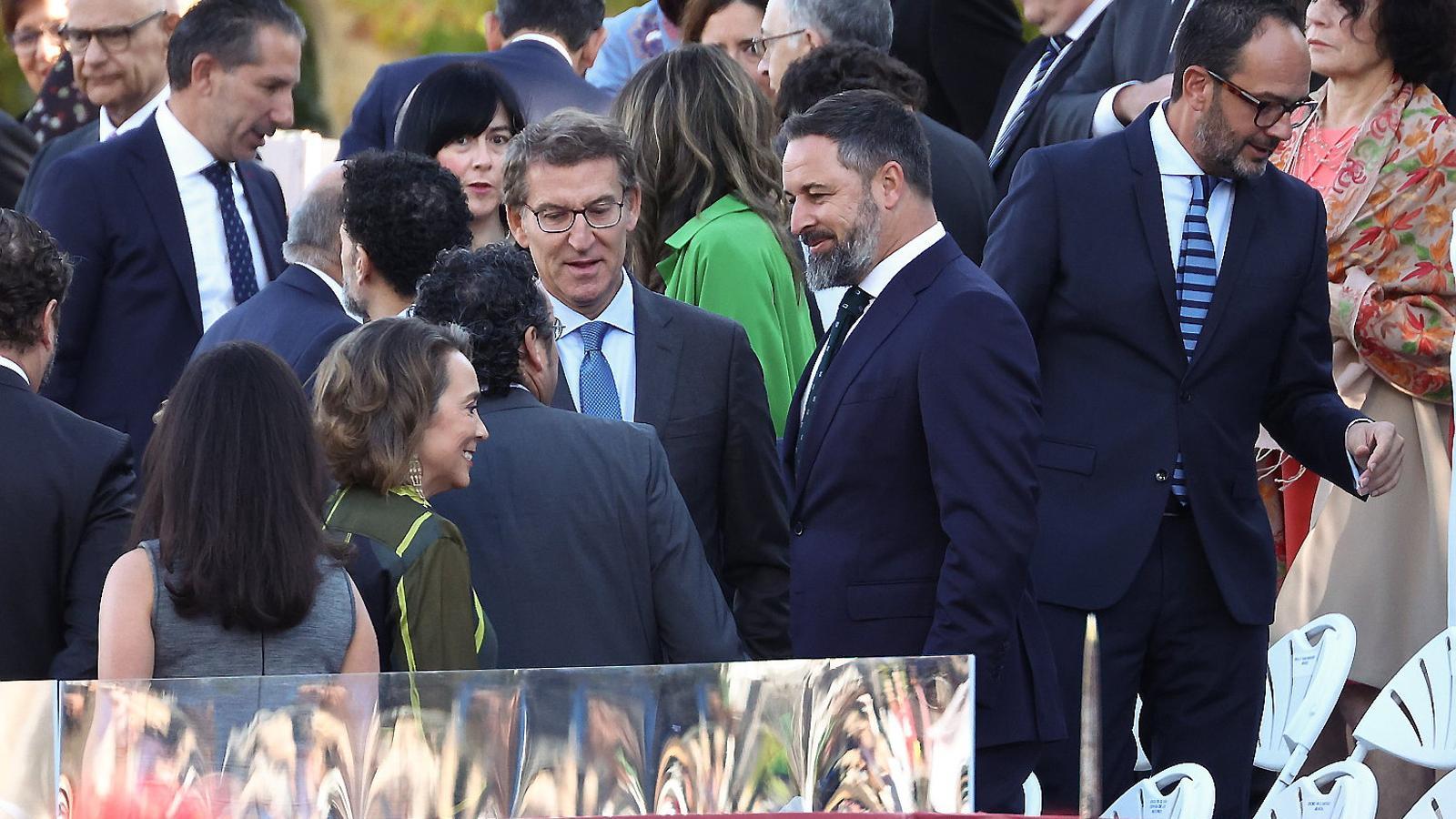

In his commentary on the YouGov survey commissioned by this newspaper, David Miró did not hesitate to declare that, looking towards 29-N, “the uncertainty is no longer who will win but the magnitude of their victory”. In the specific case of linguistic policy, what changes should we expect with a possible coalition government between the Popular Party and Vox?
Alberto Núñez Feijóo's electoral program points to two areas where there will be certain changes. Firstly, the government will promote a reform of the Congress of Deputies' regulations to return to the situation prior to the 2023 elections, so that Catalan, Basque, and Galician can no longer be used in plenary sessions or in any other situation. When the number 2 of the PP for Madrid defended that the first measure she would adopt would be to eliminate the “pinganillos” (earpieces) in Congress, a Catalan candidate for the PP rejected the idea, with the argument that the earpieces did not “bother” anyone. Perhaps they do not bother some sectors of the PP, but they do infuriate their prospective coalition partner. In this campaign, the PP is on a head-on collision course with Sánchez, but it has Vox in the rearview mirror, and it is not surprising that it champions proposals more typical of the Spanish nationalist far-right than of a modern European conservative party.
The PP also promises that it will guarantee the alleged constitutional right to receive education in Spanish at all stages of the educational system. The program does not provide further details on how this will be done; in the interview he granted to La Vanguardia, Feijóo recalled that he comes from an autonomous community where they seek a system of “linguistic balance”, in which 50% of classes are taught in Galician and the other 50 in Spanish. (In the 2023 program the PP promised that it would guarantee that, in autonomous communities with two official languages, both would have the consideration of vehicular languages “in accordance with the pattern of linguistic balance”.)
Naturally, apart from these measures that explicitly appear in the electoral program, there are others that will foreseeably be applied. The PP-Vox government, for example, will formally withdraw the request for Catalan, Basque, and Galician to be official languages of the European Union institutions, a proposal that Feijóo's party has dedicated itself to torpedoing from day one. The PP-Vox government will also not allow the processing of initiatives such as the Organic bill for the guarantee of multilingualism and the linguistic rights of citizens before the State institutions, which was left pending in Congress with the dissolution of the Courts. Additionally, there are measures that are not in the PP's program but in Vox's, some of which have already been put into practice in the autonomous communities where they govern with collusion. In its program this year, for example, Vox reiterates that it will guarantee that the lack of knowledge of the “regional” languages will in no case be an impediment to access to healthcare staff positions.
Of all these harmful measures, foreseen or foreseeable, there is one that could still be stopped before the PP and Vox access the government. The Constitutional Court must rule on the constitutionality of the Catalan law 8/2022, the law that recognizes Spanish as a vehicular language (under the euphemism of “language of curricular and educational use”) and leaves in the hands of educational centers the determination of its effective presence in accordance with pedagogical criteria (read: not numerical, but not ideological either). If the TC retains a shred of sense of state, it will constitutionally shield the linguistic-school model as specified by this law, which expressly avoids any idea of exclusivity for Catalan. Otherwise, it will pave the way for the PP-Vox coalition government to devise a reform of the organic law on education to implement its idea of linguistic balance in Catalan schools.
If the triumph of PP and Vox is as inevitable as David Miró said, and if in the end the Constitutional Court also rules against it, how can one preserve a linguistic policy that continues to realistically protect and promote the Catalan language? Someone might think that the only alternative to Spanish nationalism or ultra-nationalism consists of having one's own state. The results of the latest survey on Knowledge and linguistic uses in Andorra show that political sovereignty does not necessarily prevent the decline of the language, because there are sociolinguistic dynamics that are independent of independence.
