Sánchez Piñol and the Buddha of Montaigne
-
CAT -
CAST
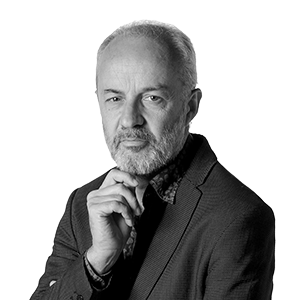
I run into Albert Sánchez Piñol on the street. We hadn't seen each other for years. I was a passionate reader of his. He likes excitement, and in a matter of seconds we are already arguing about politics, of course. A hasty dialectical combat. But neither I, nor the person accompanying me, an ex-girlfriend of his, have any intention of convincing him: we already know what he thinks. Annoyed, he turns on his heel and leaves. That's Albert! He has hot blood. Surely we agree on one thing: both he and I only know how to read and write, nothing more. Naturally, he writes muuuuch better.
Now that elections are approaching, there will be many rushed political conversations, face-to-face or via WhatsApp. What I like is chatting without the need to have to win. My erotic dream is for the interlocutor to make me doubt. Gadamer defended the art of letting oneself be convinced, the pleasure of not being right. It's very difficult, eh? Catalans, as Mediterranean Latins, get heated. From the Pyrenees upwards, things go more smoothly.
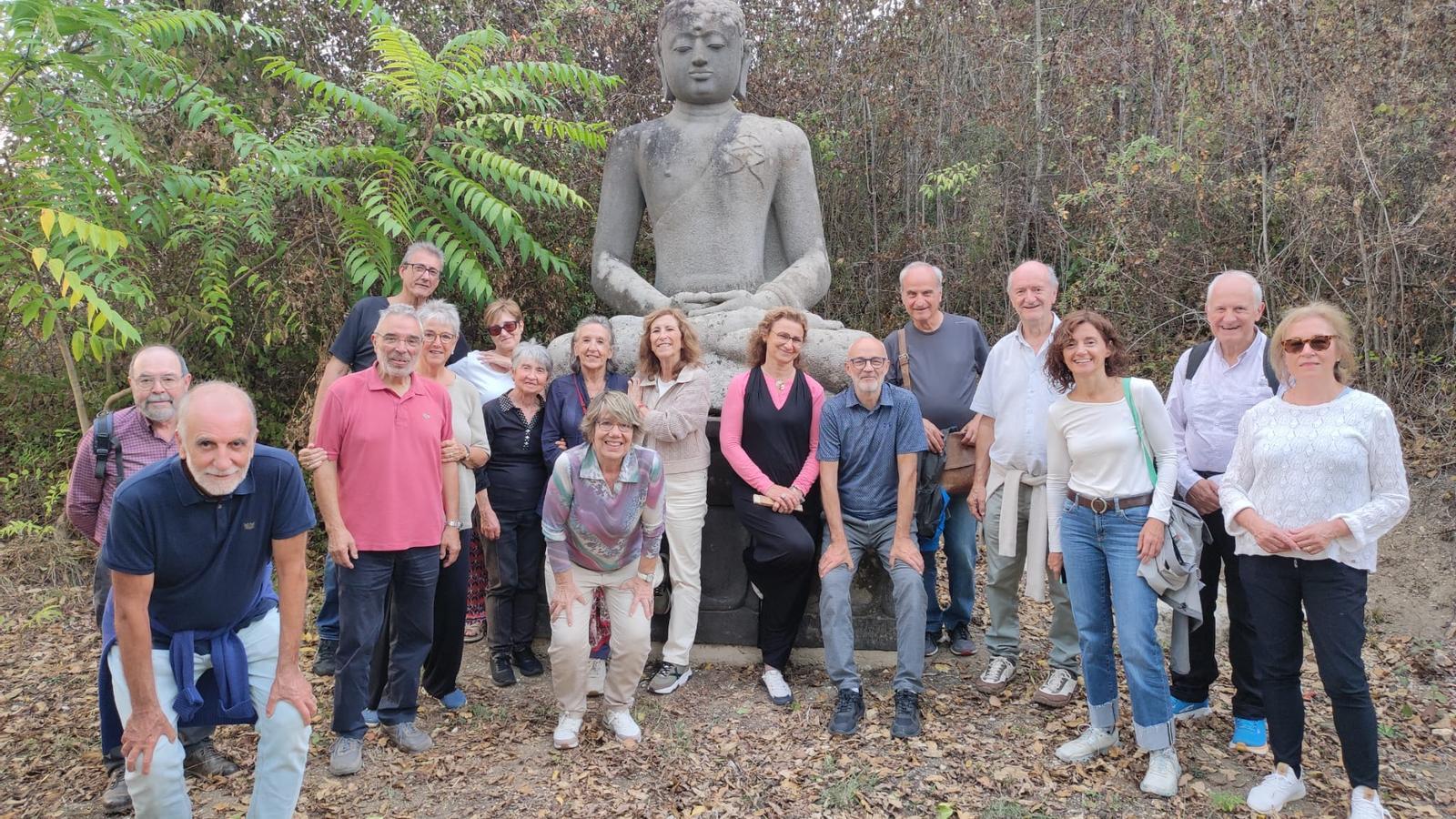
I have verified this in recent days in Michel de Montaigne's Périgord. We were a group of ARA readers. At restaurants, they would put us in a separate room so as not to disturb the tranquility of the French tables. One of the travel companions, Mariano, an architect, nailed it: "There's all kinds of people". In reality, it is a quote: it is what the bullfighter Rafael Ortega once replied when he was introduced to Ortega y Gasset and told that he was a philosopher. "There's all kinds of people". An entire philosophy that explains quite well what the author of the Essays thought. We are all unique -some noisier than others- and at the same time we all embody the human condition. To cultivate conversation or friendship, we must be clear about Montaigne's motto: "I am me because you are you".
In the small town where Montaigne's castle is located, we met Pascal, a kind of artist MacGyver, who showed us the four-ton Buddha in his garden, a piece brought a few years ago from Japan to Bordeaux. A Buddha in Montaigne? I cannot imagine the sage of the Périgord enlightened by nirvana. Spirituality was not his thing. He kept his feet on the ground. He was a moderate, skeptical gentleman who, inspired by Greco-Latin philosophers, aspired to the good life and living well. Absolute ideas, religious ones included, were more of a hindrance than a help to him. But surely, as a good seeker addicted to reality and diversity, he would have been curious about the Buddha. It would have allowed him to keep rethinking himself, dialoguing with himself and with the world.
Dialogue? That is precisely what does not happen in an election campaign. Vomit disguised as ideas reigns supreme. The theater of the worst politics. In a democracy, politics should be about listening, conversation, pacts, participation, solving problems and conflicts. A vocation for public service. A high-ranking official told me recently: "I don't work for those at the top [the politicians], I work for those at the bottom [the citizens]". Work! During the Process, as obsessed and excited as we were, we forgot to make the country work: schools, healthcare, housing, language, trains, renewable energies... Now the problems are piling up for us.
Without giving up anything, it is time to get back to work. This week, a posthumous tribute was held for Josep M. Sans Travé, "the Pujol of archives," a nationalist scholar who never stopped working hard. We owe him the ambition of having created an imposing and efficient National Archive and the tireless determination to have the papers of Salamanca returned. One day he described one of his collaborators, Àngels Bernal, as an "active pessimist." Well, that's it; no matter how difficult we see everything, it is time to roll up our sleeves. And if possible, with intelligence and reasonableness. That is, for example, how the Canadian Carney faces the reckless and all-powerful Trump.
In the 16th century, in the midst of religious wars, no joke, Montaigne was an advisor to the Huguenot Henry IV of France (formerly Henry III of Navarre), whom he advised to show clemency towards the Catholics. Yes, conversation, tolerance, and work. This applies to Madrid and Barcelona. But I fear we are not heading in that direction.
