Rufián, an unexpected battering ram
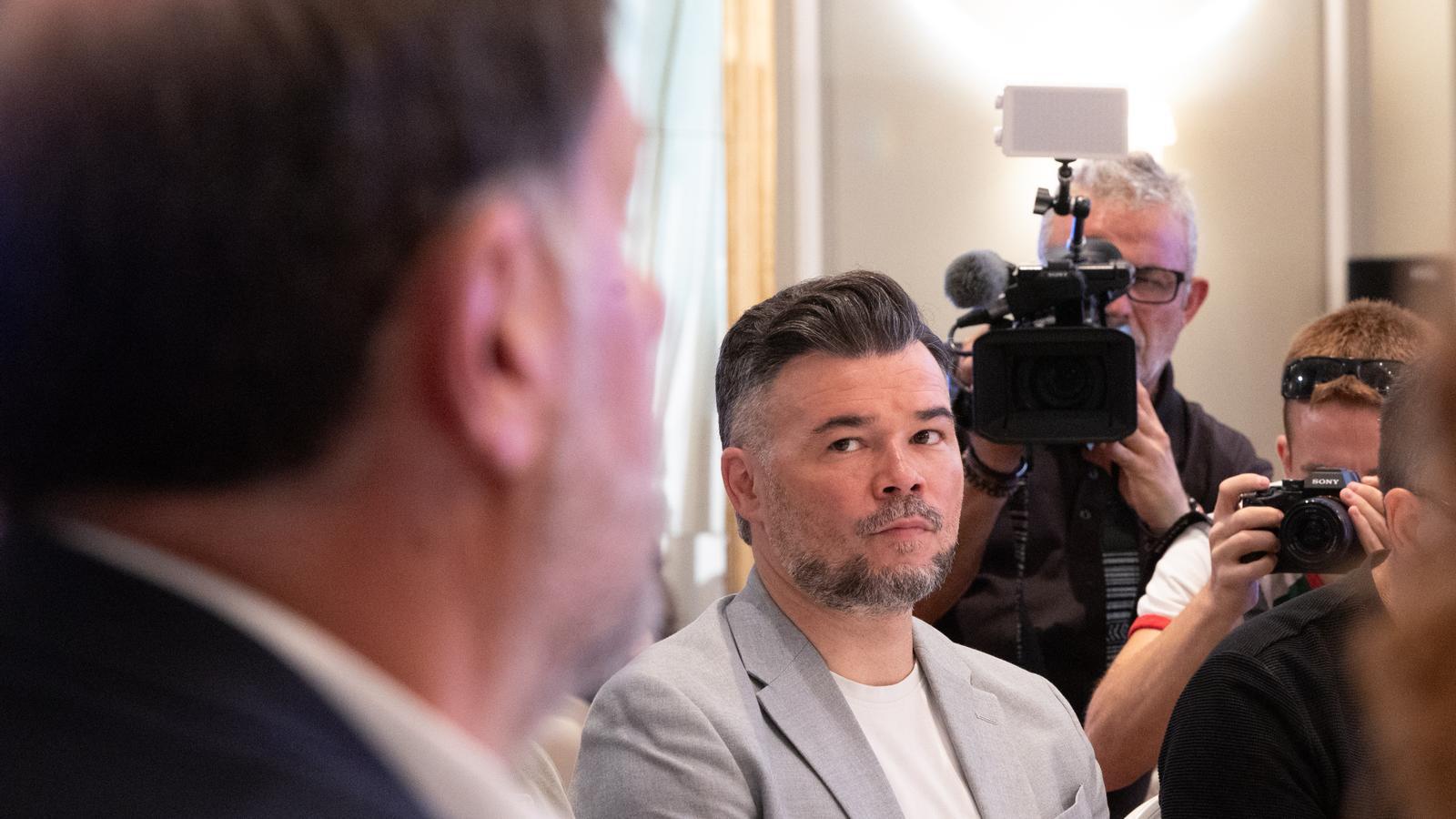

Unitary platforms against something (everyone united against a common enemy) are an invention from ages ago that sounds very good in anthems and can mobilize dormant wills, but experience tells us that Fronts, whether popular or patriotic, only exert their centripetal force in concrete, short-lived, and highly tense situations. Afterwards, the diversity of origin and destination, of likes and dislikes, causes plurality and rivalry to return, which are the basis of the system, and which are only rejected by those who wanted to use the unitary fever to avoid a failure on their own.
Despite everything, in the current context and with the existing electoral system, it is true that the coincidence of several lists to the left of the PSOE could put into the hands of the right some seats that, depending on how close things are, could turn out to be decisive. That Rufián asked for intelligence and calculation to optimize results in some provinces was, therefore, not nonsense. Another issue is that Rufián has his own agenda, which perhaps would have been imposed if his party—which continues to be ERC—had yielded to his pretensions. In this context, Sumar and its satellites interpreted that they had the excuse to impose a single candidacy throughout Spain; with different labels, yes, but monitored from Madrid.
What this whole Frente Amplio story confirms is that reality is stubborn, and that in Galicia, the Basque Country and Catalonia (at the very least) the national left-wing parties have no intention of subordinating their sovereignty, and they are quite right to do so. It is also true, in the Catalan case, that the Comuns have enough weight not to resign themselves to dissolving into the ERC list. They are two formations to the left of the socialists, with many similarities, but they profess a loathing for each other that practically began in 1936, with the founding of the PSUC. And which has sharpened since the ephemeral mandate of Pere Aragonès, and since Ada Colau took the mayoralty of Barcelona from Ernest Maragall.
ERC has had to make sacrifices to appease Rufián, but it has also used him as a battering ram to weaken this eternal rival. The agreement with Irene Montero harms Colau's options and sharpens the fratricidal struggle between Sumar and Podemos. Yesterday, Rufián lamented not having been able to convince his own, asked for forgiveness from the voters, and so on. It is hard to say whether his disenchantment is sincere or if he has already started campaigning. The fact is that he will be the head of the ERC list and that is all, and at the same time he has reached a confederal-style agreement with Podemos, which is resigning itself to disappearing from Catalonia (where it no longer mattered). If ERC knows how to explain the dual nature of its proposal well (which is not easy), it will be able to "broaden the base" –its own, not that of the independence movement– and demonstrate that its sovereignty does not make it insensitive to the threat posed by a PP and Vox government. It represents a healthy contrast with the accidentalism of Junts.
Oriol Junqueras has overcome a poisoned situation, but he has also postponed a problem. Rufián continues to mark his own profile with the same ease as always, and in an election campaign this can cause some short circuits. For the one from Santa Coloma to be a true asset to the party, he must make himself present in Catalonia and assume the strategy of his fellow party members. In Spain, Rufián can flirt with Sumar and support the PSOE against the rampant right, but in Catalonia, the priority objective of ERC is to take votes from the socialists, replace the Comuns, and not cut bridges with Junts. Defending this while Rufián acts like a rogue in Madrid is a filigree within the reach of very skilled politicians with a lot of influence over the voters.
