When peoples disappeared "as a punishment from God"
We discover the scientific aspects of the Snow Museum, in Unha (Val d'Aran)

-
CAT -
CAST
Snow is a good thermal and acoustic insulator thanks to the air it contains, which is why igloos are a good invention for spending cold nights. In fresh snow, the proportion of air reaches 90%. The Museum of Snow (Musèu dera Nhèu) dedicates a good amount of space to the scientific aspects of snow, whose germ is curiously hexagonal. This center is located in the small municipality of Unha, near Baqueira, the homeland of downhill skiing in the Aran Valley. The museum's manager, Montse Ademà, who guides me through this space located just a few steps from her home, is precisely from Unha.
The museum tells us about avalanches, an aspect that is not insignificant in this beautiful valley for a double reason – yes, aran means valley – which faces France. "Aran is a high mountain territory where 51% of the surface is potentially affected by avalanches." This is data provided to me by Jordi Gavaldà, from the Lauegi d’Aran Center, which is dedicated to avalanche prediction and mountain safety in snowy conditions. I am surprised – positively – by this precision, which certifies that they have it very well studied. It's not half, but a little more than half. If a partner in a company with 51% of the shares has absolute control, then snow has absolute control of the Aran Valley. "Avalanches have affected villages, forests, and communication routes for centuries, and in recent years, mountain sports enthusiasts and off-piste skiers have been added," he tells me. "Is off-piste skiing allowed?" I ask him. "Yes, but you need good preparation, training in snow and avalanches, to carry basic avalanche safety equipment – and be trained in its use – and to be well informed about the weather conditions and the snow you will be skiing on," Jordi tells me. "And what is the basic safety equipment?" I ask him. "It consists of an avalanche victim detector (DVA) – an electronic device that allows you to locate a person buried under the snow – a probe, and a shovel," explains Jordi, who skis as easily as he walks, with extraordinary facility. Skis have been incorporating elements that make them more effective and safer. The museum allows you to get an idea of how ski equipment has evolved. In the beginning, everything was extremely rudimentary: the main material was wood, and safety measures were non-existent.

Jordi knows very well how avalanches are triggered. "Considering the cohesion of the snow, avalanches are classified into two types: slab and point-release. Slab avalanches occur when a cohesive layer of snow resting on a weak layer of snow has a sudden overload, such as the weight of a person, breaks and moves downhill. They are the most dangerous for mountain activity practitioners," Jordi specifies. "As for point-release avalanches, the fracture starts at a single point near the snow surface, and the avalanche incorporates snow during its descent," he explains. "They are not usually as large, but they can also cause accidents.
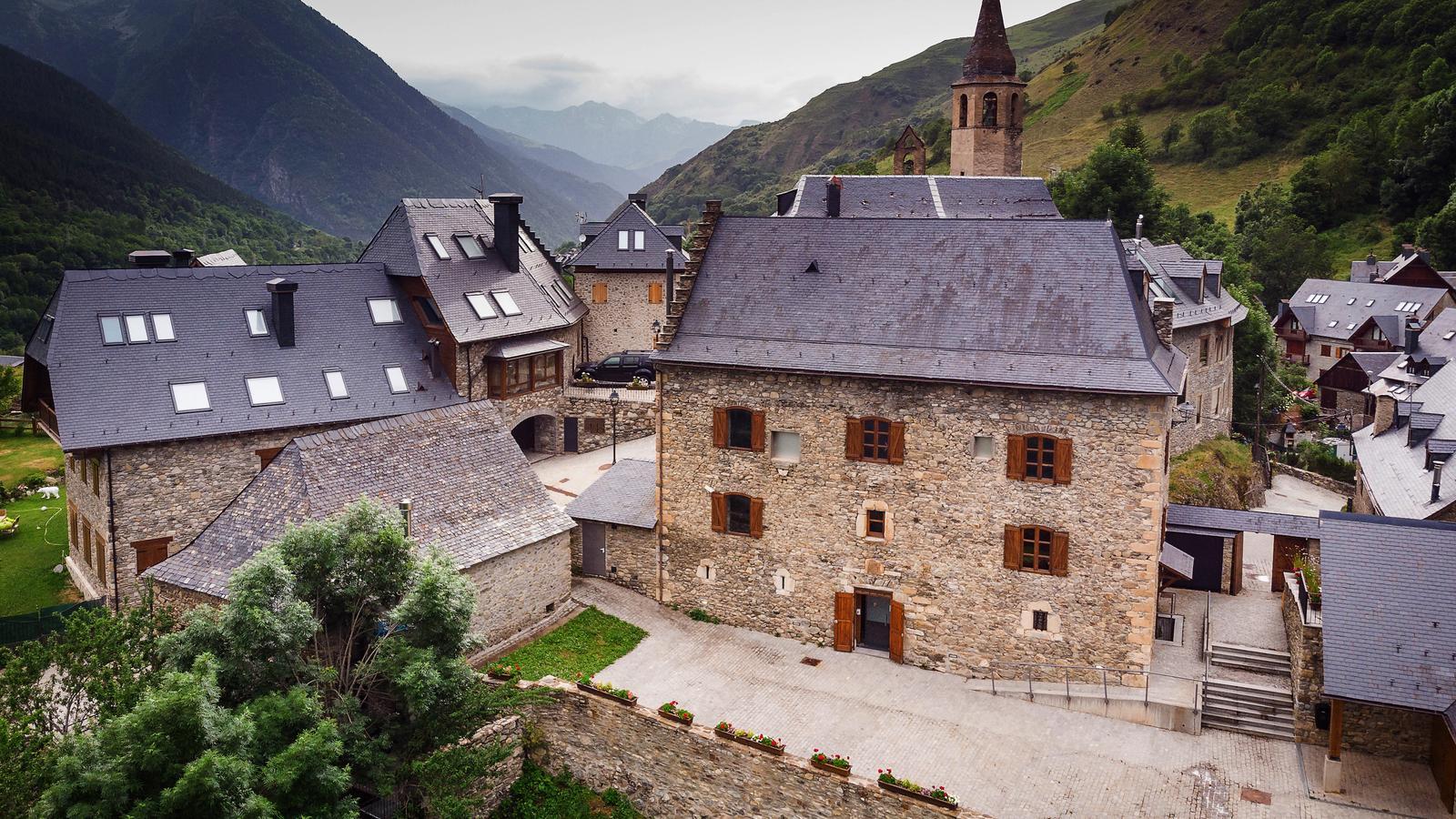
The first written reference to avalanches affecting our region is found in the 1925 book Memòries de Casa Lobato. It took place in 1444 in the small Aranese village of Gessa. "The entire village disappeared due to an act of God, due to the snow that came down from the mountain and changed the river's course".In the year 1600, a large part of the village of Unha was devastated by an avalanche. Fifteen people died there, who had gone to another house to be safer. And the village was reborn a little further up. They took advantage of the 12th-century monastery to build the new church there. The large house where the Snow Museum, Çò des de Baile, is located, from the 18th century, which preserves the Renaissance facade, was built after that tragedy.In 1758 a poví (a powder snow avalanche) seriously affected the village of Garòs and destroyed its church bell tower, which was rebuilt with donations from parishioners. And in 1855 – in April, after winter had passed! – an avalanche in the village of Era Cassenhau, in the Toran valley – one of the least known and best preserved places in the Aran Valley – caused sixty fatalities. This was the deadliest avalanche in Catalonia and the Spanish State.
If you go to the Aran Valley, don't miss the Snow Museum, which transports you to the extreme harshness of winters in this mountainous territory, where snow posed a challenge for survival. On several occasions, Aranese people had to leave their homes through the first-floor window because the entrance door had been blocked by heavy snowfall. Or they would place the porró near the fire because otherwise the wine would freeze. When the Bonaigua pass – opened in 1923 – and the Viella tunnel – opened in 1948 – did not yet exist, the valley was often completely isolated by heavy snowfalls. It was even difficult to get around inside. One of the oldest items in the museum is a beautiful, quite large sleigh that transported bread through the Aran Valley, pulled by horses.
Twelve people have lost their lives to avalanches in the Pyrenees in the winter of 2025-26 On January 31, 2003, after heavy snowfall, there was an episode of high avalanche activity. One of them fell on the Baqueira plain and affected a significant number of houses. It was the spark for the creation of the Centre de Lauegi d’Aran, which, from the first snowfalls of autumn until well into spring, daily studies the state of the snowpack and publishes avalanche danger bulletins, following the guidelines of the EAWS (European Avalanche Warning Services), of which it is a member.
Avalanche accidents mainly occur during winter mountain sports (ski touring, snowshoeing...) or activities around ski resorts, such as freeride, off-piste skiing and snowboarding. Particularly worrying have been the accident data for the winter of 2025-26: in the Pyrenees as a whole, twelve people have lost their lives in avalanches in nine accidents.

