"Tell me which motorcycle you have and I will tell you which helmet you wear"
The "uncomfortable" helmet transforms into a pillar of design and connectivity
-
CAT -
CAST
In the collective memory of those who traveled through cities during the nineties, that television campaign by the General Directorate of Traffic still resonates, which, under the slogan "Ponte el casco", tried to convince a generation of motorcyclists of the importance of wearing a helmet during their journeys.
Back then, the helmet was perceived almost unanimously as a punitive formality, a bothersome, heavy, and sweltering item that was carried hanging from the arm or the motorcycle handlebar until a police patrol was spotted. Three decades later, the cultural metamorphosis is absolute. Today, the helmet has not only become an unquestionable element of personal protection on a motorcycle, but it has also conquered urban micromobility (electric scooters and e-bikes) and even ski slopes, becoming an object of desire, identity, design, and high engineering.
How has this revolution occurred in which protection has learned to become “invisible” thanks to materials science and digitalization?
From sanction to identity
The evolution of the helmet reflects the change in urban society itself. If thirty years ago the user saw it as an obstacle that flattened their hairstyle or limited vision, today no one questions the use of the helmet and a piece is demanded that combines safety, ergonomic comfort, design and even, an expression of identity.
“Cultural transformation is based on technology and a real concern for safety,” points out Vicente Jiménez, product specialist at the Japanese firm Shoei. “Improvements in active safety, improvements in ventilation, fit, comfort, and weight reduction through aerodynamics allow the driver to concentrate one hundred percent on driving” without suffering fatigue.
“It is a reality that today's motorcyclist is much more demanding than the one from before, and also has other types of needs, from using their motorcycle to go to work every day, to sporting use on a track, and the biggest growth in recent years: motorcycle trips”, they also point out from the firm.
This contrasts between the buyer looking for a high-end product and the reality of markets with different degrees of maturity in helmet use. “In many emerging countries, the majority of users do not use helmets or use non-homologated helmets, but we forgo that part of the market to focus on homologated helmets with maximum quality and design, which are considered premium in many countries.” This is explained by Ivan Abad, CEO of MT Group, the company of Murcian origin that has become the European manufacturer with a presence in more than 120 countries.
In the current two-wheeler market, there seems to be an unwritten axiom: "tell me which motorcycle you have and I will tell you which helmet you wear." "In this world, the motorcycle a person rides marks the type of user and the use they give to the helmet. Motorcycle-user-helmet go hand in hand and we keep this very much in mind every time we design a helmet," explains Abad. "For us, the basis of the design starts from understanding the user, and among our team there are many motorcyclists of different styles who end up being part of the testing road team," adds the R&D director of MT Group, Alberto Murcia.
And all of this affects not only safety but also aesthetic design. “Offering designs that are attractive to the user has become a fundamental thing for the brand,” highlights Jiménez. “In a global market, every client has their preferences when it comes to design. In South America, there are bolder designs with more vivid colors, in Asia they ask us for designs with oriental motifs, while in Europe they are more sober, with many plain, black, grey, or white helmets. And we adapt,” adds Abad. In fact, he points out that this flexibility is what has allowed them to reach so many countries.
One of the most profound sociological changes is the breaking of gender bias. Historically, this sector has maintained a markedly masculine focus. The presence of women was treated very superficially. According to Abad, it is true that "in terms of design, practically everything was resolved by adding pink, but that is changing; furthermore, most products are unisex. In our case, we have many designs and color variations per design, and some are approached from a more feminine perspective, but we do not categorize the helmets by gender".
Within this change where women become active drivers, Abad directly links the design strategy with the visibility of women in high-performance competition. “On the other hand, our commitment to women's motorcycling is clear, as we have María Herrera on our MT Riders team, who precisely became world champion for the second consecutive year with our helmet. We hope this helps to give visibility to women as elite riders; fortunately, there are more and more women riding motorcycles, and driving, not as passengers”.
This growing female and youthful presence has opened the door to new alliances where the helmet goes beyond traditional motor channels to become a style accessory. As an example of this connection between fashion and urban mobility, Abad explains the recent collaboration of MT Helmets with Brownie, a fashion company focused on teenage girls, which wanted to make a collection of products to celebrate its 20th anniversary. “They contacted us to develop a helmet with an exclusive design framed within this collection. So we now have a helmet in the window of fashion stores”.
The battle of weight
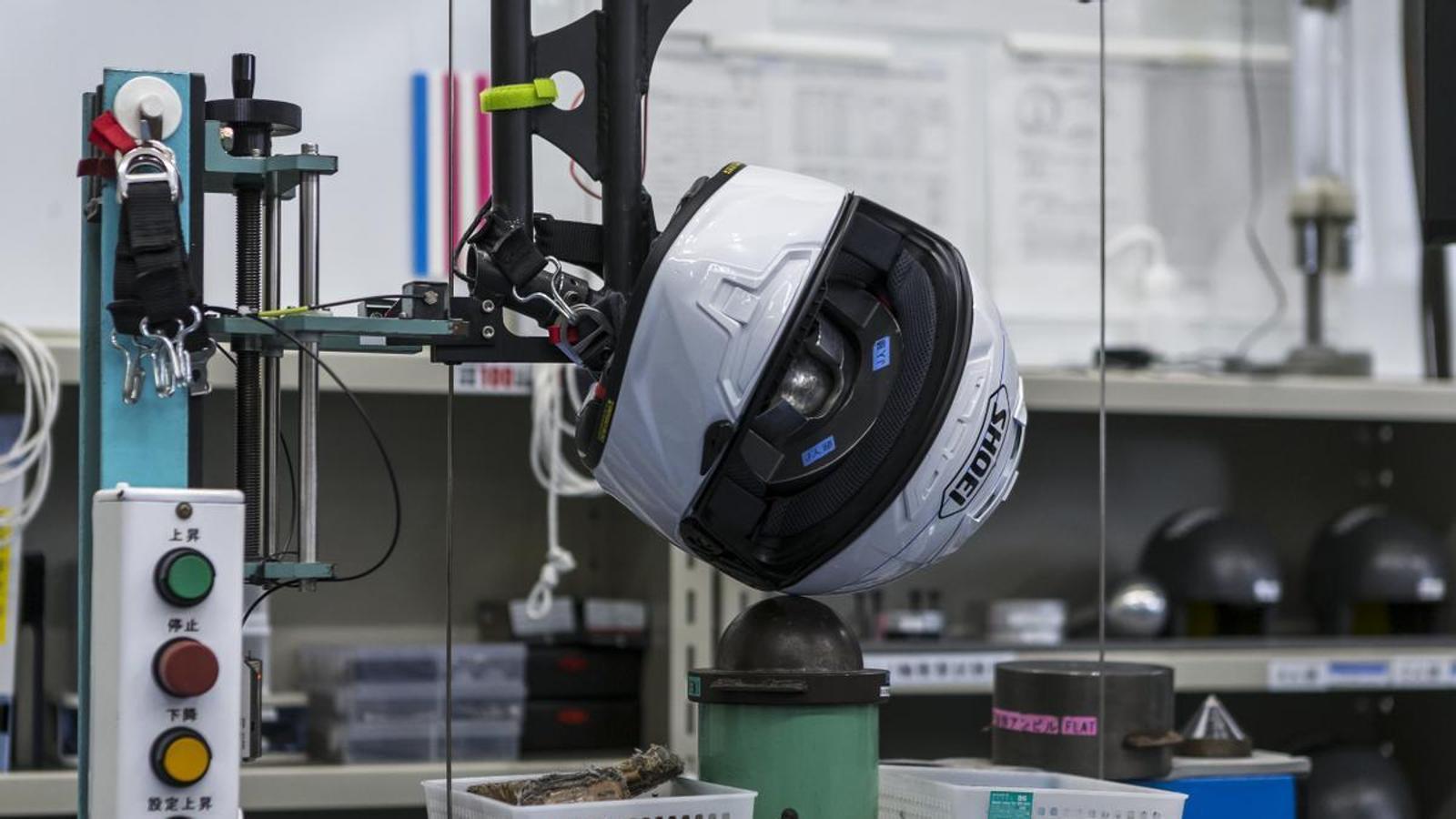
Beyond the early designs of decades ago, the entry into force of the new European ECE 22.06 approval currently requires passing much more demanding tests, including rotational impact tests to simulate the friction forces that the brain suffers when falling at an oblique angle.
Passing these exams without making the helmet heavy is the great challenge. Alberto Murcia explains this from the technical laboratory that the company maintains in Cartagena. “MT has always counted on high safety margins, so passing the new 22.06 was not a problem. In this case, a complete review of the weakest areas was carried out, making significant improvements, especially in the area of the screen mechanism and sun visors” and “creating formulations that, together with a specific design, would achieve a helmet response to an impact that is superior to that of more expensive helmets”.
The maximum exponent of this race for lightness is the MT KRE 2 PLUS, the only Spanish helmet with FIM #2 certification for MotoGP and the lightest in the world in its category (1,250 grams).
These improvements applied to elite competition helmets also have a direct application in day-to-day city life. As Murcia himself remarks regarding the benefits of this weight reduction, "the development of products for the most demanding users, such as professional riders, ends up impacting technologies that we then apply to the rest of the range," such as helmets for street users, where weight becomes a great differentiator without affecting safety.
For its part, Shoei bets on its AIM+ technology (organic fibers, glass fibers and high-performance ones) and on development in two of its own wind tunnels in Japan, and an All Weather tunnel capable of simulating rain, wind and temperatures of up to -5 ºC to guarantee absolute stability and acoustic insulation. “In addition to field tests in the hands of professional riders, tests in our wind tunnel are fundamental during the design and development of our helmets in order to achieve optimized aerodynamics”, explains Jiménez from the Japanese brand.
However, the best materials engineering is of no use if the helmet does not fit correctly. A 2025 study by the RACC and ANESDOR (National Association of Companies in the Two-Wheeler Sector) reveals a worrying fact: in 20% of motorcycle accidents, the helmet flies off due to not wearing the right size or not being fastened correctly. In this regard, Shoei has focused on personalized ergonomics with the development of its PFS (Personal Fitting System) service. According to Jiménez, since the end of 2022, they have offered this service at specialized points of sale where the customer can acquire a completely custom-fit helmet: “This is the only real service of its kind that exists in the world, with specific measurements, with specific tools, and with a computer-assisted system that applies the necessary changes based on the user's ergonomics and using more than two hundred different adjustment pieces”, a program that the brand has been developing in Japan for over fifteen years.
Visor screens
The second great functional revolution is the transformation of the helmet into a connected device. If a few years ago intercoms were attached as external packs that generated aerodynamic noise and rigid points, today the industry trend is internal integration.
“Lately, all smart devices are very fashionable, and of course the helmet is not isolated”, acknowledges the R&D director of MT Group. “For us, the queen technology that makes the helmet smart is the intercom. Since 2020, we have been incorporating into practically all models some systems that allow for the installation of an intercom in an integrated way, where the only thing that sticks out is a small button panel, and this allows the user to have a better-balanced helmet in terms of weight and aerodynamics”.
The step towards augmented reality is marked by Shoei with the launch of the GT-Air 3 Smart, in collaboration with the company EyeLights, which allows for the incorporation of an integrated Head-Up Display (HUD) visor. Regarding the goal of bringing GPS navigation information or calls directly to the visor without distracting the rider, Shoei explains that “answering or making a phone call, receiving GPS instructions, or listening to music are common actions in our daily lives, whether riding a motorcycle, driving a car, or taking a walk. Reflecting this information through a latest-generation HUD visor is a comfortable and safe way for the motorcyclist to keep everything in their field of vision, without the need to take their eyes off the road”.
"Just as the first motorcycle intercoms hit the market 20 years ago, and today have become a practically indispensable accessory, it is not unthinkable that a HUD visor, as a technological accessory that contributes to safety, could follow the same steps in a few years," adds Jiménez.
Regarding the engineering challenges of including screens, microphones, and batteries without compromising structural safety or making the helmet bulky, “in all helmet models that incorporate an integrated sun visor, safety is not affected at this point thanks to an increase in the outer shell without sacrificing the thickness of the EPS (expanded polystyrene), and thanks to a careful design, it does not look like a bulky helmet”.
In this sense, the technology incorporated into helmets could provide a response to specific urban risk points. According to a 2026 RACC report, 53% of motorcyclists consider turns at intersections with bidirectional bike lanes to be dangerous. From the same mobility club, Max Zañartu, project manager of the RACC mobility area, points out that, although features such as better peripheral vision, LEDs, or blind spot detectors provide an additional layer of protection, "technology can help, but it cannot replace good infrastructure," which is why he calls for action directly on the design of intersections and roundabouts.
The scooter fever
Outside the strict scope of the motorcycle, the use of the helmet has experienced exponential growth in the new urban mobility. According to the data from the 5th RACC Barometer of Mobility in VMP (2025), the use of the helmet among electric scooter users in Barcelona has skyrocketed to 91% in just one year, following the entry into force of the new Municipal Traffic Ordinance. Furthermore, 79% of the same users value this mandatory requirement positively, in a context in which 55% declare feeling vulnerable when circulating through the city.
This reality contrasts with that of urban cyclists. According to the RACC, 45% of cyclists still ride without a helmet (despite it being a safety recommendation). Max Zañartu recalls that “the helmet does not prevent accidents, but it can considerably reduce the severity of injuries,” which is why he advocates combining regulation with pedagogy.
Given this scenario, the two major motorcycle brands have a very clear business strategy and focus. “What I don't understand is why it isn't 100%; I believe that a scooter reaching certain speeds and sharing the road with motorcycles and cars should have the same safety requirements as a small-displacement motorcycle. The impact to the head against a curb at a certain speed is equally dangerous regardless of whether you fall from a motorcycle, a bicycle, or a scooter,” asserts Ivan Abad. Even so, the executive rules out entering these segments for now, “our focus is to grow internationally doing what we know how to do best: motorcycle helmets.”
Shoei expresses itself along a very similar line when asked about the possibility of jumping into micromobility. “Although currently Shoei manufactures some specific full-face helmet model for bicycles for the Japanese market, the brand's main market and objective is to continue developing new products for the motorcycle sector”.
Meanwhile, the urban bicycle and scooter market has developed its own design solutions. On one hand, portability proposals such as foldable helmets that reduce their volume by 55% in a second, to be able to be stored in a backpack; or smart helmets that incorporate LED indicators, accelerometer brake lights, and fall detection systems with SOS alerts. A process of assimilating safety that reminds one of what was experienced on ski slopes, where two decades ago the helmet was anecdotal and today it is practically universal.
With millions of helmets in circulation, the industry faces the environmental challenge of their expiration (recommended every 5 or 7 years) and their mandatory disposal after suffering an impact. As they are complex structures formed by the fusion of fibers, polycarbonates, EPS, and interior mechanisms, traditional recycling is extremely difficult.
Regarding the possibility of using recycled materials in the manufacturing of new helmets, Alberto Murcia is categorical regarding safety priorities at MT Group. “It is true that the recycling of these products is complex, for example, we do not apply the use of recycled materials in any of our components due to the high degree of safety we must comply with, but we do apply the Eco-Conscious principle in terms of design, which is based on designing the helmet so that it has high reparability.” “Most of its components can be replaced to increase the service life or so that they can be classified in recycling processes for by-products of other industries,” he adds.
The helmet of 2035
Looking towards the next decade, the sector's revolution will be oriented towards the combination of new materials and integrated digital solutions, where pilot protection will continue to be a central pillar of the industry.
Shoei emphasizes that the future involves continuing to lead investment in active safety and incorporating any technological advancement that helps the rider maintain maximum concentration on the road: “There will be more and more options or solutions that technology itself will provide us, and if they contribute to safety for the rider, it will be logical and natural to be able to take advantage of them to offer them in our future products”.
A vision shared by Zañartu, which foresees that in the next 5 to 10 years we will see helmets capable of interacting with the vehicle, the mobile phone, and urban infrastructure (with risk warnings, blind spot vehicle detection, intelligent lighting, or automatic accident notification). However, he reminds us that this technological evolution must be accompanied by better infrastructure, more user training, and a greater road safety culture.
In this same vein, Alberto Murcia considers that, with regard to the master guidelines for future helmet engineering, “the future requires equipping the helmet with more technology that improves user comfort in terms of connectivity or even in the use of materials with new properties. But above all, achieving products with an ever higher level of safety”.
In this way, with an eye on more connected cities and on communication between the vehicle and the infrastructure, the helmet of the future will reinforce its essential mission as "design safety" that protects the rider without interfering with their riding.
