Your new laptop will be more expensive because of AI, even if you don't use it
The era of "more for the same price" is over: the AI chip greed has us paying more for less

-
CAT -
CAST
BarcelonaWe had gotten used to it: when changing mobile phones or computers, for the same price we got more: more memory, more speed, more storage. Price increases were reserved for truly new categories (foldable phones, to name one that hasn't convinced anyone yet), while the rest of the catalog offered more features for less. This cycle has ended, and the culprit has a name: artificial intelligence (AI) and its consumption of memory chips.
The RAM Apocalypse
Unlike the shortage of 2020-2023 – a logistical jam caused by the pandemic – the current crisis is structural: the industry has decided that it is more profitable for them to manufacture expensive memory for AI data centers than cheap memory for our laptops.
The numbers sing: last year, DRAM memory rose 172% compared to 2024. A 32 GB DDR5 module that cost less than 100 euros in the spring of 2025 was worth more than 300 euros in April 2026. NAND memory, the one inside laptop SSDs and storage of smartphones, saw how the contracts for the oblates (wafers, in English; the 30-centimeter diameter silicon wafers on which chip circuits are etched) became more than 60% more expensive in just one month, November. This is according to TrendForce, which for this quarter already forecasts new increases of 60% in DRAM and 70% in NAND.
Even chip manufacturers acknowledge it: Micron admitted a few days ago that it expects "conditions to persist beyond 2027." The president of SK stretched it even further: "There will be some shortage until 2030," because securing new wafers "takes at least four or five years." Microsoft calculates that its memory costs have more than doubled this year and could double again by the fall of 2027.
Two letters that explain everything: I and A
The fever for building data centers has sent the demand for HBM memory, the kind Nvidia processors need, skyrocketing. Manufacturing one gigabyte of HBM3E consumes, according to the aforementioned Micron, three times the capacity of the same amount of conventional DDR5. Each wafer that goes to a data center is, therefore, three that will never reach our computers.
The most flagrant case is OpenAI's Stargate project. In October 2025, Sam Altman signed letters of intent with Samsung and SK Hynix to secure up to 900,000 DRAM wafers per month, equivalent to 40% of all global production. And who controls this production? Three companies: Samsung, SK Hynix, and Micron share almost 90% of the DRAM market, and all three decided to divert capacity towards HBM and slow down consumer DDR4 and DDR5. Some have already taken them to court, accusing them of colluding, cartel-style, to inflate memory prices by 700% in four years. We'll see what the judge thinks.
There is also geopolitics: United States restrictions on the export of advanced chip manufacturing equipment have constrained Chinese production. And we must not ignore that a lack of foresight borders on shamelessness: burned by losses in 2022-2023, manufacturers cut investment and now have no hurry to expand it, because the scarcity is gifting them margins they haven't seen in years.
Apple throws in the towel
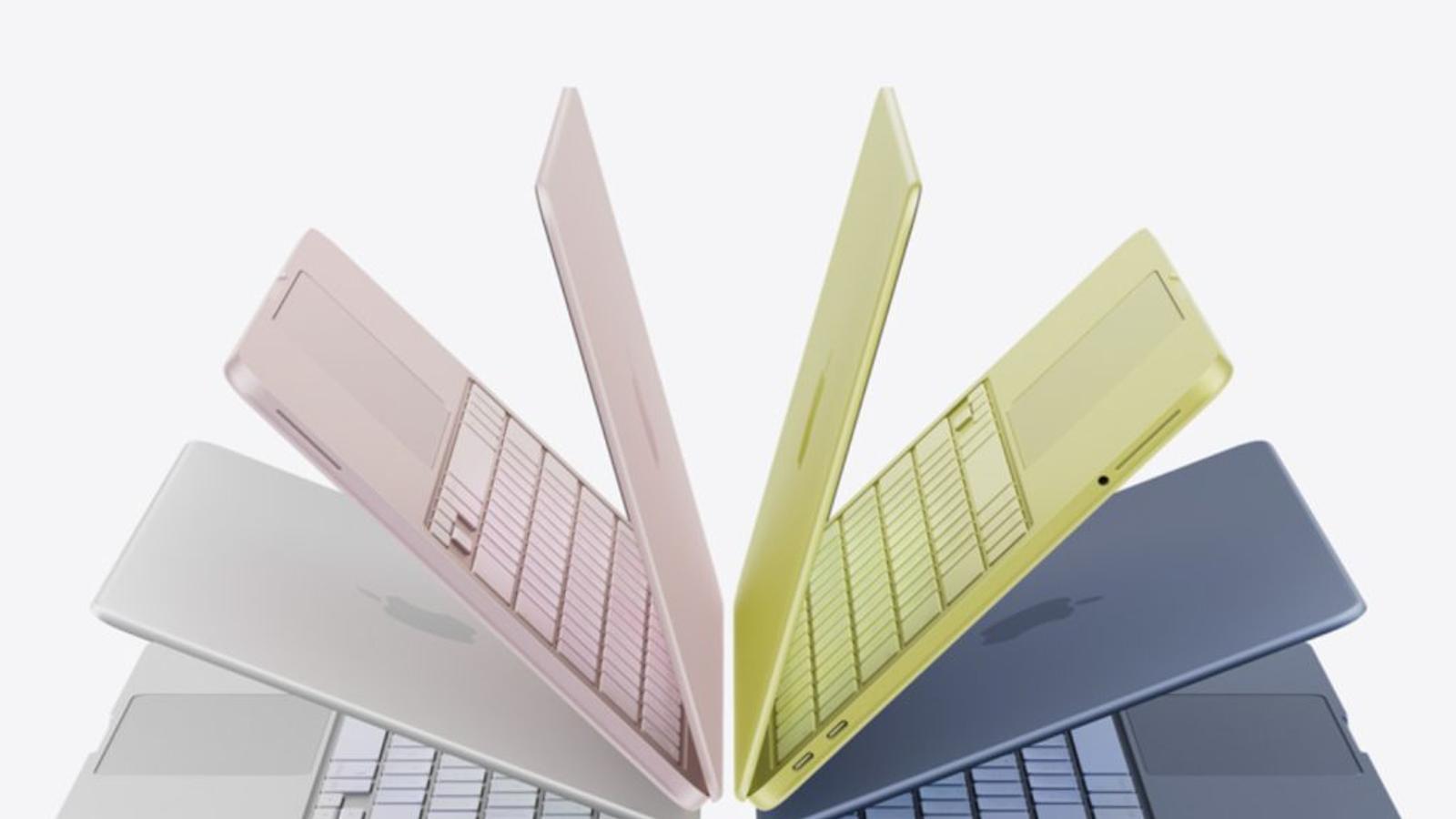
Last week, Apple formalized what its CEO Tim Cook had announced days earlier in the Wall Street Journal: the price increase was inevitable given a cost of memory and storage that the company considers unsustainable. F14 MacBooks and iPads are now on average 20% more expensive than on June 25 (between 13% and 32%, depending on the model).
The 13-inch MacBook Air with M5 chip has gone from 1,199 to 1,429 euros, and the 15-inch one, from 1,499 to 1,729 (230 euros more in both cases). The entry-level model MacBook Neo increases from 699 to 799 euros. Those who want a 14 or 16-inch MacBook Pro with M5 Max chip will have to add 600 euros to the previous price, the biggest increase in absolute terms for the entire laptop range. The basic iPad tablet is the one that increases the most in percentage, 32%, going from 379 to 499 euros. In the rest of the catalog, the Mac Studio with M3 Ultra chip jumps from 4,849 to 6,349 euros: 1,500 euros more from one day to the next.
Apple had avoided these increases even with Trump's tariffs and the pandemic, and the iPhone, the star product, has not yet increased by a single euro, but no one doubts that it will do so in September, when the new models arrive and the brand does what it usually does: review prices. That Apple is now breaking the discipline of keeping them fixed throughout a product's cycle is not a minor detail: not even the most protected company in the sector can continue to absorb the cost of memory alone.
Xbox breaks its own business model
A few hours after Apple's news, Microsoft confirmed that Xbox video consoles will increase in price worldwide: $100 more for the 512 GB models and $150 for the 1 TB models. In the US, this puts the Xbox Series X at $800, almost 60% more than when it was released in November 2020. In Spain, where the model with a DVD reader cost 600 euros and the digital one 550 until now, the confirmed increase would bring it to 700-750 euros, although Microsoft has not yet published the official table in euros.
The console business, sold at cost price or below to recoup it with games and subscriptions, only works when components are not moving. At the new prices, an Xbox Series X now costs the same as many gaming PCs and is dangerously close to the PS5 Pro: it's the same old box, just more expensive.
Domino effect
Sony anticipated it: on April 2nd, it raised the price of all PS5 models by 100 euros (the edition with a disc drive, to 650 euros; the digital edition, to 550; the Pro, to 900), accumulating a 150 euro increase since 2020. For the first time, a five-year-old console costs more than when it was first released. Nintendo hasn't escaped either: since September 1st, the Switch 2 will cost 500 euros, 30 more than before.
On PCs, the numbers also hurt. HP explains that memory and storage, which represented between 15% and 18% of a PC's material cost, now reach 35%. Dell and Lenovo have applied increases of 15-20%. IDC calculates that global PC sales will fall by up to 11.3% during 2026; Gartner speaks of 10.4%: the biggest contraction in over a decade.
Mobile phones are not escaping either. According to IDC, the average selling price will rise by 14% this year, while units sold will fall by 12.9%, "the biggest drop in history." In Europe, Counterpoint Research speaks of a price increase of 6.9%, double what was predicted a few months ago. Who will suffer most is, as always, those who can least afford it: the same consultancy warns that mobile phones under 100 dollars (about 90 euros), crucial in countries with less purchasing power, will be "unviable," even when prices stabilize, which is not expected before mid-2027.
No turning back in sight
A Lenovo executive said that memory prices will probably "never" return to the levels of a year ago. The silicon industry has reorganized all its capacity around AI, and going back requires years of investment in factories that are not built overnight: Micron's new DRAM plant will not open until 2028. Meanwhile, the consumer is paying the bill for this war for resources. The era of "more for the same price" is over, and no one can say when it will return. If it ever does.
