Marc Serena: “With the money to buy myself a car I went around the world”
Journalist
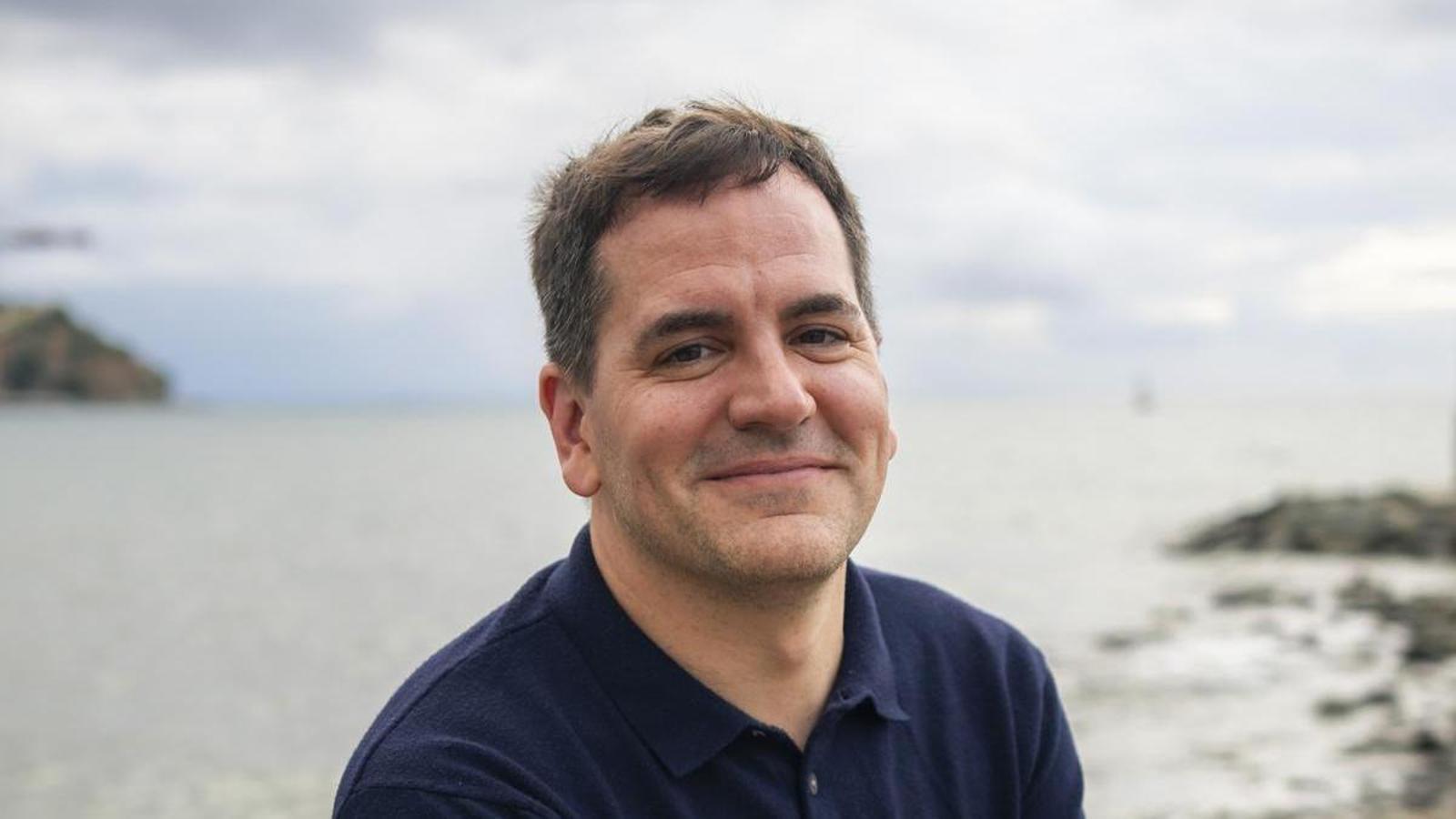

A van with drinks and small stalls in the background. It is difficult to identify which country is behind Marc Serena in his profile picture. Timor-Leste, he says. Faced with a questioning look, this journalist from Manresa explains that it is the youngest country in Asia, which gained independence in 2002. Serena has just published The other Barcelona (La Campana), a chronicle of his trip to the Venezuelan city that was founded by a Catalan. But he had already been to Venezuela at 25 years old, when he traveled around the world to meet 25 young people from 25 countries.
Traveling around the world. To find oneself, as is now the fashion?
— My grandparents went on their honeymoon to Barcelona. My parents went to Mallorca. At 25, I realized that, if I wanted to, I could travel around the world. I had the savings and I thought: do it, now you can.
How much money did he start with?
— I had worked and saved, and I had enough money to buy myself a car. But instead of buying it, I traveled around the world.
And the car?
— I have never bought one yet.
The book that resulted from it, The 25's turn, was published in five languages.
— It overwhelmed me. I even went on a tour of China. They treated me like a rock star, as if everything I said were a phrase to get tattooed. Imagine suddenly waking up one day and having managers, magazines with your photos, rooms full of people following you…
Why was it of such interest to China?
— Here we still see travel books as something very egocentric. I think the Chinese found something practical in them: for a young person who is considering what to do with their life, reading a book where 25 people from different places talk about their points of view on work, the future, or love can serve as guidance.
Later he wrote Microcatalunya. To travel the world and return to the Born?
— I was interested in rurality to explain who we are and where we come from. Photographer Edu Bayer and I traveled 14,000 kilometers through Catalonia in a van for seven months. We arrived at a farmhouse and the farmhand who lived there was dying. We took a photograph of him. Perhaps he was the last farmhand in Catalonia…
And from there to Barcelona. But the Barcelona of Venezuela.
— Venezuela was one of the countries I visited at 25. I was left with the idea of doing something with that Barcelona. I had a bit of the feeling that it was another world, another planet, a…
…parallel universe?
— For me it has to do with our egocentrism. AI asks us: “How are you, today?” and when we open Maps we always appear in the middle. We believe that we are the center of the world and it turns out that there is another Barcelona: a large city, capital of a state, that also has a cathedral, that is losing its original languages…
Do they keep in mind the other Barcelona, ours?
— A lot. Barcelona and Spain. It is also true that, in recent years, Chavismo has insisted a lot on the weight of Spanish colonization. Here it is the other way around: we sweep it under the rug.
Which carpet?
— The founder of the Venezuelan Barcelona was Joan Orpí, originally from Piera. In the town there is a plaque that speaks of him as an “indigenous peacemaker”. For years the city council has said that it should be voted on in a referendum, but time passes: it is always asked why talk about it now.
Is it hard to assume the role of Catalonia?
— I believe we are in a phase of denial. There are many people in Spain who believe that Spain did not colonize, and also many people in Catalonia. Venezuela cannot be understood without knowing how the colonization was carried out and what kind of country it left behind. But neither will we be able to understand ourselves if we miss this part of our history.
You explain two cities and two countries through small stories.
— Usually, when we travel, we prioritize going to many places, seeing many things. A more relaxed pace, of returning to places, of asking again and again, makes you see more nuances.
Have you feared for your safety while writing about dictatorships?
— I haven't suffered as much for myself as for the people who stand up, those who cannot take a plane and leave. In many countries, a climate of fear is established, where it is not so much what happens to you as what you stop doing because of what could happen to you. They say there are two types of fear: the one that protects you, because otherwise you would fall off a cliff, and the one that blocks you.
And which one does she have when she writes a book?
— I also don't know to what extent a book has so much impact. Azaña already said that, in Spain, if you want to keep a secret, you have to write it in a book.
He said it before the internet. When you arrived at the Caracas airport, they searched your networks. Aren't you worried that, if you return to the country, they won't let you in now?
— I do not know what will happen. Venezuela is currently experiencing a somewhat strange situation, with a little more openness, according to what I am told. Furthermore, the book can be seen as harmless. Although there is a Venezuelan publisher interested in publishing it, it is difficult for it to circulate, because there are no bookstores there. And the 700,000 Venezuelans who are in Spain already have a clear opinion of the country.
He went to a cockfight in Venezuela. Has he refused to see something?
— I like to travel with a somewhat childlike, naive gaze, and explain it: this is what there is, this is what I have encountered, and then let it be the reader who decides whether they think it is good or bad.
Would you have gone to see bullfights in Spain?
— I have done it, but as a journalist. It is a curious case, that of the journalist. I have been to demonstrations that I would never have gone to. I even attended the birth of a woman I didn't know at all. It was, without a doubt, one of the most impressive moments of my life. The woman, who had already had children, told me: “Come in. Honestly, I won't mind if you are there or not”.
