When your mobile forces you to support Spain in the World Cup (and how to avoid it)
"WithTheTeam", "OneWholeTeam", "GoingForSecond" are the messages with which mobile phone operators have replaced their names on the phones of many users

-
CAT -
CAST
Television viewers are accustomed to seeing the familiar bug in a corner of the screen, the logo that reminds us at all times which channel we are watching. In mobile telephony, there is an equivalent: the Service Provider Name (SPN), the text that indicates which network the terminal is connected to and that appears in the top status bar, alongside indicators such as coverage or battery level.
At least, that's what users took for granted. For a few days now, millions of customers of the major Spanish telecom companies have seen how, under the guise of the Football World Cup and without asking for their permission, this space has been occupied by messages of support for the Spanish team, in place of their own usual commercial brands.
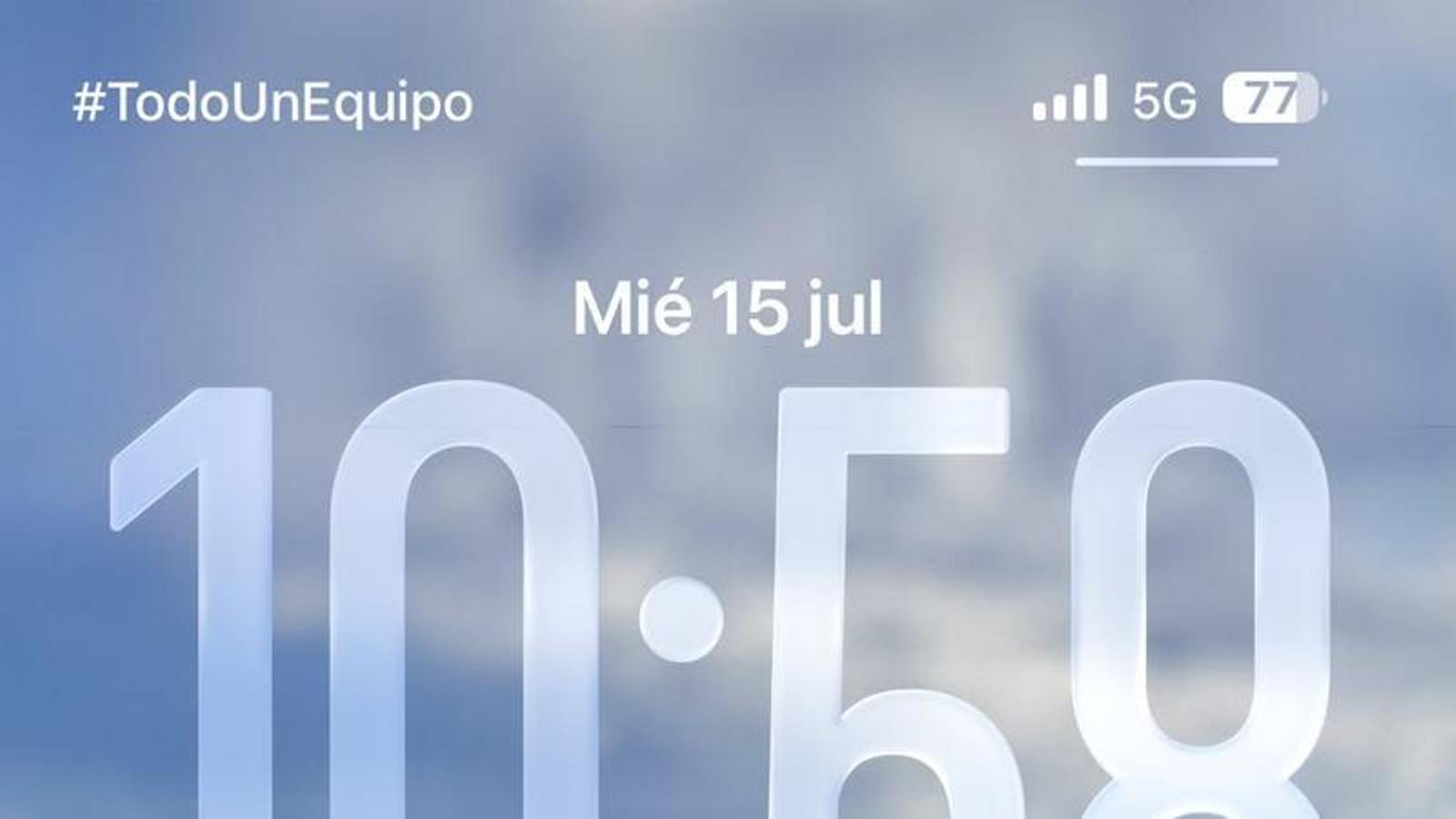
Movistar was the first to do so, consistent with its role as official sponsor of the team. On Tuesday, July 7, subscribers of the second-largest operator in the country by number of customers (and first in revenue) saw the text "Movistar" disappear in favor of "ConLaSeleccion". Eight days later, Orange followed the same path with the slogan "TodoUnEquipo", once the French team was eliminated from the championship (the same one that, according to Mariano Rajoy, "played without French footballers", and which represents the state where the parent group of Orange Spain is based).

This Friday the 17th it was Vodafone's turn, with "APorLaSegunda", in reference to the second World Cup that the Spanish team aspires to win against Argentina. Vodafone's late incorporation, which comes after numerous users demanded on social media that it imitate its rivals, has a touch of irony: it was precisely the pioneering operator in using SPN for purposes unrelated to the brand, when during the pandemic it showed the message "QuedateEnCasa" to support lockdowns. The three operators have declined to specify the number of subscribers who benefited from the change, but in each case it is tens of millions.
The three companies insist that the change is temporary, does not affect performance or coverage, and will be deactivated as soon as the team's participation in the tournament ends. All three have limited the measure to their flagship brands and have ruled out extending it to their own low-cost brands (O2 in the case of Movistar; Yoigo, Jazztel, Pepephone and others in the case of Orange; Lowi and Finetwork in the case of Vodafone), thus reserving the patriotic message for customers with the most expensive plans as if it were a privilege to see it. Nor have they applied it to the virtual mobile operators (OMVs) that rent them the use of their networks, such as Parlem and Som Connexió (which operate on the Orange/Yoigo network) or Vera (on Vodafone's), to name three of Catalan origin.
Despite this, between Wednesday and Thursday there was confusion when subscribers of Parlem and Som Connexió saw the message "TodoUnEquipo" appear on their phones, theoretically reserved for direct Orange customers. Pepephone users, who also use the Orange network (it is an OMV, but in this case owned by MasOrange), also experienced the same situation. Many affected users protested on social media and to the customer service departments of their OMVs, who apologized and assured that they had requested the host network to deactivate the message. An Orange spokesperson explained to ARA that the cause was a configuration error, corrected immediately, but not before many devices received the football indicator; in some it disappeared on its own, in others the phone had to be restarted.
Three networks behind all brands
The incident has once again highlighted a reality that often goes unnoticed: under the numerous commercial brands in the Spanish market, there are only three networks with their own antennas and spectrum, which act as hosts for all the others. This was already seen in July of last year, when the 40% of citizens did not receive the ES-Alert warnings for heavy rainfall. MVNOs are classified according to their degree of dependence on the host network (MNO, for Mobile Network Operator). A light MVNO manages its own billing and customer service but does not have its own network core; a full MVNO, on the other hand, has its own core and only rents radio access; and a reseller simply puts its brand on it, while the host takes care of all the technical part. Brands like O2, Lowi, or Jazztel, despite operating commercially as virtuals, belong to the same parent companies as the networks they use, and therefore fully share their network identifier. Operators like Parlem, Vera, or Som Connexió, on the other hand, operate with a lighter model, depending on their host's network core for subscriber registration, which leaves them exposed to incidents like this week's.
No regulation preventing it
Is this name change legal? The most outraged users by the action have asked themselves if operators have the right to impose an SPN different from the real network name. The answer, according to the CNMC, the regulator of telecommunications in Spain, is yes. Sources from the body have explained to ARA that they only assign the regulated technical identifier of the network (the MNC code), which is a numbering resource, but there is nothing established about the parameter that the operator later decides to display the name on the device. There is no specific telecommunications regulation that governs this issue: it is a different temporary identifier, for which the operator has its own criteria. The CNMC says it has not spoken out until now because it is not a widespread practice nor has it detected any impact on end-users, although it does not rule out having to speak out if circumstances change. Nothing prevents, however, that some user may take legal action through non-consensual advertising.
Few options for those who want nothing to do with it
Those of us who do not support the Spanish team and want to reverse the change have little room for manoeuvre. The operators, perplexed by our reluctance, limit themselves to recalling that the message will be withdrawn from Monday. On some Android phones, however, you can choose which SPN is displayed or, at least, hide it: in the HyperOS system of Xiaomi, Redmi and Poco terminals, the option "Edit operator name", within Settings > Status bar, allows you to replace the text with any other (or delete it); on Samsung, the QuickStar module of the free Good Lock app allows you to hide the indicator, but not rewrite it with your own text. On iPhones there is no equivalent option. However, whatever the phone, the patriotic message can be avoided by activating the "WiFi Calls" function. In all cases, this setting should not be confused with the name that can be given to the SIM card (useful, for example, to distinguish the personal line from the work line): that name is only informative for the user and does not alter the SPN displayed by the operator.
For better or worse, everything indicates that mobile operators have discovered a privileged location on our phone screens, and it should not be surprising that they resort to it again on other occasions.
