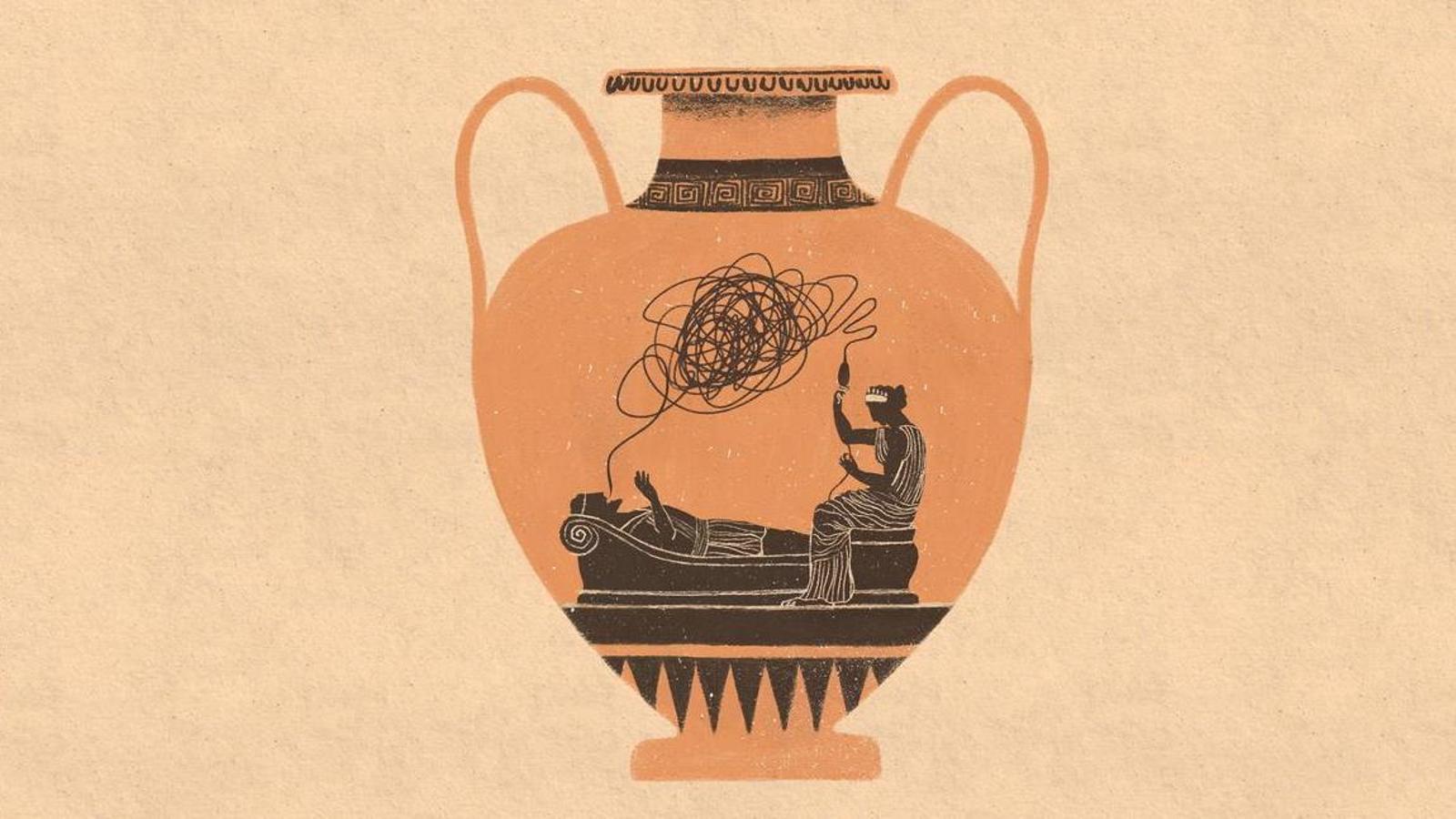
Homer was already undergoing therapy: the 'Odyssey' as a map of a wounded mind
The clinical psychologist Sam Akbar rereads Ulysses' journey as a living theory on trauma, resilience, and identity
-
CAT -
CAST
What does Homer teach us about the human psyche? This is the starting point of Mental Odyssey (Kitaeru), written by Dr. Sam Akbar. The book stems from her dual experience: that of a classical philologist trained at Oxford and a clinical psychologist who has worked for years with survivors of extreme violence.
For a long time, these two disciplines seemed completely separate to her, but it was when she sat down to write the book that she realized they had always been related. “The more I looked at it, the more I saw that it is modern psychology that has been trailing Homer, not the other way around. All great literature has great psychology at its core,” she remarks.
In this regard, the Odyssey describes the human mind with surprising clinical accuracy. Akbar reads concepts in it that would today fill entire psychology manuals: radical acceptance, post-traumatic growth, narrative therapy, emotional regulation. For her, Ulysses crying on the beach is not just an epic scene: it is the image of an overwhelmed man who has not yet been able to integrate all his experience within himself.
“The perfect hero is psychologically useless,” she states. And this is where Homer's narrative breaks with the classic narrative of strength. Ulysses is not strong because he doesn't fall, but because he falls repeatedly and, despite everything, moves forward. He is polytropos, says Homer: multifaceted, contradictory, unstable. A man capable of wisdom and destruction at the same time.
This is a central point in Akbar's reading of resilience. In her clinical experience, working with people who have lived through wars, torture, or forced displacement, survival has nothing of individual epic about it. “What sustains people is not exceptional inner strength, but connection with others,” she assures.
The Odyssey, read this way, ceases to be the story of a solitary hero to become a network of bonds: the Phaeacians who listen, Athena who guides, Penelope who keeps Ithaca standing, Telemachus who supports. “The ancient Greeks already knew what we often forget: that we are stronger with allies, and that healing happens in the relationship between us, not in solitude,” she states. Furthermore, xenia, sacred hospitality towards the stranger, appears as a moral and political category that spans centuries.
Getting to Know Each Other Again
Another of the points of the Homeric poem is the return home, the nostos, which tradition has read as a happy ending. But from a clinical point of view, this return is more like disorientation than reconciliation. “When Ulysses arrives in Ithaca, neither he himself recognizes the place nor the place recognizes him,” he points out. There is no restoration of the old self, but a confrontation with an identity that has been transformed.
Here appears a key idea of contemporary psychology: the integration of identity. Returning is not recovering what we were, but learning to live with what we have become. In this sense, Ulysses' journey is not only geographical, but internal: a slow and painful excavation within oneself.
The book also dialogues with another tension of our times: the promise of comfort and the loss of meaning. Akbar assures that the burnout, anxiety and disconnection are not signs of weakness, but predictable consequences of living in a world that constantly offers what the book calls "the Calypso effect: the seductive comfort of a life that seems perfect from the outside, but which demands that we renounce our authentic selves. “Ulysses is miserable in paradise, crying on a beautiful island with an immortal goddess, because what seems like an ideal life has nothing to do with who he really is or what matters to him,” he points out. This image helps us understand why achieving what you “were supposed to want” can leave you empty inside.
Accept what may be
On the other hand, pain is inevitable, but suffering arises when we resist that pain. Ulysses exemplifies this in the Odyssey when he says, “let this also come,” a radical attitude of openness to what must be. In practice, Akbar's work with patients consists of identifying what is truly under our control and redirecting energy there, starting with small things: like Ulysses, who responds to his powerlessness by building a boat with his own hands. “There is no total solution, but there are possible actions,” he remarks.
The Homeric poem also teaches us that the search for a perfect decision without costs is a form of paralysis. The episode of Scylla and Charybdis is central because there is no elegant solution: Ulysses must choose between a limited and predictable loss – six men devoured by Scylla – or the risk of total destruction if he approaches Charybdis. There is no third option. “Some situations only offer different types of loss, therefore, paralysis from seeking a cost-free option is the worst possible decision,” says Akbar. Only values allow us to orient ourselves.
In the end, the Odyssey speaks to us of many anxieties of our time: uncertainty, prolonged exhaustion, the temptation to remain in the safety of the known instead of taking risks. And these are not new feelings. They are, as Homer already understood, the permanent condition of being human. “And the fact of having a three-thousand-year-old poem that describes them with such precision is, in itself, a remarkable source of comfort,” concludes the author.
