'Farming aura', 'six seven' and other harmless constructions of youth identity
Experts assure that the new trends on the networks respond to needs for recognition and belonging, but they warn of the risks of the digital environment
-
CAT -
CAST
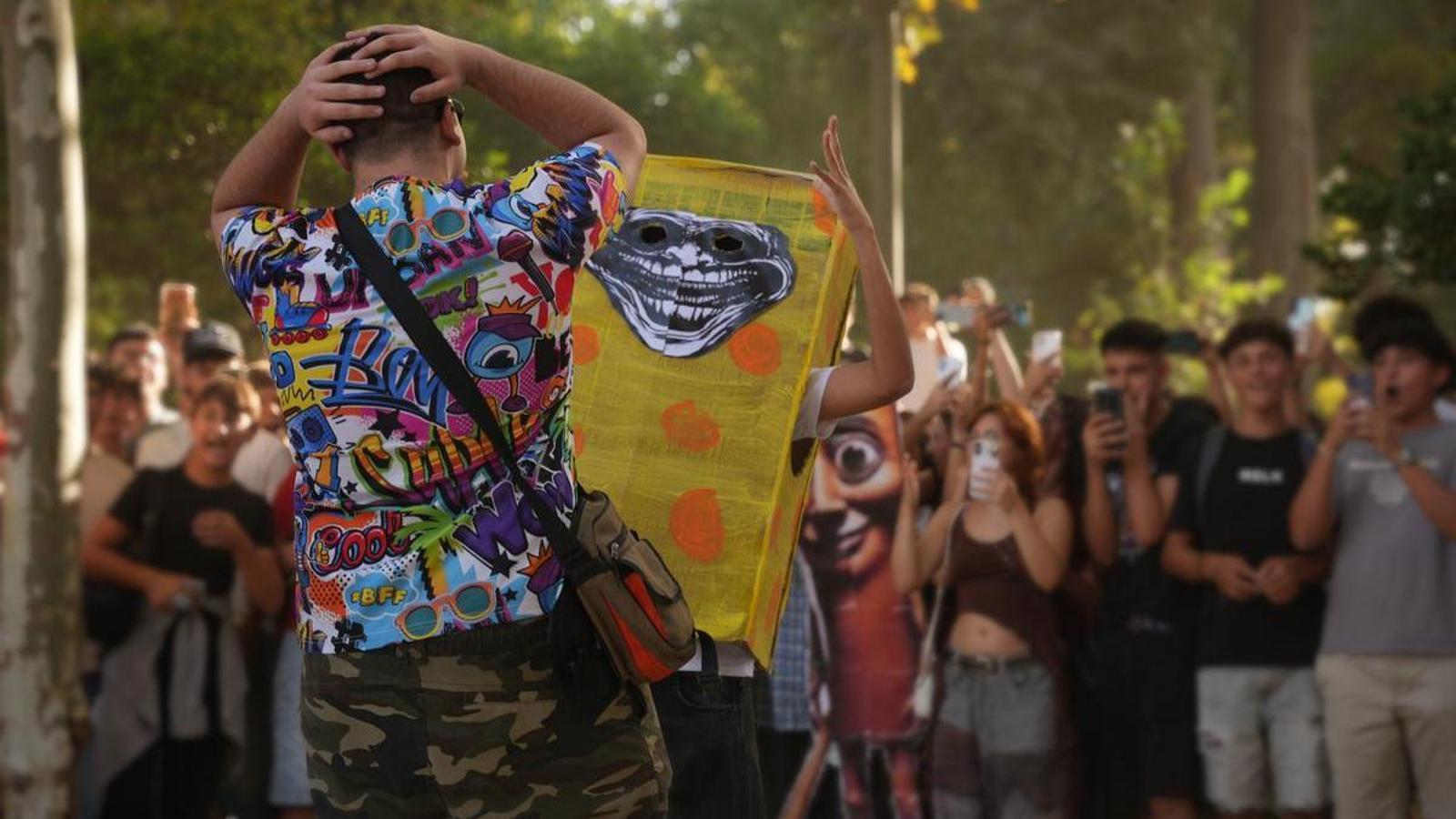
BarcelonaIt is seven in the evening on an August Wednesday in Barcelona. Under the Arc de Triomf, hundreds of young people summoned by social media participate in a phenomenon that in recent weeks has jumped from TikTok to radio talk shows, television, and all kinds of conversation spaces. These are the aura battles, with the goal of farming aura, a practice as simple as performing actions designed to project an attractive, interesting, or simply different personality.
For decades, each generation has found its own ways to mark territory and recognize itself; through clothing, vocabulary, gestures, or listening to music that adults do not know. What changes now is the speed. And also the stage. Before, it could be a main character moment at the disco, with the goal of earning the respect of peers, as we could see in movies like Grease; now they are the aura battles in the street.
While veteran generations look with surprise – and often with rejection – at this virality, young people occupy the street with screen codes. A six-seven, sigma, NPC, lookmaxxing or delulu appear and disappear from conversations. These are words that do not seek to say much, and therein lies their value: ways to build identity and seek recognition. Old needs with new codes in a faster, more visible, and ephemeral setting.
The leap from social media to the street
Aura farming might seem, seen from the outside, a competition to see who can get the most attention. But for Kepa Paul Larrañaga, a sociologist of childhood and researcher at the UCM, there is something more interesting: young people are moving phenomena born on the internet into the public space. We saw this years ago with the Harlem Shake or Pokémon Go. Larrañaga explains that the performance makes them visible and identifiable and, above all, allows them to appropriate a space that “they also consider theirs”.
Anna Berga, a doctor of sociology and professor at Blanquera-URL, explains that all generations have built codes to distinguish themselves from adults and recognize themselves among peers. “In the eighties, there were words like mola, guai or flipar”, and later on, with the beginnings of social networks, “came LOL, XD or OMG”. The difference, explains Berga, is that now a code can go from a small group of young people to millions of people in a matter of days. Networks haven't invented the need to belong: “They have accelerated its circulation”.
Six-seven doesn't need a deep meaning to fulfill a social function. The value is sharing the code: "It is a complicity, and complicity builds community", points out Berga. Aura farming functions as youth symbolic capital to gain status. It does not differ in substance from historical reputation strategies, such as the debutante balls in Paris or the Anglo-Saxon presentation in society that dates back to the 18th century; what changes is the language and the platform where they are produced.
This function was closely linked "to urban tribes, which shared an aesthetic, a music, a vocabulary and a space". Today it has shifted to the digital space, but this does not imply isolation: phenomena like aura battles return to the street as a physically shared experience. Larrañaga reiterates this occupation of the public space: faced with the adult discourse that young people no longer play in the street, now the internet brings them back to it.
The threat of digital environments
The thing is that this identity is not built only on the streets. It is also recorded. It is photographed. It is posted. And it remains. This is where one of the big differences with respect to previous generations appears. Doing something ridiculous at fifteen is nothing new. That the scene remains recorded, that it circulates and reappears years later, that certainly is. The risk of public mockery exists, but Larrañaga asks to focus on another element: "The role of the platforms themselves in the construction of these phenomena". It must be remembered that networks are designed to retain the user and generate advertising consumption and, therefore, it also conditions the behavior and interaction of users.

The question is not just what adolescents do, but what happens when their practices enter a system that can "amplify them, turn them into content, and reward their visibility." Larrañaga distinguishes between the culture created by the young people themselves and the culture that platforms can end up manufacturing or modulating, a phenomenon studied by experts under concepts such as the dead internet theory, among others. This is where concepts like looksmaxxing, sigma, NPCor delulu. These are different phenomena, with different meanings and responding to different contexts. For this reason, Larrañaga asks to "understand where each phenomenon comes from, who spreads it, and above all, what young people do with it when they appropriate it."
The psychology behind the question of identity
Behind the desire to be interesting, to make people laugh, or to stand out from others, there is a very ancient need for recognition. José Ramón Ubieto, clinical psychologist, psychoanalyst, and lecturer at the UB, links it to three questions that have always been part of adolescence: "Who am I and what do I desire, to which group do I belong, and what do I do with my body and my sexuality." Ubieto reminds us that social networks have not invented these questions, but they have "accelerated and spectacularized" them.
In this context, farming aura can also be understood as a way of learning how to carry oneself: showing security, confidence, charisma, knowing what to say and how to behave in front of others. This is where Ubieto adds the presence of influencers, who act as "behavioral prescribers" and teach ways of presenting ourselves to the world. The problem, he explains, is not necessarily participating in this performance or wanting to attract attention. The problem is what happens when this personal identity depends too much on a form of recognition that can disappear as quickly as it arrived.
For the expert, this is a more significant risk than an eventual fall into viral humiliation. Prestige has always existed, but digital prestige can be more ephemeral: "A flash of recognition that takes over everything and by tomorrow has already disappeared." Fragility, he warns, appears when a personality builds its identity on this unstable recognition such as aura.
This does not turn it into a mental health problem. All three experts agree on avoiding the adult-centric view that pathologizes youth behavior. For Berga, that adults do not understand a code is its function: "When a youth expression is adopted by adults, it ceases to fulfill the same function of belonging and is replaced." A circuit similar to that of memes, which are born on Reddit or Discord, jump to Instagram, and end up dying on Facebook. The best adult response is not to prevent an aura battle or to learn all the words on TikTok. Larrañaga defends "digital literacy based on conversation": asking, understanding how they interpret networks, and accompanying without imposing.
Farming aura, saying sixseven, being a sigma or an NPC, lookmaxxing or embracing the delulu are, in short, different ways of playing with identity. Some will be ephemeral; others will leave a trace. What will not disappear is the need behind it: to find others, to know who you are, and to ensure that, for a while, others recognize you too.
