Why is separating students by levels counterproductive?
It is a questioned solution and, according to some experts, it clashes with the inclusive vocation of education
-
CAT -
CAST
BarcelonaThe diversity we find in the classrooms of educational centers is a reflection of the society in which we live. However, in these contexts, this plurality is not defined only by different social and geographical realities or backgrounds, but also by the skills, aptitudes, attitudes, and learning rhythms of each student. Good classroom management requires taking this diversity into account at all levels, although, in some cases, the lack of resources or other situations that may arise lead to solutions that can affect this heterogeneity to a greater or lesser degree.
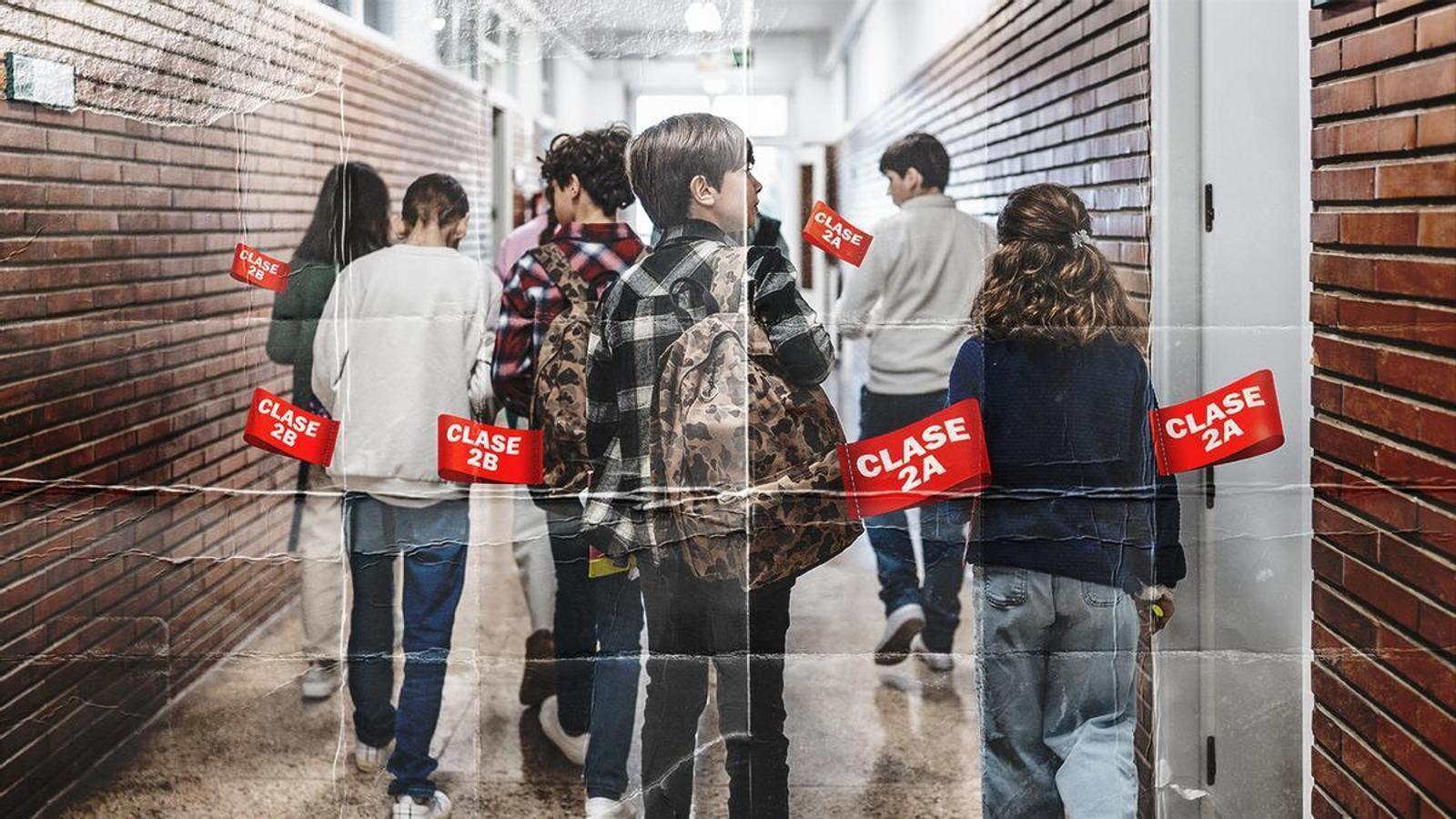
To manage this diversity, especially in secondary education, some centers choose to separate students of each grade level by ability with the aim of adapting the members of each group to theoretically shared learning rhythms. It is a questioned solution and, according to some experts, it clashes with the inclusive vocation of education. “All research concludes that separation by level does not generate global improvements in the average performance of the student, but, on the contrary, it tends to increase educational inequalities, especially in students from certain social backgrounds, socioeconomic levels, or low initial performance,” points out Andrea Jardí, doctor in education and society, graduated in primary education and master in psychopedagogy from the University of Barcelona.
According to Jardí, the separation of students by level has negative effects on the efficiency of the system and on equity, one of the foundations of the inclusive school, as it evidences a clear reproduction of the social inequalities that may exist outside the classroom. Furthermore, she indicates that students who are in a low group do not manage to have high expectations of overcoming challenges and improvement. “The level they usually receive is not a reinforcement to accelerate learning and to manage to level up with the others. Usually, the education they receive is of lower quality, less demanding with the curriculum, and with more repetitive activities, which entails fewer opportunities for them to develop complex or more abstract skills.” Jardí considers that the work done in these groups is rather compensatory and reinforcement-based than with the will to accelerate learning.
Switzerland and Germanyversus the Canadian system
Andrea Jardí refers to studies related to educational outcomes based on tracking by level in countries like Switzerland or Germany where, until now, students were divided in the classroom according to their grades at a very early age, which determined the path they would follow later. “In these cases, only 3% of students in the lowest track reached university despite being told that if they tried hard enough they would achieve it. In contrast, 30% of students who were part of a higher academic track, among whom there were also vulnerable students, managed to access university studies”.
If a comparative study is made with other educational systems, such as the one implemented in Canada which is called comprehensive –it does not differentiate students by level–, Jardí indicates that the most vulnerable students with immigrant status access higher education in similar proportions to native-born students. “The system has the capacity to reverse these inequalities”. In the case of our country, she points out that there are not many studies on the matter, but the reality is that there are centers where different classes are held according to level within the same grade, even within the same class in certain activities. “And this is also harmful,” she adds.

Lower self-esteem
“Inclusive education should take into account what every student needs. It is evident that there are many differences between them, but this difference is optimal. It should not be seen as something negative, as it only concerns capacities and not other types of skills. And within the classrooms, one must work by anticipating all this diversity,” points out Natàlia Luján, pedagogue and psychopedagogue, educational counselor and member of the Research Group on High Capacities and Attention to Diversity of the Official College of Pedagogy of Catalonia. Luján questions whether this separation of groups by levels favors the performance of some students to the detriment of others. “On one hand, we would be segregating, and on the other, the students who would find themselves at a lower level would have a self-concept that would affect their self-esteem.” In her opinion, the differences between students would increase.
In this sense, Andrea Jardí also speaks about the psychological effects that separations by levels can entail. “On one hand, in a group of students with low academic self-esteem there is more demotivation, more school disconnection and absenteeism. But, on the other hand, if you are placed in a higher group you might have more confidence, but also higher academic pressure, which is also not positive.” At this point, she cites the big-fish-little-pond (big fish - small pond) effect, a theory that states that people have more self-confidence and self-concept when they are the ones performing best in a less capable group, in comparison with those who have an average performance in a high-capacity group.
“The idea of trying to create groups by levels when everyone is different is complicated. Even if you want to make this separation, there will always be differences between the students who are part of the same group because some will know more about one thing and others about another. It is better to deal with this in a heterogeneous way and not with homogeneous groups, because you will never achieve a homogeneous group”, recommends Jardí. In fact, he suggests that students should have the possibility to interact with everyone so that there is mutual help, and what one cannot understand, the other can explain to them and share and show them that they can also reach it. “Separation by levels does not provide benefits for low-achieving students and for high-achieving students, the benefits are inconsistent. Nor would academic excellence be promoted, because they would have the same level in whatever group they were in”.
On the other hand, these separations by levels do not only affect students inside the classroom, but also outside of it. Jardí talks about the concept of path dependence, as if these students already had one assigned to them by the fact of being part of one group or another. “In the end, this has to do with who you become friends with. If you only approach or group yourself with certain classmates, social cohesion is not encouraged. And the reality is that mobility between groups in classrooms is scarce”.
Flexible groups
“When we make a diagnosis, we must take into account that a student's capabilities will not be the same throughout their life. This is variable. Who tells us that the results that have come out a certain way now will not change later? Taking tests is just taking a snapshot of the moment,” recalls Luján. That is why, in centers like the Institut Escola Sant Felip Neri in Barcelona, they are clear about it when applying methods to be able to reach all levels of students in each secondary year through the implementation of flexible groups in instrumental areas and small groups in other areas. “We create these groups according to the content being worked on and according to each student's progress,” explains David Vilella, head of secondary studies at this center.
They form groups with certain students with whom they detect that they need to review specific content, but after a certain time, they create them with different students because the previous ones may have already achieved what was necessary and no longer need it. They also create them with students who understand everything well, but who ask for more, and for this reason, they give them some extension because they observe that they have a lot of ease in learning a specific subject.
“When the commitment to inclusive schooling was made, it seemed incoherent or old-fashioned to remove students from the classroom, as if you were labeling or condemning them, practically. With time, we have realized that this does not always have to be negative. It is only so if it stigmatizes the student and they are not given opportunities, if you simply remove them from the classroom so the others can work. That is not productive.” Vilella points out that if the formulation and practice of these flexible groups are well formulated and oriented from a pedagogical point of view, it must be possible to provide this support to students who may need it on a punctual basis.
For the students of the Institut Escola Sant Felip Neri in Barcelona, working with flexible groups is neither a strange nor a traumatic situation, as Vilella affirms. They value it very positively, and she explains that on many occasions it is they themselves who ask for it. “We form a group of four or five and review what is asked of us outside the classroom; we give them that support.”
Vilella assures that they try to make the most of the schedules and resources. “It may be that, for example, of the three weekly hours we spend on Catalan language in the third year of secondary school, for two of them there are two teachers in the classroom supporting the students through co-teaching, but for the other hour, one of the teachers is outside the classroom.” The efforts of the teaching staff try to compensate in this way for the lack of resources that some centers face: of spaces, of materials, etc. “If we had many more teachers or much smaller ratios, perhaps we wouldn't have to do this, but we have classrooms with more than thirty students in secondary school, and if we don't do it this way, we cannot cover everything,” states Vilella.
